Understanding Ayahuasca: Composition, Pharmacology, Evidence, Risks, and Cultural Context
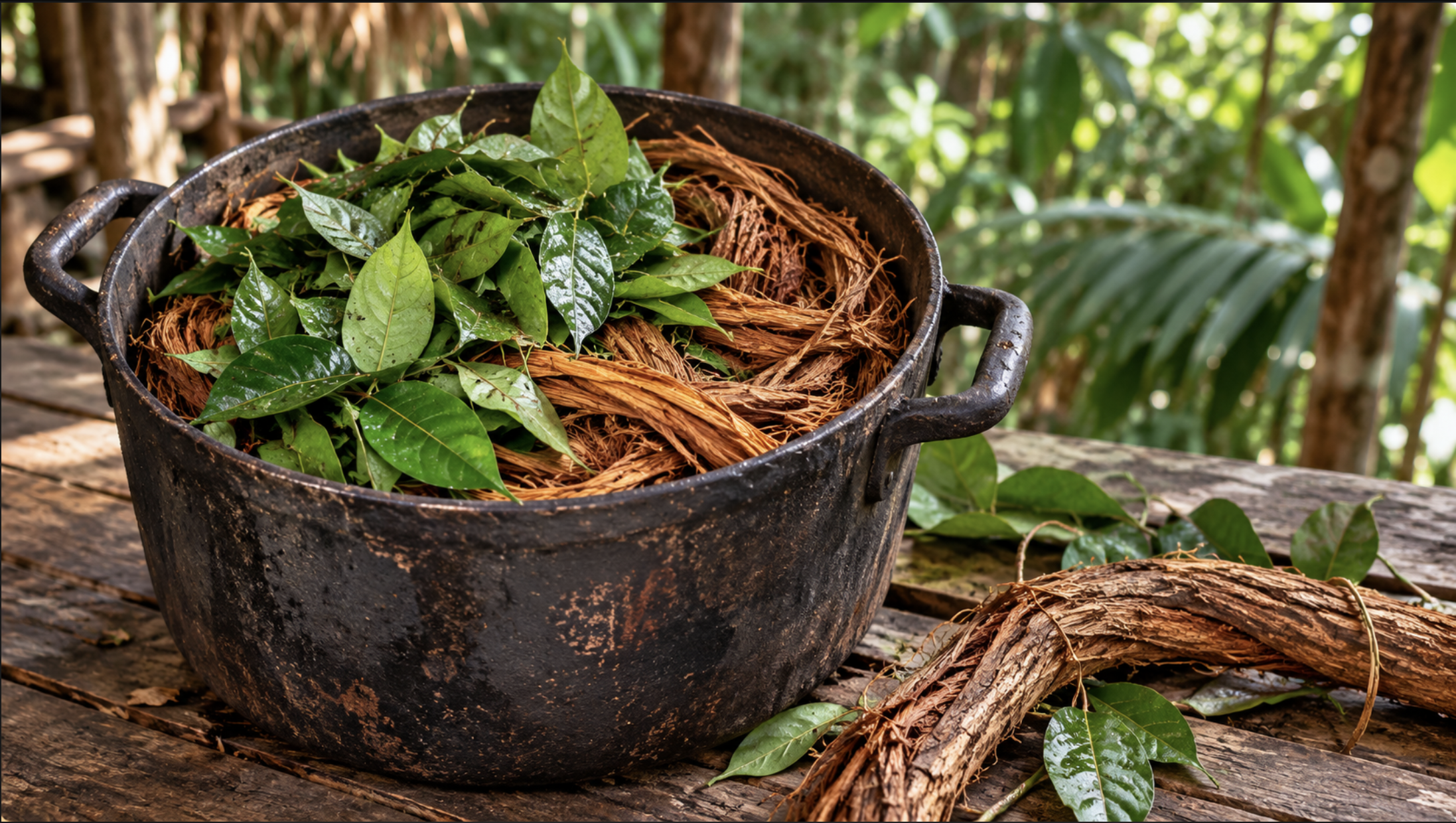 Vine material and leaves associated with ayahuasca preparations; composition varies across traditions and settings.
1. Introduction, Scope, and Central Conclusion
Ayahuasca is unusually difficult to describe with a single category.
It is commonly called a psychedelic, but that description captures only part of what the word can mean. In different contexts, ayahuasca may refer to a botanical preparation, the Banisteriopsis caapi vine itself, a sacrament within an organized religion, a medicine within an Indigenous or mestizo healing system, a subject of pharmacological and clinical research, or a substance used in contemporary ceremonial settings. These meanings overlap, but they are not interchangeable. [1]
That distinction matters because conclusions drawn in one setting do not automatically transfer to another. A laboratory preparation administered to screened research participants is not identical to a preparation used within a Shipibo-Konibo healing context, a Brazilian ayahuasca religion, a contemporary neo-shamanic ceremony, or an unidentified product associated with a poison-control report. Analytical studies also show that preparations carrying the same broad name can differ substantially in measured concentrations of DMT and beta-carboline alkaloids. [2]
Chemically, preparations commonly described as ayahuasca often combine B. caapi, which contains beta-carbolines including harmine, harmaline, and tetrahydroharmine, with a DMT-containing plant such as Psychotria viridis. Human pharmacology and analytical literature support reversible monoamine oxidase A inhibition by beta-carbolines as central to making DMT orally active in conventional preparations. [3]
That pharmacology is important, but it is not a complete definition of ayahuasca. Historical and ethnographic research documents systems in which plants, healers, songs, ritual relationships, spiritual concepts, community obligations, and understandings of illness are not necessarily regarded as peripheral “setting” around a drug. Within some traditions they are constituent parts of the practice. Biomedical research approaches these questions differently, often attempting to distinguish pharmacological effects from expectation, ceremony, social context, and other variables. [4]
The scientific evidence requires similar precision. Human pharmacology studies establish measurable exposure to DMT and beta-carbolines and document acute subjective, autonomic, electrophysiological, and brain-network changes. [5] Small clinical studies have also produced preliminary therapeutic signals, with depression representing the most developed controlled clinical domain in the current ayahuasca literature. [6]
Those findings do not establish ayahuasca as a proven treatment for every condition for which it is discussed. The literature includes small trials, uncontrolled studies, surveys, long-term religious-user comparisons, qualitative research, case reports, preclinical experiments, and studies of isolated DMT or individual beta-carbolines. These evidence classes answer different questions. Several publications also arise from the same underlying participant cohorts, so publication count cannot be treated as independent replication. [7]
Safety requires the same calibration. Nausea, vomiting, transient cardiovascular changes, and difficult psychological experiences are documented across controlled and observational research. Large surveys and poison-center data also contain reports of more serious physical and psychiatric events, while case reports describe prolonged psychotic or manic reactions in particular individuals. These sources demonstrate possible hazards more readily than they establish incidence among all ayahuasca users. [8]
Preparation identity is especially important in interpreting severe events. An event following an unusual, adulterated, or incompletely characterized mixture should not automatically be attributed to conventional ayahuasca, just as findings from a standardized research preparation should not automatically be generalized to every preparation used outside research. [9]
Global expansion adds another layer. Ayahuasca practices now exist far beyond the Amazonian regions in which many traditions developed. Anthropological and policy literature describes intercultural exchange alongside disputes about commercialization, representation, appropriation, Indigenous authority, reciprocity, ecological pressure, and who benefits when traditional knowledge enters a global psychedelic economy. [10]
There is no single Indigenous position on these questions, just as there is no single Indigenous ayahuasca tradition. Different peoples, communities, healers, religious organizations, researchers, governments, and practitioners may understand these plants and practices differently. This guide therefore treats cultural specificity as part of factual accuracy rather than as decorative background. [11]
This article examines what ayahuasca is and why definitions vary; its botany and chemical composition; pharmacology and metabolism; clinical and observational evidence; acute and longer-term risks; historical and contemporary cultural contexts; religious traditions; globalization and ethics; legal frameworks; and conservation and sustainability.
Its central conclusion is necessarily qualified: ayahuasca is a pharmacologically active and culturally diverse family of preparations and practices whose effects and risks depend materially on composition, population, context, and setting. Human research contains credible signals of potential therapeutic benefit, particularly in depression, but the clinical evidence remains preliminary relative to many popular claims. Serious adverse outcomes appear uncommon in controlled research but are possible, and existing evidence does not justify describing ayahuasca as universally safe. [12]
This guide is educational. It does not provide individualized medical or legal advice, preparation instructions, dosing recommendations, procurement guidance, medication-management instructions, or personal eligibility determinations. Readers primarily seeking information about ceremonial programs, facilitator considerations, travel, or program evaluation should use the separate Guide to Ayahuasca Retreats and Ceremonial Programs.
Why Definition Changes the Evidence Question
A useful definition of ayahuasca has to do more than name a psychoactive effect. If every orally active DMT mixture is treated as ayahuasca, research on chemically different preparations can be combined too freely. If the term is restricted to one idealized recipe, historically and culturally documented variation disappears. The evidence reviewed here supports a middle position: identify the botanical and chemical exposure as precisely as the source permits, and separately identify the cultural or institutional context in which that exposure was understood. [13]
This approach prevents several common category errors. “Ayahuasca,” “DMT,” and “oral DMT” are not synonyms. B. caapi is not synonymous with ayahuasca, and an isolated beta-carboline is not a whole botanical preparation. An experimental DMT-plus-harmine combination can illuminate mechanisms relevant to ayahuasca without becoming evidence about every constituent, ritual context, or long-term outcome associated with traditional preparations. Likewise, a product reported or marketed under an ayahuasca label cannot be assumed to have a conventional composition when no botanical or analytical verification is available. [14]
The distinction matters clinically because exposure definition sets the boundary of inference. A finding from a chemically characterized preparation belongs first to that preparation and population. A finding from isolated DMT belongs first to isolated DMT. A finding from a religious cohort describes people participating in that religious context. Similarities among these literatures can generate hypotheses, but they should not be used to erase the differences that made the studies interpretable in the first place. [15]
It also matters historically. Contemporary English-language usage can create the impression that “ayahuasca” has always referred to one stable, pan-Amazonian object. Ethnographic and historical sources instead document regional terminology, distinct practices, intercultural exchange, and changing religious formations. Archaeological evidence can establish ancient psychoactive plant knowledge without proving that a recovered material was the same preparation now described by the contemporary term. [16]
For that reason, this guide uses definitions as an evidence-control tool rather than as a claim to cultural ownership. When a study identifies species and chemistry, those details are reported. When a community or religious tradition uses its own terminology, that context is preserved. When a source does not establish composition, the article does not silently supply it. This allows biomedical precision and cultural specificity to coexist without requiring one to replace the other.
2. Definitions, Terminology, and Why Ayahuasca Is Not One Standardized
Product
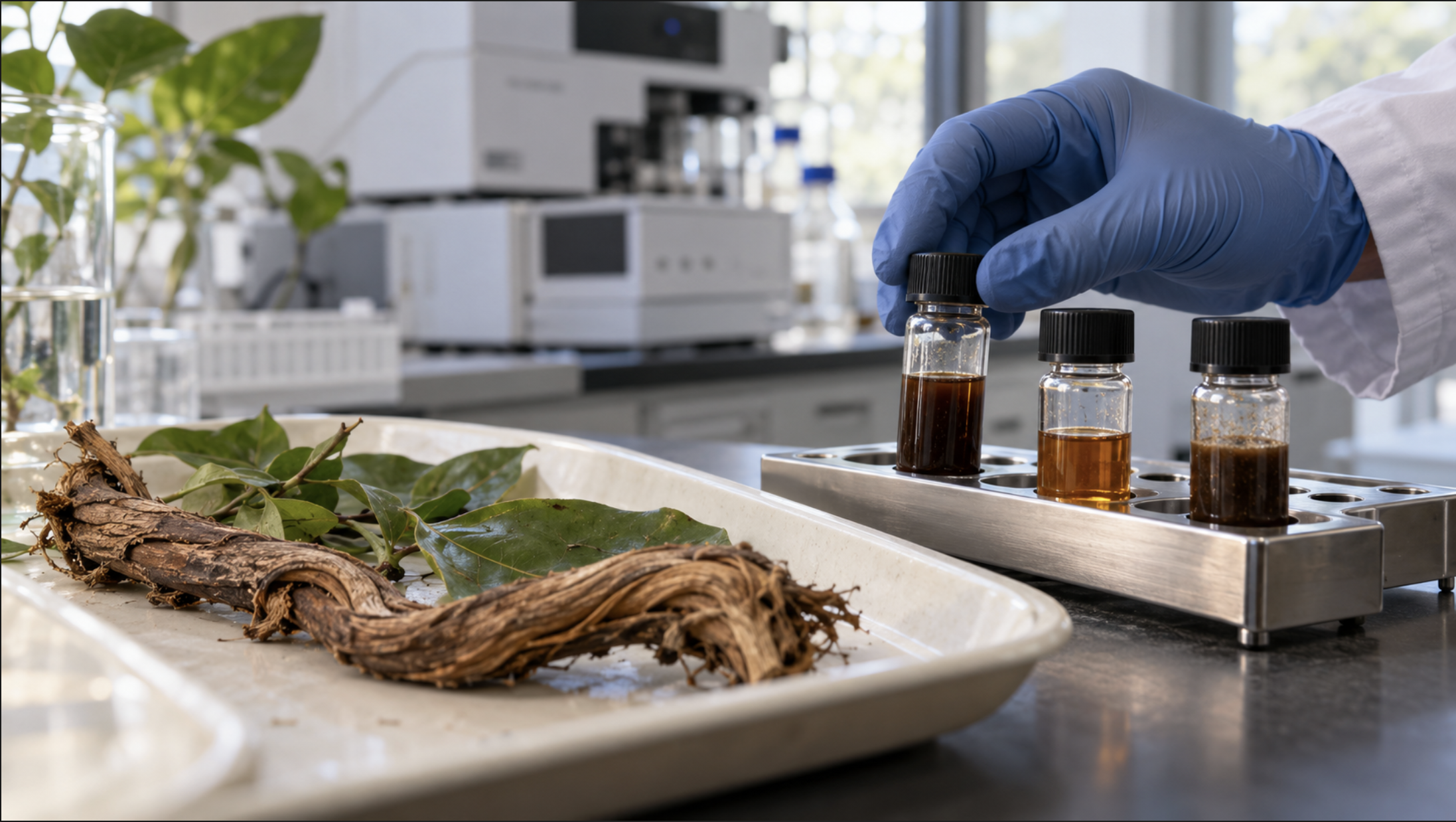
Botanical materials and laboratory samples. Appearance alone cannot establish composition, potency, or safety.
One of the easiest ways to misunderstand ayahuasca research is to assume that the word always names the same chemical product. It does not. In contemporary scientific literature, ayahuasca often refers to a psychoactive botanical preparation containing both DMT and beta-carboline alkaloids. A frequently studied combination involves Banisteriopsis caapi together with Psychotria viridis. Analytical studies, however, demonstrate substantial variation among preparations in concentrations of DMT, harmine, harmaline, tetrahydroharmine, and other measured constituents. [17]
This variability has immediate consequences for interpretation. Two studies can both report administering “ayahuasca” without administering chemically identical preparations. Botanical identity, source material, preparation characteristics, storage, degradation, admixtures, and analytical methods can all affect what is ultimately measured. [18]
Banisteriopsis caapi is a South American liana in the Malpighiaceae family and is central to many preparations and traditions described as ayahuasca. Pharmacologically important constituents include harmine, harmaline, and tetrahydroharmine, although profiles and concentrations vary. [19]
The vine is not simply an inert carrier for DMT. Its beta-carbolines are central to the pharmacological explanation for oral DMT activity in conventional preparations and have pharmacological properties of their own. Evidence concerning those properties ranges from human pharmacokinetic observations to cellular and animal experiments, so findings involving isolated compounds cannot automatically be converted into claims about whole ayahuasca in humans. [20]
Psychotria viridis is one of the well-documented DMT-containing companion plants associated with ayahuasca preparations. [21] DMT is a chemical constituent; P. viridis is a botanical organism containing DMT among other constituents; and ayahuasca is a broader preparation or cultural category. These distinctions prevent major evidentiary errors.
A study of isolated DMT is evidence about DMT under the conditions studied. A cellular experiment involving harmine is evidence about harmine in that experimental system. Neither is automatically evidence that whole ayahuasca produces the same outcome in humans. Likewise, a clinical study using a defined or freeze-dried ayahuasca preparation provides evidence about that preparation, participant population, and research setting rather than every material called ayahuasca. [22]
Globalization further complicates terminology. Preparations may use plants other than the Amazonian species most commonly described in the literature while attempting to reproduce the broad pharmacological combination of DMT and monoamine-oxidase inhibition. Other contexts may involve isolated DMT, DMT combined with beta-carbolines, or products described with ayahuasca terminology despite uncertain composition. These categories should not be collapsed.
Forensic analytical work illustrates the problem: identification of DMT in a material does not by itself establish the beta-carboline profile expected from a conventional B. caapi-containing preparation. This becomes particularly important in adverse-event interpretation, where the label attached to a product or mixture may not establish its actual ingredients. [23]
Variability does not make ayahuasca impossible to study. Researchers can chemically characterize preparations, quantify major alkaloids, analyze biological samples after administration, and examine pharmacokinetics under controlled conditions. These approaches have produced a meaningful scientific picture of several important constituents. [24]
The conclusions nevertheless remain bounded. If a study uses a freeze-dried preparation with a measured alkaloid profile, its results belong to that exposure and population. If another examines a ceremonial preparation from a particular community, the two exposures should not be assumed chemically or contextually identical.
Ayahuasca research therefore presents a recurring interpretive problem: the name of the exposure is broader than the chemistry of any one sample. The rest of this guide preserves that distinction whenever composition, pharmacology, clinical outcomes, or safety are discussed.
3. Historical Development and Diversity of Traditional Use
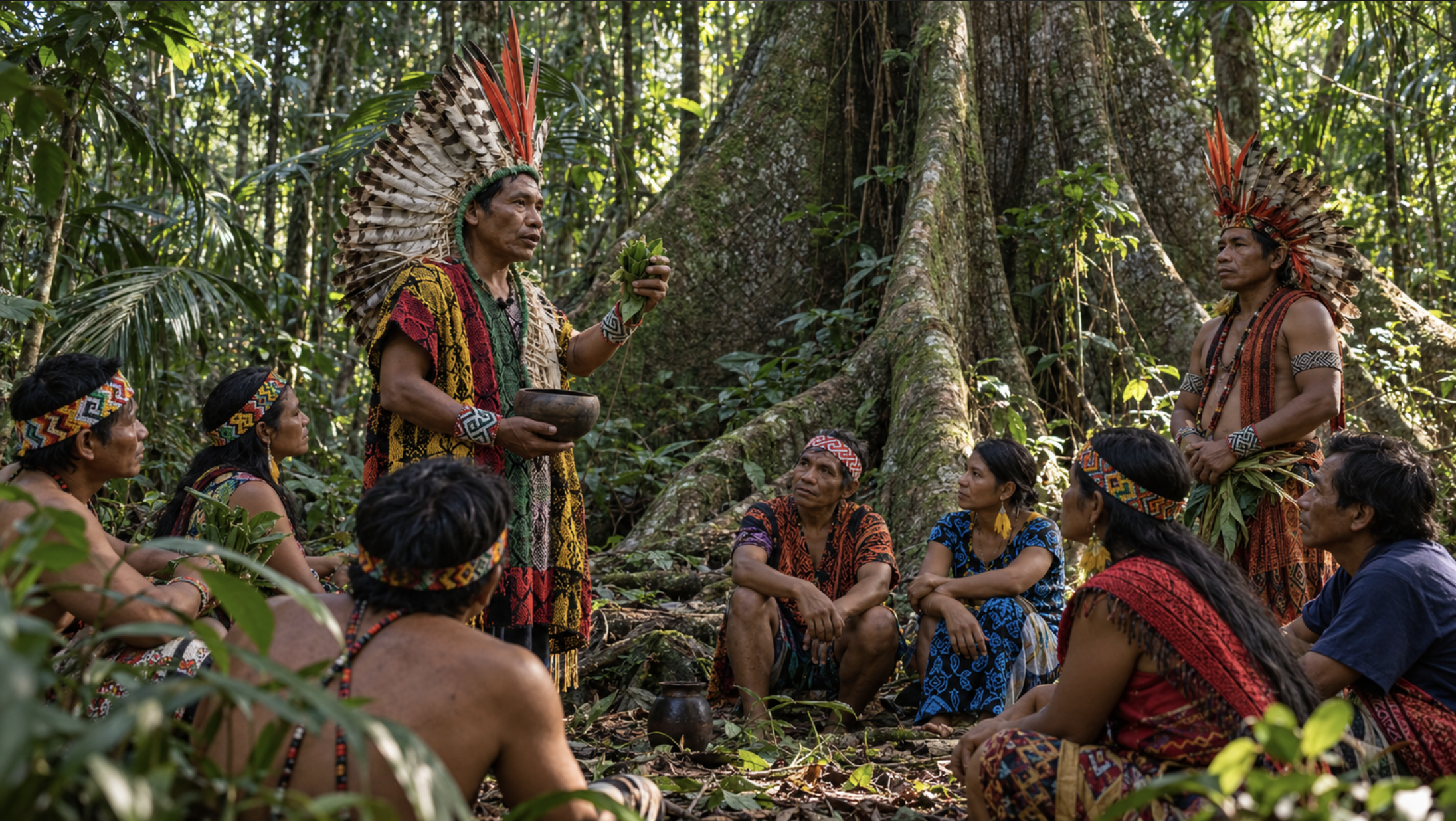
Among the Huni Kuin, ayahuasca—known as nixi pae—is part of living ancestral traditions linking ceremonial songs, spiritual practice, and knowledge passed between generations.
Discussions of ayahuasca often begin with a simple story: an
ancient Amazonian brew has been used in essentially the same form for thousands
of years and has only recently become visible outside the region. The available
evidence supports a deeper history of Indigenous knowledge of psychoactive and
medicinal plants, but it does not support treating the history of ayahuasca as
one unbroken, chemically standardized tradition.
That distinction is important because different kinds of historical evidence answer different questions. Archaeology can establish that particular plants or chemical compounds were present in an ancient material context. Ethnography can document practices, concepts, and relationships described by particular communities or practitioners at particular times. Historical documents can show what observers recorded, while also reflecting the assumptions and interests of those observers. Contemporary oral histories and community knowledge can preserve understandings that written archives do not. These forms of evidence can inform one another, but they are not interchangeable. [25]
Archaeological evidence and the limits of an “ancient ayahuasca” claim
A frequently cited archaeological finding comes from a ritual bundle recovered from Cueva del Chileno in southwestern Bolivia. A sample of the bundle's outer leather bag was radiocarbon dated to cal. 905–1170 CE. LC-MS/MS analysis of residue from the fox-snout pouch identified DMT, harmine, bufotenine, cocaine, and benzoylecgonine; the study also reported a possible psilocin signal. [26]
The finding is significant because it documents multiple psychoactive compounds in a single archaeological artifact and supports extensive pre-Columbian botanical knowledge and access to plants from different ecological regions. The co-presence of DMT and harmine in the pouch is especially relevant to the history of ayahuasca pharmacology, but it does not establish that they were prepared or consumed together.
It does not, however, demonstrate that the bundle contained the modern beverage now commonly called ayahuasca, nor that DMT and harmine were consumed together in a preparation chemically equivalent to contemporary ayahuasca. The archaeological evidence should therefore be described as evidence of ancient psychoactive-plant knowledge and practice rather than direct proof of an unchanged ayahuasca recipe extending back a millennium. [26]
This boundary illustrates a larger principle used throughout this guide: similarity between chemical constituents does not establish identity between cultural practices or preparations.
Amazonian traditions are plural
Historical and ethnographic literature documents psychoactive and medicinal plant practices across numerous Amazonian peoples and regions. It would be inaccurate to compress these into a single “Indigenous ayahuasca tradition.”
The Shipibo-Konibo, Asháninka, Ashéninka, and other peoples have distinct histories, languages, territories, social structures, and bodies of knowledge. Contemporary Peruvian government records themselves distinguish these peoples rather than treating “Amazonian Indigenous” as a single identity. [27]
Ethnographic sources likewise show that concepts surrounding plant knowledge can differ from the categories used in biomedicine. In work near Iquitos, Luis Eduardo Luna documented a mestizo vegetalista framework in which certain plants were understood as teachers and in which dieting, songs or icaros, and relationships with plants were central to healing knowledge. That research is valuable evidence about a particular practitioner and regional tradition; it should not be universalized as a description of all Amazonian peoples or all ayahuasca practices. [28]
Work concerning Shipibo-Konibo contexts similarly cautions against treating what outsiders encounter as a timeless ceremonial template. Drawing on fieldwork in the central Ucayali Valley during the first decade of the twenty-first century, Bernd Brabec de Mori describes varied and sometimes ambiguous Shipibo-Konibo responses to foreign interest in ayahuasca. He argues that some ayahuasca sessions staged for Northern visitors became more explicitly ritualized and responsive to outsiders’ expectations of “indigeneity.” This is a geographically and historically bounded ethnographic interpretation, not a description of all Shipibo-Konibo people or Amazonian traditions. [29]
These findings complicate two opposite simplifications. One is that there exists a single, fixed Indigenous ceremony from which modern practices can be measured for authenticity. The other is that contemporary ceremonial forms are simply modern inventions disconnected from Indigenous knowledge. Historical change, exchange, adaptation, migration, and community continuity can coexist.
Colonialism, extraction economies, and intercultural exchange
Ayahuasca history also cannot be separated from the political and economic history of Amazonia.
European colonization, missionary activity, disease, displacement, extractive economies, and labor systems profoundly affected Indigenous communities and regional relationships. Later rubber economies brought Indigenous peoples, migrants, and laborers into new forms of contact, coercion, exchange, and mobility.
Research from the Upper Juruá region of Brazil is useful here. Pantoja and Silva da Conceição describe ayahuasca or cipó practices among rubber-tapper populations in a setting shaped by interaction with Indigenous healing traditions. [30] This evidence resists a simple Indigenous-versus-non-Indigenous binary: knowledge can move through relationships created under historically unequal conditions while being adapted within new communities.
That history matters to contemporary debates about ownership and representation. Cultural exchange did not begin with twenty-first-century psychedelic tourism. At the same time, the existence of historical exchange does not erase questions about colonial power, consent, commercialization, attribution, or who benefits from the circulation of knowledge.
From regional practices to Brazilian ayahuasca religions
During the twentieth century, distinct Brazilian religious traditions developed around sacramental use of ayahuasca, including Santo Daime, União do Vegetal (UDV), and Barquinha. These traditions are sometimes grouped together as “ayahuasca religions,” but they should not be treated as a single institution or theology. [31]
Santo Daime developed in Acre around Raimundo Irineu Serra and incorporated Amazonian plant practice into a religious system shaped by Christianity and other Brazilian cultural currents. UDV developed separately and has its own institutional history, doctrine, ritual structure, and terminology. Barquinha likewise represents a distinct tradition, with scholarship emphasizing Amazonian, Christian, Spiritist, and Afro-Brazilian dimensions. [32]
These distinctions matter scientifically as well as historically. Some of the best-known long-term observational studies of ayahuasca involve members of organized Brazilian religions. Findings from these populations therefore reflect not only repeated exposure to a psychoactive preparation but also participation in durable communities with behavioral expectations, rituals, social relationships, and selection processes. [33]
Religious context is consequently neither irrelevant background nor proof that observed outcomes were caused by religion. It is part of the exposure environment that must be considered when interpreting the evidence.
Globalization and the emergence of new ceremonial settings
By the late twentieth and early twenty-first centuries, ayahuasca had become increasingly visible outside its Amazonian and Brazilian religious contexts. International travel, migration, academic and popular writing, psychedelic subcultures, retreat tourism, religious expansion, and online communication all contributed to the emergence of new networks of practitioners and participants. [34]
Anthropological research describes a wide spectrum of contemporary settings: Indigenous and mestizo healing practices, Brazilian religious congregations, urban circles, neo-shamanic groups, therapeutic or quasi-therapeutic programs, and commercial retreats. These settings may borrow from one another while making very different claims about authority, healing, spirituality, and tradition. [34]
Evgenia Fotiou's ethnographic work on globalized ayahuasca shamanism highlights how Western expectations can romanticize or selectively reconstruct Indigenous shamanism while obscuring local histories and complexity. [35] Olivia Marcus similarly documents ethical tensions around globalized shamanisms and integration, including how participants and practitioners negotiate ideas about legitimacy, care, and responsibility. [36]
These sources do not support a single verdict about globalization. Global circulation can create relationships, new communities, economic opportunities, research collaborations, and forms of cultural exchange. It can also produce unequal extraction, stereotyping, commercialization, ecological pressure, and claims of authority that communities themselves may contest.
The appropriate historical question is therefore not simply whether a contemporary practice is “traditional.” More useful questions include: Which community or lineage is being described? What historical evidence supports the claim? Who is making the claim of authority or continuity? How has the practice changed through contact and migration? And whose interpretation is missing?
History without a single origin story
The current evidence does not require choosing between “ayahuasca is an ancient unchanged medicine” and “ayahuasca is a modern invention.” Both formulations flatten a more complex history.
There is credible evidence for longstanding Indigenous knowledge of psychoactive plants in South America and for historically deep Amazonian plant-healing traditions. There is archaeological evidence for pre-Columbian use of multiple psychoactive compounds relevant to the broader history. There are later ethnographic and documentary records of regionally specific practices, histories of exchange under colonial and extractive conditions, twentieth-century Brazilian religious developments, and contemporary globalized forms. [37]
What cannot responsibly be inferred from those strands is that one chemically standardized brew, one ritual form, or one explanatory system has persisted unchanged across all of them.
That conclusion is not a weakness in the history. It is what makes the history intelligible. Ayahuasca is best understood as part of multiple living traditions and evolving intercultural histories rather than as a cultural artifact frozen at an imagined point in the past.
From Botanical Identity to Measured Exposure
The botanical identity of ayahuasca matters because a name used for a preparation does not, by itself, specify its chemistry. Banisteriopsis caapi is central to many well-documented preparations, and Psychotria viridis is a frequently described DMT-containing companion plant, but analytical research demonstrates that samples identified with ayahuasca-related terminology can differ substantially. Scientific interpretation is strongest when investigators report both the botanical material and the measured chemical profile rather than assuming that either one can stand in for the other. [38]
B. caapi itself is chemically more complex than a shorthand such as “the MAOI plant” suggests. Studies have measured harmine, harmaline, tetrahydroharmine, and related compounds in plant material and preparations, with relative concentrations varying among samples. P. viridis is commonly discussed because of its DMT content, yet phytochemical analysis also identifies additional constituents. For the purposes of human pharmacology, the important point is not that every detected molecule has a demonstrated clinical role. It is that the whole botanical preparation should not be silently equated with isolated DMT. [39]
Analytical studies also show why concentration claims need a source and a sample context. Measurements from one collection, one batch, one religious preparation, or one laboratory specimen do not establish a universal concentration for ayahuasca. Differences can reflect botanical source, plant part, preparation practices, storage, sampling, suspended material, and analytical method. A numerical value is therefore most informative when tied to the material actually analyzed. [18]
Storage adds another layer of variability. Stability research has followed DMT and major beta-carbolines under defined storage and handling conditions and found that measured profiles do not all behave identically. This matters for research because the chemistry measured at one point may not be assumed to remain unchanged under every storage condition. It also reinforces why retrospective descriptions of an unidentified preparation provide less exposure certainty than direct chemical analysis of study material. [40]
Modern analytical methods allow researchers to move beyond labels by characterizing principal alkaloids in preparations and relating measured composition to controlled human pharmacology. Together, audited chemistry and human pharmacology studies show that composition and systemic exposure can be examined rather than assumed from the name “ayahuasca.” [41]
That bridge is crucial when comparing whole-preparation research with isolated-compound research. An experiment involving isolated DMT answers questions about DMT under the conditions of that experiment. A study of harmine or tetrahydroharmine alone answers questions about that compound. A preparation containing multiple measured constituents creates a different exposure. Evidence can inform neighboring questions across these categories, but the categories should remain visible so that findings are not transferred without qualification. [42]
Preclinical findings make this boundary especially important. Laboratory studies of B. caapi alkaloids have reported effects on neural progenitor cells and microglial inflammatory signaling. Those results are scientifically relevant to hypotheses about constituent biology, but they do not demonstrate that drinking ayahuasca produces human neurogenesis or treats inflammatory disease. The experiment's level—cellular, animal, human pharmacological, observational, or clinical—sets the ceiling for the claim. [43]
Preparation identity also matters in toxicology. Forensic and seized-material analyses show that products associated with ayahuasca terminology do not always reproduce a conventional botanical or alkaloid profile. When an adverse event involves an atypical mixture or additional psychoactive compounds, the safest scientific description is the measured exposure rather than an assumption based on the label. This protects the literature from attributing the effects of one mixture to every preparation called ayahuasca. [44]
Taxonomy creates a related but distinct issue. Botanical nomenclature can be revised as specimens and classifications are re-examined. A taxonomic name establishes biological identity according to a classification system; it does not establish that every specimen has the same chemical profile or cultural role. For readers, taxonomy, phytochemistry, and ethnobotanical use are connected layers of information, not interchangeable forms of proof. [45]
These distinctions also improve cultural accuracy. A laboratory may define a research preparation through species identification and measured alkaloids, while a community may identify a preparation through place, lineage, plant relationships, ritual knowledge, or other culturally meaningful categories. Scientific characterization is necessary for many biomedical questions, but it does not become the sole authoritative definition for every cultural question. The reverse is also true: cultural identity does not substitute for chemical characterization when a pharmacokinetic or toxicological claim depends on actual exposure. [46]
For future research, better reporting would make studies easier to compare. Botanical identification, preparation provenance, analytical methods, concentrations of major measured constituents, storage conditions when relevant, and clear separation of whole-preparation findings from isolated-compound findings can all reduce ambiguity. These practices do not eliminate natural variation. They make variation visible enough to interpret rather than treating it as an unmeasured background assumption. [47]
The resulting conclusion is deliberately narrower than the common phrase “ayahuasca contains DMT.” Many studied preparations do contain DMT together with beta-carbolines, and this combination is central to the best-characterized oral pharmacology. But ayahuasca is not a single standardized pharmaceutical composition. Accurate scientific writing therefore identifies the preparation, the constituents measured, and the level of evidence before generalizing from chemistry to effects. [3]
4. Botany, Composition, Alkaloids, and Preparation Variability
The phrase “ayahuasca chemistry” can create the impression that researchers are describing one reproducible formula. In practice, the chemistry belongs to particular plants, particular preparations, and particular samples. That distinction is foundational to interpreting both pharmacology and safety.
Banisteriopsis caapi: the central vine
Banisteriopsis caapi is the botanical species most consistently associated with ayahuasca across scientific, ethnobotanical, and many ceremonial contexts. Taxonomic work continues to refine the nomenclature surrounding B. caapi and related names, underscoring that botanical identification itself is part of evidence quality rather than a trivial label. [45]
Chemical analyses of B. caapi and ayahuasca preparations consistently identify beta-carboline alkaloids, especially harmine, harmaline, and tetrahydroharmine (THH), as major pharmacologically relevant constituents. Their relative concentrations are not fixed. Analyses of source plants and finished decoctions have reported variation across samples, and the measured profile of a preparation should therefore be treated as a property of that sample rather than a universal formula. [18]
This matters because beta-carbolines have two roles in the scientific literature that should be kept separate. First, reversible inhibition of monoamine oxidase A is central to the conventional pharmacological explanation for why orally consumed DMT can become systemically available. Second, harmine, harmaline, THH, and related compounds have been investigated for additional pharmacological effects. Evidence for those additional effects ranges across experimental systems and should not be treated as proof that the whole preparation produces the same effect in humans. [48]
Psychotria viridis and DMT-containing companion plants
Psychotria viridis is one of the principal DMT-containing plants documented in ayahuasca research. Phytochemical literature identifies DMT among its constituents, while also describing other compounds in the plant. [21]
The distinction between plant and molecule is important. “DMT-containing” does not mean that the biological or cultural significance of P. viridis is exhausted by DMT, and it does not make an isolated-DMT study equivalent to a study of P. viridis or ayahuasca. Conversely, the presence of DMT in an unknown material does not establish that the material is ayahuasca.
Other botanical combinations occur in particular regions and contemporary contexts. Because the article's purpose is explanation rather than preparation guidance, the important point is not to catalog combinations or provide formulas. It is to recognize that botanical identity affects chemical identity, and that the term ayahuasca alone is insufficient to establish either.
The major alkaloids are measurable, but their proportions vary
Modern analytical methods can identify and quantify DMT and major beta-carbolines in plant material, preparations, and biological samples. Liquid chromatography coupled with mass spectrometry and related techniques have been used to characterize multiple alkaloids and metabolites. [49]
Callaway and colleagues' phytochemical analyses of B. caapi, P. viridis, and ayahuasca preparations helped establish the importance of measuring actual material rather than assuming a standard composition. Subsequent studies have reinforced this point. Kaasik and colleagues examined chemical composition across traditional and analogue preparations, while later analytical work used methods including NMR and LC-MS/MS to characterize DMT, harmine, harmaline, THH, harmol, and other components. [18]
One 2022 analytical study also identified fructose as a major non-alkaloid constituent in the preparations examined and reported that some harmine was associated with suspended solid material. [50] Such findings are useful reminders that ayahuasca is a complex botanical matrix, not merely a solution containing four isolated psychoactive compounds.
The correct inference is not that every minor constituent has established clinical importance. Many do not. Rather, chemical complexity places limits on claims that reduce whole-preparation effects to a single molecule without supporting evidence.
Traditional, laboratory, commercial, and unidentified materials should not be conflated
The provenance of a sample matters.
A preparation made and used within a named community or religious tradition has a cultural and material history that should be documented where possible. A laboratory-prepared or freeze-dried research material may offer greater analytical control but is not automatically representative of ceremonial preparations. A commercially marketed product may carry an ayahuasca-related label without adequate botanical or chemical verification. A seized or unidentified material may contain DMT while lacking the beta-carboline profile expected from a conventional B. caapi preparation. [51]
Forensic analytical work is particularly useful for illustrating the last category. Eller and colleagues described an analytical strategy applied to seized materials in which DMT was detected but beta-carbolines were absent from the products examined. [23] Such evidence supports a narrow but important conclusion: a label, appearance, or DMT finding cannot by itself establish that an exposure was chemically representative of ayahuasca.
This distinction becomes critical when case reports, poison-center calls, or forensic events are used to discuss safety. If composition is uncertain, the uncertainty belongs in the causal interpretation rather than being hidden in a footnote.
Storage and handling can change what is measured
Chemical composition is not necessarily static after a preparation is produced. Silveira and colleagues evaluated the stability of DMT, harmine, harmaline, and THH under different storage conditions, including refrigeration, elevated temperature, and freeze-thaw cycles. Their results indicated that stability differed among analytes, with DMT relatively stable under the studied conditions while harmala alkaloid profiles showed changes. [40]
This does not provide a consumer storage protocol, nor should it be used as one. Its relevance is methodological: when samples are collected, stored, transported, archived, or analyzed at different times, stability can influence measured composition. Researchers comparing studies should therefore consider not only what plants were reportedly used but also whether the material was chemically characterized and how analytical samples were handled.
Preparation variability complicates dose comparisons
Human studies sometimes report exposure using volume of beverage, DMT normalized to body weight, or a freeze-dried equivalent. These conventions can improve description within a study but do not create a universal conversion across preparations. [52]
For example, early human pharmacology studies characterized specific hoasca or freeze-dried ayahuasca preparations and then measured plasma concentrations or physiological and subjective responses after administration. [52] Those studies are foundational because they connect measured preparation exposure to measured human pharmacokinetics and effects. They should not be interpreted as establishing a standard ayahuasca potency.
This article therefore avoids translating research exposures into practical dosing guidance. Doing so would ignore variability in composition and would cross the boundary between explaining evidence and instructing use.
Analytical chemistry helps separate identity from assumption
Three questions should remain distinct throughout ayahuasca research:
1. What was the material called? 2. What botanical ingredients were documented? 3. What compounds and concentrations were actually measured?
A strong study may be able to answer all three. Other studies can answer only one or two.
This hierarchy matters when evidence from different domains is combined. A controlled clinical trial with a chemically characterized preparation provides relatively strong exposure information. A retrospective survey in which participants report having consumed “ayahuasca” can provide valuable information about real-world experiences but usually cannot establish the chemistry of every exposure. A poison-center report may identify a suspected substance yet have limited compositional verification. [53]
The limitations of one design do not make the study useless. They determine which claims it can support.
Adulterants and unexpected constituents are an identity problem before they are an ayahuasca problem
Reports involving unexpected compounds require particularly careful language. If a preparation contains a substance not characteristic of the conventional preparation being discussed, an adverse event may demonstrate the danger of that mixture without establishing the same danger from chemically different ayahuasca.
The 2005 forensic report by Sklerov and colleagues is an important example. The fatal intoxication involved a preparation reported to contain DMT, 5-MeO-DMT, THH, harmaline, and harmine. [54] Because 5-MeO-DMT materially changes the exposure, the case should not be presented as straightforward evidence of fatal toxicity from a conventional B. caapi plus DMT-containing-leaf preparation.
The responsible approach is neither to dismiss such reports nor to sensationalize them. They are evidence that composition uncertainty can have serious consequences and that the category name attached to an exposure is not enough for causal attribution.
Chemical standardization and cultural standardization are different questions
Scientific research often benefits from reducing variability. Chemical characterization allows investigators to know more precisely what participants received and makes replication easier.
Cultural practices do not necessarily share that goal.
A community may define a preparation through botanical relationships, ritual knowledge, lineage, place, or other meanings that cannot be reduced to an alkaloid specification. Conversely, a chemically standardized research material can be scientifically useful without becoming the authoritative definition of ayahuasca for communities whose knowledge systems understand it differently. [4]
These are not competing facts. They are different levels of description.
For biomedical research, composition must be measured when conclusions depend on chemistry. For historical and cultural description, researchers must avoid assuming that a laboratory definition supersedes community terminology. For safety analysis, uncertain composition must remain uncertain rather than being converted into a confident claim about ayahuasca generally.
The most defensible scientific position is therefore also the simplest: ayahuasca is not one standardized chemical product. Its major constituents can be identified and quantified, and recurring pharmacological patterns can be studied, but individual preparations can differ materially. Every later claim about pharmacokinetics, mechanisms, therapeutic outcomes, or risk must be read with that variability in mind.
Mechanism, Measurement, and the Limits of Translation
Mechanistic explanation is strongest when it proceeds in layers rather than jumping from a receptor or molecule directly to a therapeutic conclusion. Human pharmacokinetic studies establish that DMT and beta-carbolines from studied ayahuasca preparations can be measured after oral administration and that their concentrations change over time. Human EEG and neuroimaging studies then show acute changes in brain activity or connectivity under particular experimental conditions. Those findings help characterize exposure and acute neurophysiology. They do not, by themselves, establish why a person later reports improvement in depression, grief, wellbeing, or another clinical outcome. [19–25, 36–39]
The role of monoamine oxidase inhibition is comparatively well grounded. DMT is ordinarily subject to rapid metabolism, while beta-carbolines associated with B. caapi inhibit MAO-A and can make orally administered DMT pharmacologically active. That interaction is central to the conventional pharmacological account of ayahuasca. Broader claims of “synergy,” however, can mean several different things: enabling oral bioavailability, changing pharmacokinetics, contributing independent psychoactive effects, or producing emergent therapeutic effects greater than the constituents alone. Evidence for the first proposition is substantially stronger than evidence for every broader use of the word. [23–25]
This distinction becomes important when preclinical findings are discussed. Harmine, tetrahydroharmine, and related compounds have been investigated in cellular systems, including work involving neural progenitor cells and inflammatory signaling in microglia. Such experiments can identify biologically interesting pathways and generate hypotheses for future research. They cannot establish that a whole ayahuasca preparation produces the same effect in the human brain at ceremonial or clinical exposures, and they cannot establish a therapeutic outcome in people. [90–91]
Neuroimaging requires similar restraint. Acute changes in the default mode network, salience-related circuitry, or other connectivity measures are observations about brain function under the study conditions. A statistically detectable imaging change is not automatically a biomarker of healing, ego dissolution, psychological flexibility, or antidepressant response. To make that bridge, research would need to show that the proposed neural measure reliably relates to the relevant clinical outcome and that alternative explanations have been addressed. [37–38]
Pharmacokinetic variability also helps explain why a single universal “ayahuasca effect” is scientifically difficult to define. Preparations differ chemically, participants differ in metabolism and physiology, and studies use different materials and procedures. Even when two studies use the same broad label, the actual exposure can differ. Chemical characterization and plasma or urine measurements therefore strengthen interpretation because they reduce uncertainty about what was administered and what the body encountered. [12–18, 19–22, 87–89]
Metabolism studies further demonstrate why parent compounds are only part of the exposure picture. Researchers have measured parent alkaloids and metabolites in plasma, blood, and urine, allowing reconstruction of aspects of absorption and disposition. These measurements are valuable for pharmacology and toxicology, but a detectable metabolite should not be treated as evidence of a particular psychological meaning or therapeutic mechanism. Biological measurement and experiential interpretation remain different levels of analysis. [19–22, 88–89]
Finally, mechanistic plausibility should not outrun clinical evidence. A receptor action, enzyme interaction, cellular effect, EEG pattern, or imaging result may make a therapeutic hypothesis more biologically plausible, but efficacy still requires clinical outcome evidence. Conversely, a clinical signal can be worth investigating even when its complete mechanism is unknown. Keeping these evidentiary layers separate prevents two opposite errors: dismissing outcomes because every mechanism has not been mapped, and declaring a treatment established because an appealing mechanism has been proposed.
5. Pharmacology, Pharmacokinetics, Metabolism, and Proposed Mechanisms
Ayahuasca pharmacology is often summarized in a single sentence: beta-carbolines inhibit monoamine oxidase, allowing DMT to become orally active. That description captures an essential interaction, but it is only the beginning of the pharmacological picture.
The preparation contains multiple bioactive compounds whose concentrations vary, and research spans whole-preparation human studies, isolated-compound experiments, neuroimaging, electrophysiology, cellular work, animal models, and computational or pharmacokinetic modeling. These evidence types should not be treated as though they demonstrate the same thing.
Why orally consumed DMT behaves differently in ayahuasca
DMT is rapidly metabolized when taken orally in isolation, principally through monoamine oxidase A (MAO-A). In conventional ayahuasca preparations, beta-carbolines from B. caapi—including harmine and harmaline—reversibly inhibit MAO-A. This reduces first-pass metabolism sufficiently for DMT to reach systemic circulation and produce central effects. [55]
This interaction is among the most established pharmacological features of ayahuasca. Human studies have directly measured DMT and beta-carbolines in plasma following oral administration of characterized preparations. [56]
Calling this interaction “synergy,” however, can introduce ambiguity. MAO-A inhibition enabling oral DMT activity is well supported. Broader claims that every constituent acts synergistically to produce a specific therapeutic outcome require additional evidence and are less firmly established. A systematic review of pharmacological interactions among ayahuasca compounds supports the central importance of MAO inhibition while also showing that the wider interaction literature remains incomplete. [57]
Human pharmacokinetics: what enters the circulation and when
Early human pharmacokinetic studies are foundational because they connected chemically characterized preparations with measured concentrations of DMT, harmine, harmaline, THH, and metabolites in biological samples.
Callaway and colleagues studied hoasca alkaloid pharmacokinetics in healthy volunteers and demonstrated measurable systemic exposure following oral consumption. [58] Earlier analytical work from the same research program quantified DMT and harmala alkaloids in human plasma after administration. [59] Later work by Riba and colleagues examined metabolism and disposition using a freeze-dried ayahuasca preparation and urinary metabolite analysis. [60]
Together, these studies support a basic pharmacokinetic conclusion: whole-preparation administration can generate measurable exposure to DMT and beta-carbolines, and those compounds do not share identical absorption, metabolism, or elimination profiles.
The studies should also be interpreted within their boundaries. Sample sizes were small, preparations were specific, and some participants had prior psychedelic experience. Their value lies in demonstrating human pharmacokinetics under defined conditions, not in establishing a universal concentration-time profile for every ayahuasca preparation. [61]
Metabolism is not identical across constituents
DMT and the principal beta-carbolines follow different metabolic pathways. MAO-mediated metabolism is especially important for DMT, while beta-carbolines undergo their own metabolic transformations. Human analytical studies have identified parent compounds and metabolites in plasma, blood, and urine. [62]
This is one reason whole-preparation pharmacology cannot be reduced to the plasma concentration of DMT alone. The pharmacokinetic environment includes compounds that alter DMT metabolism while themselves being absorbed, metabolized, and eliminated.
Individual variability can also matter. Enzyme activity, physiology, preparation composition, and other participant-specific factors may contribute to differences in exposure and response. Existing studies demonstrate variability but do not provide a reliable method for predicting an individual's experience or clinical risk from simple demographic characteristics.
The acute time course
Those observations describe the research preparation and conditions studied; they are not a dosing or timing guide. Chemical variability, participant characteristics, food and metabolic factors, and study design can all affect observed timing.
The scientifically important point is that subjective effects and measured pharmacokinetics occur on overlapping but not perfectly interchangeable timelines. A participant's reported intensity cannot be used as a direct substitute for plasma concentration, and a concentration measurement does not fully describe the psychological experience.
Serotonergic signaling and DMT
DMT interacts with serotonergic receptors, with 5-HT2A receptor activity considered central to the psychedelic effects of classic serotonergic psychedelics. Reviews of ayahuasca pharmacology accordingly discuss DMT's serotonergic receptor activity as an important component of its acute effects. [64]
Yet receptor binding is not the same as a therapeutic mechanism.
A chain of inference often appears in popular explanations: DMT acts at a receptor; receptor activation changes neural signaling; neural signaling is associated with plasticity; therefore ayahuasca heals a particular psychiatric disorder. Each step requires its own evidence. The first steps may be supported pharmacologically while the final clinical conclusion remains preliminary or unproven.
For this reason, this guide distinguishes a demonstrated pharmacological target from a proposed pathway and from an observed clinical outcome.
Beta-carbolines may contribute more than MAO inhibition—but evidence levels differ
Harmine, harmaline, THH, and related compounds have been investigated for effects beyond MAO-A inhibition. Experimental literature includes work on neural progenitor cells, inflammatory signaling, and other biological pathways. [43]
For example, Morales-García and colleagues reported that B. caapi beta-carbolines stimulated proliferation, migration, and differentiation-related measures in neural progenitor cell systems. [65] This is evidence of neurogenesis-related activity in an experimental cellular context. It is not evidence that drinking ayahuasca causes adult human neurogenesis or that such a process explains clinical improvement.
Similarly, Santos and colleagues examined B. caapi constituents in cultured microglial cells and reported anti-inflammatory effects under some experimental conditions, while higher harmine exposure was also associated with reduced viability and other adverse cellular measures. [66] These findings are mechanistically interesting but remain preclinical.
The distinction is consequential. “Ayahuasca promotes neurogenesis” or “ayahuasca reduces neuroinflammation” would be stronger human claims than these experiments support.
Brain electrophysiology
Human electrophysiological studies provide another level of evidence.
Riba and colleagues used pharmaco-EEG methods to examine acute brain electrical activity after ayahuasca administration in experienced psychedelic users. The study reported dose-related changes, including decreases in theta activity. [67]
EEG can show that brain electrical activity changes during an acute drug state. It does not, by itself, identify a therapeutic mechanism, establish that the change is beneficial, or demonstrate a durable alteration after the acute effects resolve.
This boundary applies broadly to neuroscience findings. A measurable neural change is evidence that the brain is responding. The meaning of that change depends on the study design and on independent evidence connecting it to behavior or clinical outcomes.
Functional neuroimaging and large-scale brain networks
Neuroimaging research has examined ayahuasca-related changes in networks implicated in self-referential processing, salience, attention, and other functions.
Palhano-Fontes and colleagues reported acute changes involving the default mode network (DMN) in experienced Santo Daime users, including reduced activity in core DMN regions and altered connectivity involving the posterior cingulate cortex and precuneus. The small study did not detect every hypothesized network relationship, including a significant change in the DMN-task-positive-network relationship. [68]
A later randomized placebo-controlled study of ayahuasca-naïve healthy participants examined resting-state connectivity approximately a day after administration. It reported increased connectivity within the salience network, decreased posterior-cingulate connectivity within the DMN, and altered connectivity between salience and default-mode systems. [69]
These studies support the proposition that ayahuasca can alter measurable large-scale brain-network activity and connectivity under the conditions studied. They do not establish that DMN alteration is the mechanism by which ayahuasca treats depression, trauma, addiction, or another disorder.
The temptation to move from imaging result to clinical explanation is understandable because the networks have psychological associations. But reverse inference—assuming that a brain pattern proves a particular mental process or therapeutic mechanism—is a known interpretive problem in neuroscience.
Brain structure findings are associative
Long-term observational research has also examined structural brain differences in regular ayahuasca users. Bouso and colleagues compared regular users with matched controls and reported differences in cortical thickness in particular regions. [70]
Because the design was cross-sectional, it cannot determine whether ayahuasca caused those differences. Long-term users may differ from controls in lifestyle, religious participation, prior traits, selection into continued use, other exposures, or variables not measured by the study.
Structural differences should therefore be described as associations observed in a particular population, not evidence that ayahuasca “rewires” or permanently improves the brain.
Biomarkers and proposed biological mediators
Clinical research has also measured biological markers alongside psychological outcomes.
Studies associated with the Brazilian depression research program have examined markers including brain-derived neurotrophic factor (BDNF), cortisol, C-reactive protein (CRP), and interleukin-6. [71] Reported changes and associations have generated hypotheses about neuroplasticity, stress physiology, and inflammatory pathways.
These findings remain exploratory. A peripheral blood biomarker is not the same as a direct measure of a process occurring in the human brain, and an association between biomarker change and symptom change does not establish that the biomarker mediated the clinical outcome.
This is especially important when several papers come from related participant samples. Multiple biomarker analyses can deepen characterization of one research program without constituting multiple independent demonstrations of therapeutic mechanism.
Psychological mechanisms are not purely pharmacological mechanisms
Some hypotheses about ayahuasca's longer-term effects involve psychological processes such as changes in decentering, mindfulness-related measures, emotional processing, autobiographical perspective, or the personal significance of acute experiences. [72]
These are different from receptor-level mechanisms, even though biological and psychological processes can interact.
A naturalistic study may find that a particular kind of experience predicts later wellbeing. That does not establish that the experience was pharmacologically necessary or sufficient. Similarly, a controlled study may document acute receptor-mediated effects without explaining why two participants interpret similar physiological changes differently.
This is where context becomes difficult to separate from mechanism. Expectations, music, ritual structure, social support, facilitator behavior, cultural interpretation, and prior experience can shape phenomenology and meaning. [73]
For some biomedical research questions, these factors are potential moderators or confounders. In some traditional frameworks, they are understood as integral parts of healing. Both descriptions should be represented accurately rather than forcing one into the conceptual vocabulary of the other.
Preclinical evidence has value without being clinical evidence
Animal and cellular studies are important for generating and testing mechanistic hypotheses. They can examine pathways that would be difficult or unethical to isolate in humans and can identify possible biological effects that warrant further investigation.
They are also among the easiest forms of evidence to overstate.
Preclinical findings involving beta-carbolines, neurogenesis-related cellular processes, microglial signaling, or developmental toxicity do not directly establish the corresponding effect in humans. [74]
The correct language is therefore specific: a compound altered a measured process in a cell culture; an animal model showed a behavioral or biological change; or an experimental exposure produced developmental toxicity in rats. Translation to human therapeutic benefit or human risk magnitude remains a separate question.
Pharmacokinetic interaction modeling is hypothesis-generating
A newer layer of evidence uses physiologically based pharmacokinetic modeling to estimate how compounds might interact under specified assumptions.
A 2026 PBPK study modeled DMT and harmine in relation to selected serotonin reuptake inhibitors and predicted possible pharmacokinetic interactions. [75] Modeling can help identify scenarios that deserve clinical investigation, but a modeled increase in exposure is not equivalent to an observed adverse event and does not quantify an individual's real-world risk.
Accordingly, this evidence belongs in the interaction discussion as modeling evidence, not as medication-management instruction. Individual medication decisions require qualified clinical judgment and cannot be derived from a population model alone.
Mechanism should not outrun outcome evidence
The pharmacology of ayahuasca is richer than the shorthand “DMT plus an MAOI,” but scientific complexity does not justify mechanistic certainty.
Several conclusions are reasonably well supported: conventional preparations can combine DMT with beta-carbolines that inhibit MAO-A; this permits measurable oral DMT exposure; major alkaloids and metabolites can be measured in humans; acute administration alters subjective experience, physiology, electrophysiology, and brain-network measures. [76]
Other propositions remain plausible but less established: that particular network changes explain therapeutic outcomes; that cellular neurogenesis-related effects occur meaningfully in the human brain after ayahuasca; that inflammatory or neurotrophic biomarkers mediate clinical change; or that a broad multi-compound “synergy” explains benefits beyond the established role of MAO inhibition. [77]
This distinction is central to responsible psychedelic education. A mechanism can be biologically plausible without being clinically demonstrated. A brain change can be measurable without being beneficial. A therapeutic outcome can be observed without its mechanism being known.
The next sections therefore move from what the preparation does at pharmacological and physiological levels to what people report experiencing—and then to the much harder question of what the clinical evidence actually supports.
6. Acute Effects, Phenomenology, and the Role of Context
Ayahuasca experiences are often described in unusually vivid language: visions, autobiographical memories, emotional release, encounters with spiritual beings, fear, insight, bodily discomfort, connection, confusion, or a sense of profound meaning. Scientific descriptions must make room for this range without treating every interpretation as an established pharmacological fact.
Phenomenology—the study and description of lived experience—is useful here because it asks what people experience without requiring that one explanatory framework settle what the experience ultimately “is.”
Acute experiences can involve several domains at once
Controlled and observational studies describe acute changes across sensory, cognitive, emotional, bodily, autobiographical, relational, and sometimes explicitly spiritual or religious domains. [78]
Visual phenomena may include altered patterns, imagery, intensified color or form, and internally generated scenes. Cognitive experiences can include unusual associations, changes in attention, altered self-referential thinking, or shifts in the perceived significance of memories and ideas. Emotional states can range from joy, gratitude, awe, and connection to fear, grief, anxiety, or dysphoria.
These categories frequently overlap. An autobiographical memory can be experienced simultaneously as visual, emotional, relational, and spiritually meaningful. Reducing such an event to only one dimension can misrepresent what participants report.
Difficult experiences are part of the acute profile
Not every intense experience is experienced as positive.
Broader observational research documents challenging psychological experiences, including fear, distress, confusion, and experiences that participants may struggle to interpret during or after the acute period. [79]
The existence of difficult experiences does not by itself determine whether a participant later interprets the event as harmful, beneficial, meaningful, or some combination of these. Conversely, later attribution of meaning should not erase acute distress or convert an adverse event into a therapeutic necessity.
This distinction is particularly important around culturally loaded concepts such as “purging.” Nausea and vomiting are common physical effects in ayahuasca research and ceremonial reports. [80] Some traditions or participants may understand vomiting through spiritual, cleansing, or therapeutic frameworks. Those interpretations can be described as cultural or experiential meanings, but biomedical evidence does not justify stating as fact that vomiting removes “toxins” or is required for therapeutic benefit.
Bodily effects are not merely background
Ayahuasca can produce acute somatic and autonomic effects alongside psychological changes. Human studies have measured cardiovascular changes, and observational datasets include gastrointestinal symptoms and other physical effects. [81]
People may experience bodily sensations as inseparable from the psychological event. Nausea, abdominal sensations, changes in perceived temperature, tremulousness, weakness, altered coordination, or awareness of heartbeat can affect emotional interpretation and behavior during an experience.
From a safety perspective, however, phenomenology should not obscure physiology. A sensation interpreted within a ceremonial framework may still warrant medical interpretation when clinically significant. The fact that an effect is expected in some settings does not automatically make every instance benign.
Context can shape what the experience becomes
One of the most consistent themes across psychedelic research and anthropology is that drug effects occur in context.
Expectation, prior experience, physical environment, music, ritual structure, social relationships, facilitator behavior, group dynamics, cultural beliefs, and the meanings participants bring to an experience can influence how acute effects are perceived and interpreted. [73]
Perkins and colleagues, using data from the Global Ayahuasca Survey, examined associations between context or setting variables and reported outcomes. [82] Because the dataset is observational and self-selected, it cannot establish that a particular contextual factor caused an outcome. It nevertheless supports the broader conclusion that experiences reported in naturalistic settings cannot be understood solely from chemical exposure.
Hartogsohn and colleagues examined set and setting in Santo Daime, illustrating how a highly structured religious environment can organize expectation, behavior, music, social interaction, and interpretation. [83] Santo Daime should not be treated as a universal model of ayahuasca use; its value here is precisely that it demonstrates how one specific tradition creates a distinctive experiential context.
In some traditions, “context” is not an external variable
Biomedical language often treats set and setting as factors surrounding the pharmacological intervention.
Some Indigenous, mestizo, and religious frameworks conceptualize the situation differently. Plants, songs, healers, relationships, diet or discipline, spiritual understandings, and communal practices may be understood as components of the medicine or healing process rather than modifiers around a drug effect. [84]
This difference should not be resolved by declaring one framework scientifically or culturally superior. It should be represented accurately.
Biomedical research may need to isolate variables to test causal hypotheses. Ethnography may instead ask how healing is constituted within a particular system of relationships and meanings. The questions differ, and evidence answering one does not automatically answer the other.
Meaning can change after the acute effects end
The immediate experience and its later interpretation are not necessarily the same.
A frightening event may later be interpreted as valuable. An experience initially perceived as profound may later become confusing or destabilizing. A participant may develop new interpretations through conversation, community narratives, psychotherapy, religious practice, or ordinary reflection.
Prospective and naturalistic studies examining outcomes days or months later therefore measure more than the acute pharmacological state. They capture a period in which memory, interpretation, social reinforcement, subsequent behavior, and life circumstances can contribute to reported change. [85]
This is one reason an association between the intensity or character of an acute experience and a later outcome does not establish a simple pharmacological mechanism.
Spiritual and religious experiences require careful attribution
Participants may describe encounters with entities, communication with plants, divine presence, healing energies, ancestral experiences, or other events they understand as spiritually real.
An educational article can report those experiences without affirming or denying their metaphysical interpretation.
The appropriate distinction is between the report and the explanatory claim: a participant or community may understand an experience spiritually; a biomedical study may describe the same episode using psychological or neurobiological constructs. Neither vocabulary should be silently substituted for the other.
This principle is especially important when discussing Indigenous and religious traditions. Spiritual claims should be attributed to the communities or individuals who hold them rather than rewritten as either universal scientific facts or symptoms by default. [86]
Acute intensity is not the same as therapeutic benefit
A dramatic experience can feel consequential, but intensity alone does not establish clinical efficacy.
Clinical outcomes require outcome measures, appropriate follow-up, and study designs capable of addressing the question being asked. A participant's report of insight or emotional catharsis can be meaningful while remaining different from a measured change in depression severity, functioning, substance use, or another clinical endpoint.
Likewise, a difficult experience is not automatically evidence of harm. Harm may involve persistent impairment, injury, clinically significant psychiatric symptoms, medical complications, or other outcomes that extend beyond the fact that an experience was unpleasant.
Keeping phenomenology, benefit, and harm distinct prevents two opposite errors: romanticizing all difficult experiences as healing and pathologizing all difficult experiences as injury.
The experience is real evidence—but evidence of a particular kind
First-person reports are indispensable for understanding ayahuasca because many of its most salient effects are subjective. They tell researchers what participants perceived, felt, remembered, feared, valued, or believed occurred.
They do not, by themselves, establish why the experience occurred, whether its interpretation is objectively correct, whether it caused a later clinical change, or whether another person will experience the same thing.
The strongest account of acute ayahuasca phenomenology therefore preserves several levels at once: measurable pharmacological exposure; observable physiological and neural changes; reported subjective experience; cultural interpretation; and later meaning-making.
None should be silently substituted for another.
This framework also prepares the reader for the clinical evidence. Before asking whether ayahuasca “works,” it is necessary to ask what kind of study is being cited, what outcome was actually measured, what comparison was available, and what conclusions the design can support.
Evidence Strength Is Not the Same as Evidence Volume
A large literature can still rest on a limited number of independent samples. This is particularly important when one research program publishes clinical outcomes, secondary psychiatric outcomes, biomarkers, imaging, or follow-up analyses from related participants. Each paper may answer a legitimate new question, but counting papers as though each were an independent replication exaggerates certainty. The same caution applies to related adolescent cohorts and to multiple analyses derived from a large survey dataset. [87]
Systematic reviews help organize a field, but they do not automatically strengthen weak primary evidence. A review of small uncontrolled studies remains a synthesis of small uncontrolled studies. Reviews are most useful when they make design limitations visible, distinguish whole ayahuasca from isolated DMT or constituent studies, and identify where independent replication is missing. Their conclusions should be read alongside the quality and comparability of the studies they include. [88]
Sample size and study design answer different methodological problems. A small randomized study may provide stronger causal inference for a narrowly defined outcome than a very large retrospective survey, while the survey may better represent the diversity of real-world settings and experiences. Neither is simply “better” for every question. The randomized study trades breadth for control; the survey trades control for breadth. Responsible synthesis uses each where it is strongest rather than collapsing them into a single hierarchy detached from the claim being evaluated. [89]
Follow-up duration also changes the question. Acute pharmacology studies can establish what happens over hours. A depression trial can examine symptom change over days. Prospective naturalistic studies can follow participants over months. Evidence for an acute effect does not establish durability, and a durable association does not by itself establish what caused it. Readers should therefore look for both the time point and the design whenever an outcome is described as lasting. [90]
Finally, absence of evidence and evidence of absence should not be confused. If a vulnerable population has not been adequately studied, the literature cannot establish safety merely because a serious outcome has not been reported in a trial. Conversely, a published case establishes that an event can occur under some circumstances without showing that it is common. These distinctions are essential in a field where controlled samples remain relatively small and real-world exposures are heterogeneous. [91]
7. How to Interpret the Evidence Base
The ayahuasca literature contains randomized trials, open-label clinical studies, prospective observational cohorts, cross-sectional comparisons, surveys, qualitative interviews, case reports, toxicology data, animal experiments, cell studies, neuroimaging, pharmacokinetic research, systematic reviews, and studies of isolated DMT or individual beta-carbolines.
All can be useful. They do not carry the same evidentiary weight or answer the same question.
Start by identifying the exposure
Before interpreting a result, ask what was actually studied.
Whole ayahuasca, isolated DMT, B. caapi, an individual beta-carboline, DMT combined experimentally with harmine, and an unidentified product reported as “ayahuasca” are not interchangeable exposures. [92]
This distinction is especially important because the broader psychedelic literature contains substantially more research on some isolated compounds than on chemically characterized whole ayahuasca. Evidence should not migrate from one category to another merely because the compounds are related.
Study design determines what a result can establish
Randomized placebo-controlled trials can provide stronger evidence for causal effects than uncontrolled studies, but their conclusions remain limited by sample size, blinding, participant selection, outcome choice, follow-up duration, and the specific preparation studied. The controlled ayahuasca depression literature illustrates both the value and current limits of this design. [93]
Open-label studies can identify promising signals and characterize change over time, but without a comparison group they cannot cleanly separate treatment effects from expectation, regression to the mean, concurrent care, natural symptom fluctuation, or other influences. [94]
Prospective naturalistic studies follow participants through real-world ceremonial or community use. They can capture settings and populations that controlled trials may not, but the intervention is often a package of pharmacology, ceremony, social interaction, expectation, and subsequent meaning-making. [95]
Cross-sectional studies can identify differences between groups at a particular time. They cannot establish that ayahuasca caused those differences. Long-term religious users, for example, may differ from comparison participants before use, through community selection, lifestyle, social support, or continued participation. [96]
Case reports and poison-center records are valuable for detecting possible hazards, especially unusual or severe events. They are usually poor tools for estimating how often an event occurs among all users because the denominator, composition, co-exposures, and reporting pathways may be uncertain. [97]
Association is not causation
A recurring pattern in the literature is an association between ayahuasca use and a psychological, behavioral, biological, or social outcome.
Association can be meaningful evidence. It becomes misleading only when rewritten as causation without a design capable of supporting that inference.
If long-term users score differently from controls, the defensible conclusion is that the groups differed on the measured outcome. If people report improved wellbeing after a ceremony, the defensible conclusion is that improvement was reported following the experience. Stronger claims require stronger designs.
Publication count is not participant count
Multiple papers may analyze the same or overlapping participant samples.
This occurs in the depression research program, where clinical outcomes, suicidality, inflammatory markers, BDNF, cortisol, and other measures have been reported across related studies. [98] It also matters for adolescent UDV research and for publications derived from the Global Ayahuasca Survey. [99]
These publications can provide distinct analyses, but they should not be counted as independent replications simply because each has a separate citation.
Reviews create another possible illusion of volume. A systematic review synthesizes primary evidence; it does not add another independent participant sample to that evidence.
Statistical significance is not the same as clinical importance
A statistically significant change can be small, short-lived, exploratory, or measured on a scale whose meaning differs from everyday functioning.
Conversely, a study can show a potentially meaningful numerical difference without reaching conventional statistical significance, particularly when the sample is small.
For this reason, the clinical sections consider the direction and magnitude of change where available, comparison groups, follow-up, response and remission definitions, functional outcomes, and consistency across studies rather than treating a p-value as a verdict.
Biomarkers are not automatically mechanisms
Changes in cortisol, BDNF, inflammatory markers, brain connectivity, EEG activity, or other biological measurements can help generate mechanistic hypotheses. [100]
They do not automatically demonstrate why a participant improved.
To establish mediation, research must do more than show that a biomarker and a clinical outcome changed in the same study. The temporal and causal relationship must itself be tested. Until then, biomarker findings are better described as associated biological changes or candidate mechanisms.
Preclinical evidence remains preclinical
Cell and animal experiments can reveal biological possibilities that are difficult to study directly in humans. They can also identify potential toxicological concerns. [74]
But a cellular finding about neural progenitor cells is not evidence that ayahuasca causes human neurogenesis. An animal behavioral result is not a clinical trial for substance-use disorder. Developmental toxicity in rats is a safety signal, not a quantified human pregnancy risk.
Throughout this guide, such evidence is explicitly labeled preclinical rather than blended into human therapeutic evidence.
Context is both scientifically important and difficult to isolate
Ayahuasca studies often involve unusually rich contexts: ceremony, music, group participation, religious belief, facilitator relationships, psychotherapy or counseling, travel, expectation, community, and post-experience interpretation. [101]
These variables can contribute to outcomes, confound outcomes, or—in some traditional frameworks—be understood as part of the healing process itself.
Consequently, an observational ceremonial study can provide evidence about the whole experience as it occurred without establishing that the brew alone caused the outcome. This is not a flaw unique to ayahuasca; it is a question of matching the claim to the design.
Evidence strength in this guide
To keep conclusions calibrated, this article uses a small set of evidence-strength concepts.
Strong is reserved for propositions supported by converging, appropriate evidence with relatively limited uncertainty for the claim being made.
Moderate means the evidence supports the proposition but important limitations remain.
Limited or preliminary describes early, small, inconsistent, uncontrolled, or otherwise constrained human evidence.
Preclinical only identifies findings established in animal, cellular, or other nonhuman experimental systems without adequate human confirmation.
Contested or unresolved identifies questions for which credible sources disagree or available evidence cannot presently settle the issue.
Unsupported means the reviewed evidence does not justify the claim.
These labels apply to individual propositions, not to ayahuasca as a whole. The same substance can have strong evidence for one pharmacological fact and preliminary evidence for a particular therapeutic use.
A practical rule for reading the next section
For every therapeutic claim, four questions help prevent overstatement:
1. What exactly was administered or experienced? 2. Who was studied, and in what setting? 3. What outcome changed, compared with what? 4. How long was the change followed?
A fifth question is often equally important: has the result been independently replicated?
With those distinctions in place, the therapeutic literature becomes easier to read. The question is no longer whether “ayahuasca works” in the abstract. It is what the evidence supports for a particular outcome, population, preparation, setting, and period of follow-up—and how certain that conclusion can reasonably be.
8. Clinical, Therapeutic, and Longer-Term Evidence
The therapeutic literature on ayahuasca is simultaneously promising and easy to overstate.
Human studies have reported changes in depression, suicidality, grief, mindfulness-related measures, personality variables, substance use, wellbeing, cognition, and other outcomes. But the evidence is uneven across these domains. Some findings come from randomized trials; others from small open-label studies, religious-user comparisons, surveys, or naturalistic ceremonial cohorts. Several publications also analyze overlapping samples.
The appropriate question is therefore not whether ayahuasca is “therapeutic” in a general sense. It is what has been observed for a specific outcome, under a specific design, in a specific population, and with what degree of uncertainty.
Depression: the most developed controlled clinical signal
Depression is the area in which whole-ayahuasca research has produced some of its clearest controlled clinical evidence.
Palhano-Fontes and colleagues conducted a randomized placebo-controlled trial involving 29 participants with treatment-resistant depression. Participants received a single session of ayahuasca or placebo in a controlled setting. Depression scores declined in both groups, but the ayahuasca group showed stronger improvement on several measures and time points. A statistically significant difference in response was reported at day 7, while the between-group difference in remission at that point was not statistically significant. [102]
This trial is important because it moved beyond uncontrolled reports and directly compared ayahuasca with placebo in a clinically relevant population. It is also small, single-site, and short in follow-up. It supports a preliminary antidepressant signal rather than a conclusion that ayahuasca is an established treatment for treatment-resistant depression.
Taken together, these studies justify serious clinical interest. They do not establish long-term efficacy, comparative effectiveness against standard treatments, optimal treatment models, or effectiveness across the broad range of people diagnosed with depressive disorders.
Evidence assessment: Limited to moderate, with a credible controlled signal but substantial replication and durability questions remaining.
Suicidality: clinically important, but secondary and preliminary
Suicidality has been examined in analyses related to the depression studies.
A secondary analysis of the randomized trial reported reductions in suicidality measures following ayahuasca. However, the between-group findings did not consistently meet conventional thresholds for statistical significance. [104] An additional open-label analysis reported within-person reductions among participants with baseline suicidality, but the absence of a placebo comparison limits causal interpretation. [105]
These findings are important because suicidal symptoms are clinically serious and because rapid change would be meaningful if confirmed. They are not sufficient to establish ayahuasca as a suicide intervention.
Secondary outcomes in small trials are especially vulnerable to limited statistical power and multiple-comparison concerns. Suicidality also requires careful measurement beyond a single scale score.
Evidence assessment: Limited or preliminary.
Biomarkers in depression studies: clues, not proof of mechanism
The depression research program has also examined inflammatory and neurobiological markers.
Studies have reported changes or associations involving C-reactive protein, interleukin-6, cortisol, and brain-derived neurotrophic factor. [71] These findings have contributed to hypotheses involving inflammation, stress physiology, and neuroplasticity.
They should not be interpreted as demonstrating why depression improved.
Peripheral BDNF is not a direct measurement of neuroplasticity inside the brain. A reduction in an inflammatory marker does not establish that inflammation mediated an antidepressant effect. Similarly, a baseline biomarker that predicts or correlates with symptom change can be scientifically useful without being a validated clinical selection tool.
Because several analyses derive from related research cohorts, they deepen characterization of the same program rather than representing independent clinical replications.
Evidence assessment: Preliminary mechanistic or moderator evidence.
Grief and bereavement
Observational research has examined ayahuasca use among people experiencing grief.
González and colleagues prospectively studied grief-related outcomes associated with ayahuasca experiences and reported improvements on several psychological measures. [106] The prospective design is stronger than a purely retrospective report because participants can be assessed across time.
The study nevertheless remains observational. People who choose ayahuasca in response to grief may differ from those who do not, and ceremonial, interpersonal, expectancy, and meaning-making factors can contribute to subsequent change.
The evidence therefore supports the proposition that grief-related improvement has been reported prospectively in ayahuasca users. It does not establish ayahuasca as a validated treatment for prolonged grief disorder or demonstrate that pharmacology alone caused the change.
Evidence assessment: Limited or preliminary.
Anxiety and social anxiety
Compared with depression, the evidence for anxiety disorders is thinner.
The current audited evidence base does not support broad therapeutic conclusions across anxiety disorders. Anxiety also appears in safety literature as a possible acute adverse psychological response, illustrating why an acute effect and a therapeutic indication should not be conflated. [107].
Claims that ayahuasca “treats anxiety” therefore outrun the current whole-preparation evidence.
Evidence assessment: Limited or preliminary.
Trauma and PTSD: interest exceeds direct whole-ayahuasca evidence
Trauma-related experiences are frequently discussed in ceremonial communities and popular accounts, and naturalistic studies may include participants with trauma histories or report changes in trauma-related symptoms.
That is not the same as a robust clinical evidence base for post-traumatic stress disorder.
Within the audited whole-ayahuasca literature assembled for this guide, direct controlled evidence for PTSD is substantially less developed than the evidence for depression. Findings from other psychedelic compounds should not be silently transferred to ayahuasca.
This is an important example of an evidence gap: a condition can be prominent in public discussion while remaining insufficiently tested with the specific intervention under review.
Evidence assessment: Insufficient for a clinical efficacy conclusion.
Substance use and addiction
Ayahuasca has a substantial literature connecting it with substance-use outcomes, but much of that evidence is observational and context-heavy.
Research among members of União do Vegetal has reported lower measures of alcohol and tobacco use in religious participants. [108] Cross-sectional differences of this kind cannot determine whether ayahuasca caused reduced use. Religious participation, community norms, social support, selection into membership, and other lifestyle factors may contribute.
Thomas and colleagues studied an ayahuasca-assisted program in a Canadian First Nations context that combined counseling and ceremonial participation. [109] The broader substance-use literature includes observational and qualitative signals, but these designs do not establish ayahuasca as an independently effective addiction treatment. [110]
These studies are particularly important because they demonstrate the difficulty of isolating “the drug” from the intervention. The program included counseling, ceremony, relationships, cultural context, and community elements. Treating outcomes as evidence for a purely pharmacological addiction treatment would erase the actual structure of the program.
Systematic reviews have identified substance-use findings as promising while emphasizing the methodological limitations of the literature. [111]
Preclinical studies can contribute mechanistic hypotheses but should remain explicitly separated from evidence of human therapeutic outcomes. [74]
Evidence assessment: Limited human evidence, largely observational or multimodal; preclinical evidence does not establish clinical efficacy.
Mindfulness, decentering, and related psychological processes
Soler and colleagues assessed mindfulness-related capacities after ayahuasca administration and reported short-term changes, including measures related to decentering. [72]
These outcomes are relevant because they may help characterize psychological processes associated with the experience. They should not be treated as clinical diagnoses or direct evidence of durable therapeutic benefit.
A change on a mindfulness questionnaire shortly after an experience can be genuine while leaving open whether the change persists, affects daily functioning, mediates improvement in a disorder, or generalizes across populations.
Additional research has examined mindfulness-related and other post-acute psychological processes. [112] These are useful candidate processes rather than established mechanisms of treatment.
Evidence assessment: Limited, with evidence for short-term psychological changes stronger than evidence for durable clinical consequences.
Personality findings are mixed
Personality is another domain in which dramatic popular claims can exceed the evidence.
Rocha and colleagues analyzed personality outcomes in two randomized placebo-controlled studies and found that changes were not uniformly consistent across samples or traits. [113] Observational and long-term-user research has also reported personality differences or changes, but those designs carry substantial selection and causal limitations. [114]
A participant may sincerely describe becoming more open, connected, or emotionally flexible after an experience. That subjective report is meaningful but is not equivalent to demonstrating a stable personality-trait change on validated measures.
The controlled evidence does not justify a simple claim that ayahuasca reliably changes personality in a particular beneficial direction.
Evidence assessment: Mixed and limited.
Cognition and neuropsychological performance
Long-term ayahuasca use has been examined through neuropsychological testing in religious and naturalistic populations.
Bouso and colleagues compared long-term ritual users with controls and reported no broad pattern of neuropsychological impairment in the outcomes examined, with some differences favoring users. [115] This selected observational comparison does not establish cognitive benefit or general long-term safety.]
These findings are relevant to claims that long-term use necessarily produces generalized cognitive decline. They do not prove cognitive enhancement, nor can cross-sectional comparisons establish that ayahuasca caused favorable test performance.
Participant selection is particularly important in long-term cohorts. People who experience substantial problems may discontinue participation and therefore be less likely to appear in samples of established users.
Evidence assessment: Moderate evidence against obvious generalized impairment in the particular long-term cohorts studied; insufficient evidence for causal cognitive enhancement.
Adolescents in structured religious settings
A cluster of studies has examined adolescents associated with Brazilian ayahuasca religions, including neuropsychological, psychiatric, qualitative, and substance-use outcomes. [116]
These studies are unusual and potentially informative, but they should not be generalized into a conclusion that ayahuasca is safe for adolescents.
Participants were embedded in specific religious and family environments, sample sizes and designs were limited, and the studies cannot isolate ayahuasca exposure from community, parenting, religious participation, and selection factors.
The absence of detected major problems on particular measures is not equivalent to establishing developmental safety. Preclinical developmental-toxicology findings also cannot be directly translated into human adolescent risk, but they reinforce the need for caution about developmental extrapolation. [117]
Evidence assessment: Limited observational evidence in specific religious populations; insufficient for general developmental-safety conclusions.
Naturalistic mental health and wellbeing studies
Some of the largest ayahuasca datasets come from people participating in ceremonies outside formal clinical trials.
Perkins and colleagues and other investigators have reported associations between ayahuasca use and subsequent mental health, wellbeing, personality, or related outcomes in large naturalistic samples. [118] Prospective work has also followed ayahuasca-naïve participants over months and reported improvements in selected mental-health and wellbeing measures. [119]
These studies add something clinical trials often cannot: heterogeneity. They capture people from different countries, settings, motivations, and ceremonial environments.
That breadth comes with tradeoffs. Participants self-select into ayahuasca use and into research participation. Preparations are often not chemically verified. There may be no randomized comparator. Expectation, ceremony, social support, travel, concurrent treatment, and life changes can influence outcomes.
Large sample size reduces some forms of statistical uncertainty but does not eliminate confounding.
Evidence assessment: Moderate evidence that many naturalistic participants report sustained positive changes; limited evidence that ayahuasca pharmacology alone caused those changes.
Ceremonial programs and the inseparability problem
A prospective observational study in a Shipibo ceremonial program in Peru followed participants through a setting that included repeated ceremonies and traditional healers. Improvements were reported in wellbeing and quality-of-life measures. Participants themselves attributed importance to multiple aspects of the program, including healers. [120]
This study is valuable precisely because it does not resemble a laboratory drug trial. It documents a real ceremonial healing environment.
It therefore cannot answer the narrower question, “What would the beverage alone have done?” The exposure was the program as experienced.
Similar interpretive limits apply to small naturalistic studies in other populations, including work with immigrants and refugees. [121] These studies can illuminate feasibility, experience, and associations while remaining insufficient for strong causal claims.
Religious-user studies: long-term exposure inside long-term communities
Some foundational human ayahuasca research studied members of União do Vegetal or other organized religious communities.
Grob and colleagues' early psychopharmacological work compared long-term UDV members with controls and contributed important information about regular users. [122] Subsequent studies examined psychiatric, neuropsychological, substance-use, personality, and structural brain outcomes. [123]
These cohorts are valuable because they provide access to people with long histories of repeated use. They are also unusually selected populations.
Long-term religious membership may involve behavioral rules, social support, abstinence expectations, meaning systems, and community relationships. Individuals who remain active for years may not represent people who tried ayahuasca and stopped because of adverse or unwanted effects.
The evidence can therefore inform questions about observed functioning among established religious users without proving that repeated ayahuasca exposure caused every group difference.
Longer-term change and durability
One of the most important unanswered clinical questions is durability.
A rapid improvement measured one day or one week after an experience is not the same as sustained recovery months later. Naturalistic studies sometimes report changes persisting for months, but uncontrolled follow-up introduces additional influences over time. [124]
Clinical research will need longer controlled follow-up, clearer characterization of subsequent treatments and exposures, and replication across independent research groups to determine how durable specific effects are.
This is especially relevant because the experience itself may lead to behavioral changes, new relationships, psychotherapy, religious participation, or other decisions that contribute to longer-term outcomes. Those downstream changes may be clinically important even when they make pharmacological attribution harder.
Null, mixed, and adverse outcomes belong in the therapeutic picture
Therapeutic evidence should not be built only from positive findings.
Some controlled outcomes are inconsistent. Some between-group differences fail to reach statistical significance. Some participants report little benefit. Others experience distress or adverse psychological effects. Systematic reviews repeatedly note small samples, heterogeneous methods, lack of controls, and risk of bias. [125]
The Global Ayahuasca Survey likewise includes both reported benefits and adverse physical or mental-health effects. [126]
A balanced evidence review does not treat adverse outcomes as proof that ayahuasca lacks therapeutic potential, nor positive outcomes as proof that risks are negligible. Both are part of the observed distribution.
Systematic reviews: promising literature, persistent limitations
Reviews of ayahuasca's therapeutic literature generally identify promising signals while emphasizing limitations in study quality, size, heterogeneity, and causal inference. [127]
A systematic review of prospective studies identified improvements across several domains but also noted methodological constraints, including small samples, inconsistent designs, absence of control groups in many studies, and reports of persisting psychiatric complications. [128]
Another broad review included dozens of studies spanning different evidence levels. [129] Such breadth is useful for mapping a field, but combining clinical trials, observational research, preclinical work, and other designs does not make their evidentiary strength equivalent.
A ClinicalTrials.gov scoping review searched on July 14, 2025 identified 26 registered interventional trials involving ayahuasca, DMT, or DMT plus harmine. The registry sample was predominantly early-stage (22/26 phase I) and DMT-only (19/26), while only 3 trials involved ayahuasca and 4 involved DMT plus harmine. These intervention categories therefore should not be collapsed into a single efficacy literature. [130]
What the therapeutic evidence supports today
Several conclusions can be made without either dismissing the research or overstating it.
There is credible preliminary human evidence that ayahuasca can be followed by rapid reductions in depressive symptoms, including a small randomized placebo-controlled trial in treatment-resistant depression. [98]
There is observational evidence of changes in grief, wellbeing, mindfulness-related measures, substance use, personality-related variables, and other psychological outcomes. [131]
There are long-term religious and ceremonial cohorts in which broad patterns of severe psychological or cognitive dysfunction have not been detected on the measures studied, while selection and contextual factors substantially limit causal inference. [33]
There is not yet a basis for treating ayahuasca as an established general treatment for depression, suicidality, grief, anxiety, PTSD, addiction, or other psychiatric conditions. Evidence strength differs by condition, and the strongest whole-preparation clinical signal currently lies in depression rather than across all commonly discussed indications.
Finally, the evidence does not support reducing outcomes to pharmacology alone. Clinical trials, religious communities, Indigenous or mestizo healing systems, and contemporary ceremonial programs represent materially different intervention contexts. In some studies the preparation is the primary experimental variable; in others it is inseparable from counseling, ceremony, community, belief, and relationship.
That complexity does not invalidate the therapeutic literature. It defines the questions the next generation of research must answer.
Safety Evidence: What Is Known, What Is Not, and Why Denominators Matter
A central difficulty in ayahuasca safety research is that different datasets observe different populations. A controlled study begins with screened volunteers and a defined research protocol. A naturalistic survey begins with people who chose to report prior use. A poison center begins with an exposure serious or uncertain enough for someone to call. A case report begins with an unusual clinical event judged noteworthy enough to publish. None of those samples represents “all ayahuasca users,” and the percentage of adverse outcomes in one cannot be transferred directly to another. [132]
This denominator problem is especially important when dramatic outcomes are discussed. U.S. poison-center data document hundreds of reported exposures and include cardiovascular, neurological, psychiatric, and other serious outcomes. Those records are useful for identifying hazards that clinicians and public-health researchers should take seriously. They cannot establish the incidence of those outcomes among all people who consume ayahuasca because the total number of exposures in the population is unknown and poison-center cases are selected by the fact that a call occurred. [133]
Large observational surveys answer a broader but still different question. The Global Ayahuasca Survey collected reports from thousands of participants across many countries and documented both acute physical effects and subsequent mental-health effects. Vomiting was frequently reported, and a smaller subset reported seeking medical attention. Because participation was retrospective and self-selected and because preparation identity and ceremonial conditions varied, these results are best read as a description of reported real-world experiences rather than a universal adverse-event rate for a standardized product. [126]
Controlled human studies provide more precise exposure information but usually involve relatively small numbers of carefully screened participants. Their generally transient acute adverse-effect profiles are relevant to those study conditions. They cannot rule out uncommon events that require much larger populations to detect, and they do not necessarily represent people with substantial medical or psychiatric vulnerability. Safety conclusions should therefore retain the population boundary rather than generalize from screened volunteers to everyone who might encounter ayahuasca. [134]
Nausea and vomiting deserve careful terminology. They are commonly reported physical effects and may have ceremonial or spiritual meanings within particular traditions. Biomedical safety writing should nevertheless describe them physiologically rather than labeling them “detoxification.” Vomiting can have different meanings to participants and communities without becoming evidence that toxins have been medically removed from the body. Cultural attribution and biomedical mechanism are separate claims and should remain separate. [135]
Cardiovascular effects are another area where bounded claims are possible. Controlled pharmacology studies report transient changes in cardiovascular measures during acute administration, and poison-center records include tachycardia and hypertension among reported clinical effects. These findings justify recognizing cardiovascular responses as part of the safety picture. They do not establish one response for every person or preparation, nor do they provide individualized clearance for people with cardiovascular conditions. [136]
Psychiatric safety cannot be reduced to whether an acute experience was subjectively difficult. Transient anxiety, fear, confusion, or dysphoria during an altered state is different from a prolonged psychotic or manic episode. Controlled studies and surveys capture many short-lived difficult experiences, while case literature documents rarer prolonged syndromes. Conflating those categories can either exaggerate ordinary acute distress or minimize clinically significant persistence. [137]
Systematic review of published psychosis cases suggests that prolonged psychotic reactions are uncommon in controlled screened research but have been reported in uncontrolled settings. Case histories sometimes include prior psychiatric vulnerability or other relevant factors, though not every published case documents an obvious antecedent. The correct inference is that vulnerability may matter and prolonged reactions are possible—not that a single risk profile explains every event. [138]
Published mania reports similarly require case-level interpretation. A case temporally associated with ayahuasca can support clinical vigilance and hypothesis generation. It cannot determine the population incidence of mania, and temporal association alone does not settle all questions of causality. This distinction is particularly important when the underlying exposure, other substances, sleep, psychiatric history, and subsequent care are incompletely documented. [139]
The forensic literature underscores why composition belongs inside safety analysis. Materials sold, seized, or described under ayahuasca-related terminology may differ from conventional botanical preparations. Analytical testing has identified DMT-containing materials without the beta-carboline pattern expected from a conventional B. caapi-containing preparation. A severe event linked to an uncertain or atypical mixture should therefore be described according to what was actually detected rather than assigned automatically to an idealized category called ayahuasca. [44]
Interaction evidence has multiple layers. At the pharmacological level, beta-carbolines can inhibit monoamine oxidase A, which is central to the oral activity of DMT in conventional ayahuasca pharmacology. That mechanism creates reasonable concern about interactions with other compounds affecting monoamine systems. Reviews discuss these possibilities, while newer modeling work estimates potential pharmacokinetic interactions under defined assumptions. The evidence does not justify converting a general mechanism into a universal medication list, fixed washout period, or self-directed medication change. [140]
This boundary is important because “interaction risk” can refer to different things. A mechanistic interaction may be chemically plausible. A pharmacokinetic model may predict altered exposure. A case report may describe an event after combined exposures. A controlled clinical study may directly measure outcomes under a defined combination. Those evidence levels are not equivalent. Where direct clinical evidence is sparse, the responsible language is that uncertainty remains and individualized decisions belong with appropriately qualified medical professionals.
Pregnancy and developmental exposure are another area where absence of human evidence must not be mistaken for reassurance. Preclinical studies in rats have reported maternal and developmental toxicity under studied exposure conditions. Animal exposure levels and physiology cannot be translated mechanically into a human ceremonial exposure, but the findings remain relevant hazard signals. The appropriate conclusion is limited human evidence plus concerning preclinical findings—not a quantified human risk estimate and not a declaration of safety. [141]
Adolescent evidence is similarly population-specific. Published studies involving adolescents were conducted within a Brazilian religious context and assessed psychiatric, neuropsychological, qualitative, and substance-use outcomes. These papers contribute information about the selected cohorts studied. They do not establish that ayahuasca is generally safe for adolescents, and related publications should not be counted as if each represented an independent population. Family, community, religious participation, selection, and continued membership are all relevant to interpretation. [116]
Long-term adult religious cohorts provide useful reassurance about some hypothesized harms while still leaving major causal questions open. Studies of established users have not identified a simple pattern of broad neuropsychological or psychiatric deterioration on the measures assessed. However, people who remain members of structured religious communities may differ from nonmembers in numerous ways, and cross-sectional comparisons cannot establish what their outcomes would have been without participation. [142]
The distinction between hazard and risk is useful throughout this literature. A hazard is something capable of causing harm under some conditions. Risk asks how likely that harm is under specified conditions for a defined population and exposure. Case reports, poison-center records, animal studies, and mechanistic pharmacology can establish or strengthen concern about hazards even when they cannot provide a reliable population probability. A safety review should not discard those signals because incidence is unknown, but neither should it present them as quantified universal risks. [143]
Preparation variability complicates both concepts. If concentrations of DMT and beta-carbolines vary, if additional plants or compounds may sometimes be present, and if some reported products do not match conventional profiles, then “ayahuasca exposure” can encompass materially different chemical circumstances. Better safety research therefore requires better characterization of what participants actually consumed. Analytical methods already make such characterization possible in research settings. [17]
Setting can influence safety without eliminating pharmacological risk. Screening, supervision, expectations, interpersonal support, sleep, environmental stress, and the availability of medical care may affect what happens before, during, and after an experience. At the same time, a supportive setting does not make a pharmacological hazard disappear. The evidence supports treating preparation, person, and context as interacting dimensions rather than using any one of them as a guarantee of safety. [144]
Reports of positive or meaningful experiences likewise should not be used as safety denominators. A participant can describe an experience as beneficial while also having had substantial acute physical or psychological difficulty. Conversely, an adverse acute experience does not by itself establish lasting harm. Studies that ask different questions may capture both phenomena. This is one reason benefit and safety should be evaluated separately rather than assuming that one cancels the other. [145]
Future safety research would benefit from standardized adverse-event definitions, clearer reporting of preparation chemistry, prospective follow-up, better documentation of co-exposures, and denominators that permit more meaningful incidence estimates. Rare outcomes require large samples or coordinated surveillance. Clinical studies also need transparent reporting of exclusions because highly screened samples can make an intervention appear safer than it would in a broader population. [146]
For readers, the practical conclusion is intentionally bounded. Ayahuasca has documented acute physiological and psychological effects; difficult experiences are not unusual; serious medical and psychiatric events have been reported; and important uncertainties remain about incidence, interactions, vulnerable populations, and heterogeneous preparations. None of those statements determines whether a particular individual is medically or psychiatrically suitable for exposure. That judgment requires individualized professional assessment rather than a general educational article. [147]
9. Adverse Effects, Toxicology, Interactions, and Vulnerable Populations
Ayahuasca safety is difficult to summarize with a single adjective.
Controlled studies in screened participants generally describe transient acute effects and relatively few serious events. Large naturalistic surveys document common physical and psychological adverse experiences. Poison-center records and case reports demonstrate that severe medical or psychiatric outcomes can occur. At the same time, those sources differ dramatically in population, preparation identity, screening, supervision, co-exposures, and denominator quality. [148]
A responsible safety assessment therefore separates expected acute effects, adverse effects, serious events, persistent problems, plausible interactions, and uncertain causal reports rather than placing them in one undifferentiated category.
Expected acute effects are not automatically harmless
Nausea and vomiting are among the most commonly reported physical effects of ayahuasca. Other acute experiences can include gastrointestinal discomfort, dizziness, changes in coordination, tremulousness, awareness of heartbeat, and transient cardiovascular changes. [149]
In ceremonial settings, nausea and vomiting may be interpreted through cultural or spiritual concepts of cleansing or purging. Those meanings can be described accurately as participant or community interpretations. They should not be converted into a biomedical claim that vomiting removes toxins or is physiologically necessary for benefit.
An effect can also be expected without being benign in every circumstance. Repeated vomiting, impaired coordination, altered awareness, or significant cardiovascular changes can become clinically relevant depending on the person and setting.
Cardiovascular effects
Controlled human pharmacology studies have documented acute cardiovascular changes after ayahuasca administration, including changes in blood pressure and heart rate. [150]
The magnitude and clinical importance of those changes depend on the preparation, participant, baseline physiology, concurrent substances or medications, and study conditions. Small trials in screened healthy or psychiatric research participants cannot establish safety for people with every cardiovascular condition.
Poison-center data also include tachycardia and hypertension among reported effects in suspected ayahuasca exposures. [133] These records demonstrate that clinically significant cardiovascular presentations occur, but they cannot determine their incidence among all users.
The correct conclusion is therefore bounded: acute autonomic and cardiovascular effects are established; serious cardiovascular complications are possible; available data do not provide a universal individual-risk estimate.
Psychological distress and acute behavioral risk
Fear, anxiety, dysphoria, confusion, and disorientation can occur during acute experiences.
Large naturalistic datasets contain reports of challenging psychological effects. [126]
Most acute distress does not necessarily become a persistent psychiatric disorder. Yet severe confusion, panic, impaired judgment, or loss of coordination can create situational risk while a person is intoxicated.
This is one reason “psychologically difficult” and “medically harmless” should not be treated as synonyms.
Persistent psychiatric reactions
The psychiatric safety literature includes case reports and reviews describing psychotic or manic episodes temporally associated with ayahuasca use. [151]
Dos Santos and colleagues reviewed published reports of psychotic disorders following ayahuasca or DMT exposure and concluded that prolonged psychotic reactions appeared uncommon in the available literature, while noting that many reported cases involved psychiatric vulnerability or other risk factors. [138]
Published case literature describes prolonged psychotic and manic episodes temporally associated with ayahuasca or DMT exposure, while also showing substantial case-level heterogeneity in psychiatric vulnerability, other substance use, exposure details, and clinical course. [139] These reports support clinical vigilance and hypothesis generation, but they do not establish population incidence or simple causality. [152]
Case reports establish that such events can occur and can support hypotheses about vulnerability. They cannot establish incidence, prove simple causation, or determine how many people with similar characteristics used ayahuasca without developing the event.
It is therefore inaccurate both to claim that ayahuasca commonly causes psychosis and to claim that serious psychiatric reactions occur only in people with a known prior diagnosis.
Poison-center data: important hazard signals, weak incidence estimates
A U.S. poison-center analysis identified 538 reported ayahuasca exposures from 2005 through 2015. Reported clinical effects included tachycardia, agitation, hypertension, confusion, and, in smaller numbers, seizures, cardiac arrest, and fatalities. A substantial proportion of calls were categorized as moderate or major outcomes. [133]
These numbers require context.
Poison centers disproportionately receive calls when something has gone wrong or is concerning. The denominator is not the number of all ayahuasca exposures in the United States during that period. Product identity may also be based on report rather than comprehensive chemical analysis.
The study therefore provides evidence of potentially serious presentations associated with suspected exposures. It does not show that the proportion of poison-center outcomes is the risk rate among typical users.
Fatalities and the importance of composition
Fatal events require especially careful causal language.
A forensic report by Sklerov and colleagues described a death associated with a preparation containing DMT, 5-MeO-DMT, tetrahydroharmine, harmaline, and harmine. [54] Because 5-MeO-DMT materially changes the exposure, the case cannot be treated as straightforward evidence of the lethality of a conventional B. caapi plus DMT-containing-leaf preparation.
Other fatality reports may involve uncertain composition, co-exposures, underlying conditions, or incomplete information. Systematic safety reviews can identify these reports but cannot erase the uncertainty embedded in them. [153]
The appropriate safety principle is straightforward: severe and fatal outcomes associated with ayahuasca-labeled exposures should be taken seriously, while causal attribution should follow the actual evidence about ingredients and circumstances.
Seizures, loss of consciousness, aspiration, and injury
Poison-center and adverse-event literature includes neurological and behavioral presentations that can create secondary physical hazards, including seizures, severe agitation, altered consciousness, and impaired coordination. [154]
Vomiting combined with substantially altered consciousness can raise concern for aspiration. Impaired judgment or motor control can also increase the possibility of accidental injury depending on the environment.
Existing literature is better at demonstrating that such hazards are plausible or have been reported than at quantifying their incidence in a defined population.
This distinction is important because a safety review should neither minimize severe outcomes because they are uncommon in trials nor assign a numerical risk unsupported by denominator-quality data.
Medication and substance interactions: mechanism does not equal a clinical event rate
Because beta-carbolines inhibit MAO-A and DMT has serotonergic pharmacology, interactions with other pharmacologically active substances are a legitimate safety concern. Reviews discuss potential interactions on mechanistic and toxicological grounds. [155]
The evidence is not equally strong for every proposed interaction.
Some warnings are based on known pharmacology, some on case reports or toxicology, and some on extrapolation from other monoamine-oxidase inhibitors or serotonergic agents. A 2026 physiologically based pharmacokinetic modeling study, for example, predicted possible pharmacokinetic interactions between modeled ayahuasca constituents and selected SSRIs. [75] That is modeling evidence—not proof of a particular clinical event rate and not a basis for individualized medication instructions.
This guide therefore does not provide medication washout periods, tapering schedules, lists of “safe” combinations, or instructions to stop prescribed treatment. Those decisions require individualized clinical assessment by a qualified professional familiar with the person's medications, conditions, and the limitations of the evidence.
Serotonin toxicity claims require precision
Serotonin toxicity is frequently discussed in relation to ayahuasca because of serotonergic DMT activity and MAO-A inhibition.
Pharmacological plausibility is not the same as evidence that every serotonergic medication combination produces serotonin syndrome, nor does the absence of a reported event prove safety.
A careful evidence review should distinguish mechanistic concern, modeled interaction, documented clinical presentation, and confirmed diagnosis. Existing literature does not justify turning a general pharmacological warning into a universal prediction for an individual.
Psychiatric vulnerability
People with histories involving psychosis or bipolar-spectrum illness are often treated cautiously or excluded from psychedelic clinical research. That practice affects the evidence base: controlled trials that screen out higher-risk participants cannot establish safety in the very populations excluded.
Published case literature includes manic and psychotic episodes after ayahuasca exposure, sometimes in people with identifiable vulnerability and sometimes without a clearly reported prior history. [151]
Family history, prior episodes, concurrent substances, sleep disruption, and other factors may be clinically relevant, but the available evidence does not support a simple screening equation that predicts who will experience a serious psychiatric event.
This is an area where uncertainty should lead to professional clinical judgment rather than false precision.
Pregnancy, fetal development, and reproductive evidence
Human evidence sufficient to characterize ayahuasca safety during pregnancy is lacking.
Preclinical developmental-safety literature provides a reason for caution but should be represented strictly as animal evidence rather than translated directly into human pregnancy or developmental risk. [117]
These studies do not establish a numerical human pregnancy risk, nor can their exposure conditions be directly converted into human recommendations. They do demonstrate that absence of robust human data should not be rewritten as evidence of safety.
Evidence assessment: Human safety unresolved; developmental toxicity signals are preclinical.
Children and adolescents
Research involving adolescents in structured Brazilian religious communities has not identified broad dysfunction across every outcome studied. [116]
Those studies do not establish general pediatric safety.
The participants were embedded in particular families and religious communities, and observational designs cannot isolate ayahuasca exposure from those contexts. Developmental vulnerability, differences in metabolism, psychiatric development, and the limited size and scope of the evidence all argue against broad extrapolation.
The scientifically defensible conclusion is that limited observational data exist in specific adolescent religious populations; they are insufficient to establish general safety for minors.
Older adults and medically complex populations
Many controlled ayahuasca studies involve relatively small, selected samples. People with significant medical conditions are commonly excluded.
Consequently, absence of serious events in controlled research cannot automatically be generalized to older adults, people with substantial cardiovascular disease, complex medication regimens, neurological disorders, significant hepatic or renal impairment, or other medically complex populations.
For many such groups, the central limitation is not evidence of a known quantified risk but lack of adequate direct evidence.
“Not studied” should not be translated into either “dangerous” or “safe.”
Preparation uncertainty is itself a safety variable
A participant cannot experience the pharmacology of a label; they experience the pharmacology of the material actually consumed.
As Section 4 described, preparations can differ in concentrations of DMT and beta-carbolines, and products described using ayahuasca terminology may not always match conventional botanical profiles. [17]
This creates a safety problem independent of any single compound. If composition is unknown, exposure is uncertain. If unexpected constituents are present, evidence derived from chemically characterized preparations may no longer apply.
That is particularly relevant when interpreting emergency, forensic, and case-report literature.
Screening and controlled research reduce some risks—but do not prove universal safety
Modern clinical studies typically use eligibility criteria, medical and psychiatric screening, controlled environments, observation, and predefined procedures for adverse events.
Those safeguards are part of the research condition.
When serious events are uncommon in a screened trial, the result supports tolerability under those conditions. It does not establish that the same event rate applies to unscreened populations, different preparations, different environments, or people taking excluded medications.
Conversely, adverse events in uncontrolled settings do not establish that a chemically characterized preparation administered in a screened clinical population carries the same risk.
The exposure and setting must travel with the safety claim.
Long-term safety remains less certain than acute tolerability
Cross-sectional and observational studies of long-term religious users have not found a simple pattern of broad cognitive or psychiatric deterioration on the measures studied. [33]
That is reassuring within its limits.
Long-term-user studies are susceptible to survivor and selection effects. People who tolerate and value repeated use are more likely to remain in communities from which long-term samples are recruited. People who experience serious adverse effects may discontinue use and disappear from those cohorts.
Large surveys broaden the population but introduce self-selection and retrospective reporting. [156]
The current literature therefore supports more confidence about common acute effects than about precise long-term risk rates across heterogeneous populations.
Safety claims should match the evidence
Several statements can be made with reasonable confidence.
Ayahuasca commonly produces acute gastrointestinal and psychological effects and can produce transient cardiovascular changes. [81]
Serious medical and psychiatric events have been reported in poison-center, case, and forensic literature. [157]
The available evidence does not establish that those serious events are common among all users, because denominator quality and exposure verification are often limited.
Persistent psychotic or manic reactions appear uncommon in controlled research, but published cases demonstrate that they are possible. [151]
Potential medication interactions are pharmacologically plausible, but evidence ranges from established mechanisms to modeling and incomplete clinical observation. [158]
Pregnancy, pediatric use, medically complex populations, and several other vulnerable groups remain inadequately characterized.
Finally, safety cannot be separated from preparation identity. An event involving an unknown, adulterated, or chemically unusual product should not be silently generalized to every form of ayahuasca, while uncertainty about composition should never be used to dismiss a serious event.
That balance—neither reassurance beyond the data nor alarm beyond the data—is the appropriate standard for interpreting ayahuasca risk.
Cultural Knowledge, Translation, and Ethical Interpretation
Ayahuasca is often discussed in contemporary psychedelic discourse as though a single object moved from an Amazonian origin into laboratories, clinics, churches, and retreat settings. The historical and ethnographic record is more complicated. Different communities have used different names, plant combinations, ritual forms, theories of illness, songs, restrictions, relationships with specialists, and explanations of what the practice does. The existence of recurring plants or alkaloids does not erase that diversity. A chemically oriented category can be useful for research while remaining incomplete as a description of culturally situated practices. [159]
This matters because translation is never entirely neutral. Terms such as medicine, drug, sacrament, plant teacher, hallucinogen, psychedelic, cure, spirit, shaman, healer, and ceremony carry different assumptions. A biomedical paper may use one term to classify an exposure, while a community member may use another to describe a relationship, obligation, or religious practice. Accurate writing does not require accepting every spiritual proposition as a scientific fact. It does require identifying whose vocabulary is being used and avoiding the implication that one framework automatically invalidates all others. [46]
The word “shaman” is a useful example of this problem. It is widely used in popular psychedelic discourse, yet it can flatten distinct local titles, roles, and traditions into a generic image of an Indigenous healer. Where sources identify a community-specific or locally used term, that term is generally more informative than imposing a broad outsider category. Where a source itself uses “shaman,” the reader should still understand that the label may be an analytical or translated category rather than a universal self-description. [160]
Ethnographic work among Shipibo-Konibo and other Amazonian contexts illustrates why songs, plant knowledge, apprenticeship, diagnosis, social relations, and cosmology cannot always be separated cleanly into “drug” and “setting.” In some accounts, knowledge is learned through relationships with plants and through disciplined practices whose meaning is not captured by alkaloid content alone. These descriptions are culturally situated evidence about how particular people understand practice. They should neither be universalized to all Indigenous peoples nor rewritten as confirmed biomedical mechanisms. [161]
Official Peruvian Indigenous information resources also help anchor basic questions of identity and geography for peoples such as Shipibo-Konibo, Asháninka, and Ashéninka. Such records are useful for names and recognized community information, but an administrative description is not a complete ethnography and does not establish a single position on ayahuasca. Communities contain internal diversity, histories of movement, changing institutions, and disagreements like any other human societies. [27]
Historical exchange further complicates any attempt to define an uncontaminated or timeless “authentic” form. Amazonian communities have interacted through trade, migration, marriage, conflict, missionization, extractive economies, urbanization, and religious change. Scholarship from the Upper Juruá and other regions documents practices shaped through contact among Indigenous and non-Indigenous populations. Recognizing exchange does not erase Indigenous knowledge or authority; it prevents history from being reduced to a static picture created for contemporary outsiders. [162]
The twentieth-century Brazilian ayahuasca religions provide a particularly visible example of cultural transformation. Santo Daime, União do Vegetal, and Barquinha developed distinct institutions and ritual systems that drew on Amazonian plant practices while also incorporating other Brazilian religious and cultural currents. Grouping them together can be useful at a high level, but their histories, doctrines, music, ritual organization, and institutional identities should not be treated as interchangeable. [163]
This religious history also demonstrates that cultural change is not synonymous with cultural disappearance. Traditions can incorporate new elements while retaining meaningful continuity for participants. At the same time, change can occur under unequal conditions. Colonial power, missionization, racial hierarchy, extractive industries, prohibition, tourism, and global markets can influence whose practices are recognized, whose language becomes authoritative, and who benefits economically or institutionally. Historical change therefore needs description rather than an automatic verdict of either purity or corruption. [164]
Contemporary globalization accelerates those encounters. Ayahuasca practices now circulate through religious organizations, urban ceremonial networks, therapeutic communities, retreat economies, online media, research institutions, and international travel. Anthropological scholarship describes participants translating experiences across psychological, spiritual, medical, and religious vocabularies. This circulation can produce genuine relationships and new forms of community while also creating incentives to simplify complex traditions into narratives that are easier to market or consume. [34]
One recurring ethical concern is representation. Outsiders may select the elements of Amazonian traditions that fit expectations about nature, spirituality, ancient wisdom, or healing while ignoring conflict, sorcery, social obligation, Christianity, politics, economic pressures, or other features that complicate a romantic image. Ethnographic work has specifically challenged portrayals that remove uncomfortable dimensions of local cosmologies in order to make ayahuasca legible to Western seekers. [165]
Romanticization and dismissal can therefore become mirror-image errors. Romanticization can portray Indigenous people as timeless custodians of a single pure spirituality. Dismissal can treat community knowledge as superstition that matters only after biomedical validation. Both approaches reduce living communities to roles assigned by outsiders. A more accurate approach identifies particular peoples and sources, distinguishes empirical claims from attributed spiritual claims, and allows communities to be contemporary, internally diverse, and historically changing. [166]
Questions of authenticity are similarly difficult. Globalized ayahuasca settings may invoke lineage, tradition, Indigenous authority, or Amazonian identity, but those claims cannot be verified merely because they appear in promotional language. Anthropological scholarship shows that authenticity itself can become negotiated as practices move into cities and international settings. For an educational article, the responsible approach is not to certify a lineage or declare a provider authentic; it is to explain that such claims are historically and socially complex and require evidence specific to the people making them. [167]
Commercialization introduces a related set of questions. When traditional knowledge, plant resources, ritual forms, imagery, or community identities generate economic value in international markets, ethical analysis asks who controls representation and who receives benefits. The literature discusses appropriation, reciprocity, commodification, and unequal exchange without providing one formula that resolves every situation. These are governance and relationship questions as much as questions of individual consumer intent. [168]
Reciprocity is therefore broader than a charitable donation added after commercial activity. Depending on the context, meaningful reciprocity can involve long-term relationships, community authority over representation, fair compensation, benefit sharing, protection of sensitive knowledge, ecological stewardship, or participation in decisions about research and publication. The appropriate form cannot be prescribed universally by an outside article because communities differ in what they want shared, protected, funded, or left alone. [169]
Research itself is part of this ethical landscape. Scientific studies can create knowledge, professional status, intellectual property, institutional funding, and public narratives about substances and practices that have long histories outside research institutions. Ethical collaboration therefore involves more than recruiting participants. It can include who helps define research questions, how cultural concepts are translated, who interprets findings, how communities are credited, what benefits return, and whether people represented in research have meaningful opportunities to challenge misrepresentation. [169]
These concerns do not mean that only one kind of person can study or write about ayahuasca. They mean that positionality and source selection matter. An outsider ethnographer, a laboratory scientist, an Indigenous knowledge holder, a religious participant, a clinician, and a government agency may each observe different dimensions of the subject and operate under different assumptions. A rigorous article makes those positions visible instead of presenting every source as though it were a view from nowhere. [166]
The same principle applies to lived experience. Participant testimony can be indispensable for understanding phenomenology, meaning, and perceived change. It does not by itself establish a pharmacological mechanism or clinical efficacy. Conversely, the fact that a spiritual interpretation cannot be tested with the methods of a pharmacology trial does not make the testimony irrelevant to anthropology, religion, or the participant's own account. The evidentiary question is what kind of claim is being made. [170]
Religious freedom adds another layer because sacramental use can be simultaneously a matter of belief, community practice, and controlled-substance law. The histories of Brazilian ayahuasca religions and litigation involving UDV demonstrate that religious identity can have concrete legal consequences while remaining distinct from Indigenous status or cultural-heritage recognition. These categories should not be merged simply because ayahuasca appears in each. [171]
Peru's cultural-heritage recognition illustrates a different mechanism. Recognition of traditional knowledge and use affirms cultural significance, but it should not be rewritten as a universal commercial license or as governmental certification of every contemporary practice marketed under the ayahuasca name. Cultural recognition, drug regulation, religious protection, and commercial authorization are separate legal and policy questions. [172]
Ecological stewardship also intersects with cultural ethics. B. caapi and other plants are not merely raw materials in an abstract global supply chain; in many contexts they are embedded in local landscapes, livelihoods, practices, and knowledge. Field evidence of harvesting pressure in studied populations makes sustainability a concrete concern. Yet ecological responsibility cannot be reduced to a slogan. Claims about cultivation, wild harvesting, regeneration, and community benefit require evidence about actual places and supply chains. [173]
The broader lesson is that cultural respect is an accuracy standard, not an ornamental gesture. Naming communities carefully, distinguishing traditions, attributing spiritual claims, acknowledging disagreement, avoiding romantic stereotypes, and identifying the limits of outsider sources all improve factual quality. They also help prevent biomedical findings from being used to overwrite histories that the studies themselves were not designed to evaluate.
For Psychedelist's educational purpose, this approach keeps the article provider-neutral while still giving readers a meaningful framework. Understanding ayahuasca requires learning what biomedical research can establish, what cultural and historical scholarship can document, what communities say about their own practices, and where these knowledge systems answer different questions. The goal is not to force them into a single explanation. It is to let readers see the distinctions clearly enough to approach the subject with informed respect.
10. Indigenous Perspectives, Religion, Globalization, and Cultural Ethics
Ayahuasca cannot be understood responsibly through pharmacology alone.
The plants and preparations discussed under the ayahuasca label are embedded in histories, relationships, religions, healing systems, territories, and contemporary political economies. Scientific research can describe molecules and outcomes; it cannot replace the meanings communities assign to their own practices.
At the same time, cultural respect does not require pretending that all Indigenous peoples, Amazonian healers, Brazilian religions, or contemporary ceremonial communities share one worldview. Accuracy requires specificity.
There is no single Indigenous ayahuasca perspective
“Indigenous perspective” is a category containing many peoples, languages, territories, histories, and knowledge systems—not one position.
Peruvian government records, for example, separately document peoples including the Shipibo-Konibo, Asháninka, and Ashéninka. [27] Those distinctions matter. Using “Indigenous people believe” as a universal formulation can erase differences among communities just as surely as ignoring Indigenous knowledge altogether.
Ethnographic scholarship concerning Shipibo-Konibo contexts, mestizo vegetalismo, Upper Juruá practices, and other regional traditions demonstrates variation in concepts of plants, healing, songs, spiritual relationships, knowledge transmission, and ceremonial practice. [174]
The goal is therefore not to produce a single Indigenous explanation of ayahuasca. It is to identify whose knowledge is being described and to avoid expanding a local account into a universal one.
A plant can be more than a collection of active compounds
Biomedical research often begins by identifying compounds, receptors, metabolic pathways, physiological changes, and measurable outcomes.
Some traditional frameworks begin elsewhere.
Ethnographic accounts describe understandings in which plants can be teachers, relationships with plants can be cultivated, songs or icaros can participate in healing, and knowledge can be acquired through practices that do not map neatly onto biomedical concepts of drug administration. [175]
A biomedical researcher may analyze harmine, DMT, serotonin receptors, and pharmacokinetics. A practitioner within another knowledge system may understand the same encounter through relationships among plants, healer, patient, spirits, songs, diet, territory, and community.
An educational guide does not need to decide whether spiritual propositions are scientifically true in order to report them accurately. It should attribute them to the people or traditions that hold them and distinguish those claims from experimentally established biomedical findings.
“Set and setting” does not capture every traditional model
Modern psychedelic discourse often describes nonpharmacological influences through “set and setting.”
That language is useful but can still impose a biomedical hierarchy: the drug is treated as the intervention, while ceremony, music, belief, social relations, and environment become variables surrounding it.
In some healing traditions, that division may not make sense. The healer, songs, plants, ritual relationships, and other practices may be understood as constituents of healing rather than modifiers of a pharmacological event. [176]
This difference has practical implications for research interpretation. A naturalistic ceremonial study may be unable to isolate the beverage from the ceremony because the actual intervention experienced by participants was never “the beverage alone.”
That does not prevent scientific investigation. It requires researchers to state clearly what their design can and cannot separate.
Mestizo vegetalismo should not be substituted for Indigenous tradition
Another common simplification is to label all Amazonian ayahuasca practice “Indigenous.”
Luis Eduardo Luna's influential ethnographic work documented a mestizo vegetalista near Iquitos and described concepts such as plant teachers, dieting, and icaros. [28] That work is important, but “mestizo vegetalismo” and “Indigenous tradition” are not synonyms.
Amazonian history includes sustained interaction among Indigenous peoples, mestizo communities, migrants, rubber workers, urban populations, religious movements, and other groups. Research from the Upper Juruá likewise documents cipó practices among rubber-tapper populations shaped through interaction with Indigenous knowledge. [30]
Recognizing these histories avoids two errors: erasing Indigenous origins and influence, or inaccurately assigning every intercultural practice to a generic Indigenous category.
Brazilian ayahuasca religions are distinct traditions
Santo Daime, União do Vegetal, and Barquinha are frequently grouped together because each incorporates sacramental ayahuasca use. They nevertheless have distinct institutional histories, ritual structures, theological emphases, and cultural influences. [31]
Santo Daime has become especially visible internationally and has been studied in relation to set and setting, religious practice, and legal disputes. [177]
UDV has played a major role in human ayahuasca research because established congregations provided populations of long-term users for early psychopharmacological, psychiatric, adolescent, and substance-use studies. [33] Its legal history in the United States also produced an important Supreme Court decision discussed later in this guide. [178]
Barquinha scholarship describes another distinct Brazilian religious formation with Amazonian, Christian, Spiritist, and Afro-Brazilian dimensions. [179]
Calling all three simply “ayahuasca churches” can be useful at a high level, but it should not imply doctrinal or historical interchangeability.
Globalization creates exchange—and asymmetry
Ayahuasca's movement beyond Amazonia has created encounters among communities that might otherwise never have met.
Global circulation has contributed to research collaborations, religious expansion, new ceremonial communities, economic opportunities, therapeutic experimentation, and international attention to Amazonian plant knowledge. [34]
It has also produced asymmetries.
Fotiou's ethnographic work describes how globalized ayahuasca shamanism can be shaped by Western expectations and romanticized images of Indigenous spirituality. [35] Marcus examines ethical tensions within globalized shamanic and integration settings, including questions surrounding care, legitimacy, and responsibility. [36]
These dynamics make “globalization” neither inherently beneficial nor inherently exploitative. The ethical question is how relationships are structured: who controls representation, who receives economic benefit, whose knowledge is treated as authoritative, who bears ecological or social costs, and whether communities have meaningful agency in how their traditions are used.
Romanticization can erase people while appearing to honor them
Positive stereotypes can still be stereotypes.
Descriptions of Indigenous peoples as uniformly ancient, pure, mystical, environmentally harmonious, or guardians of an unchanged medicine may sound respectful while reducing living communities to roles imagined by outsiders.
Such framing can also obscure contemporary realities: communities change; people disagree; traditions adapt; individuals participate in markets; political conflicts exist; and Indigenous practitioners can have different views about tourism, commercialization, research, secrecy, religious exchange, and cultural sharing.
Fotiou's work is especially useful in showing how outsider expectations can shape the “shamanism” they expect to encounter. [180] Brabec de Mori likewise discusses ways encounters with foreign seekers can affect the presentation of Shipibo-Konibo practices. [29]
Cultural respect therefore requires more than favorable language. It requires allowing communities to remain historically and politically complex.
Authenticity is not a simple checklist
Global interest in ayahuasca often creates demand for ways to determine whether a healer, lineage, ceremony, or practice is “authentic.”
The evidence reviewed for this guide does not support a universal authenticity checklist.
Traditions can change while remaining meaningful to communities. Intercultural exchange can create new practices. A documented lineage does not automatically establish ethical conduct, and a newer practice is not automatically fraudulent because it is new.
Historical and anthropological evidence can evaluate specific factual claims—such as whether a practice is documented in a region or whether a religious movement has a particular history—but it should not be turned into a universal ranking system for cultural legitimacy.
This guide therefore avoids declaring which contemporary ceremonial providers are “authentic.”
Cultural appropriation, exchange, and reciprocity
The term cultural appropriation is used in different ways, but ayahuasca raises concrete questions beneath the label.
Who has permission to teach or commercialize particular knowledge? Are communities named and credited? Are images, songs, terminology, or ritual forms presented as generic commodities? Who earns income from the global market? Do source communities receive material benefit? Are Indigenous people able to define how their knowledge is represented? Are ecological costs shifted toward regions supplying plants?
Anthropological literature on globalization and ethical tensions makes these questions difficult to dismiss as merely symbolic. [181]
At the same time, not every instance of intercultural learning is necessarily appropriation. Communities and practitioners can intentionally share knowledge, form partnerships, adapt practices, or participate in international networks.
The relevant ethical variables include consent, authority, attribution, reciprocity, power, representation, and benefit sharing rather than a simple rule that culture must never cross boundaries.
Knowledge ownership and intellectual property
Global psychedelic development creates additional questions when traditional knowledge helps identify plants, practices, or therapeutic possibilities that later acquire commercial or intellectual-property value.
The historical record makes clear that Amazonian knowledge did not begin with contemporary pharmaceutical or psychedelic industries. [182] Recognizing that history does not by itself settle every legal question about intellectual property, but it changes the ethical frame.
A company or researcher may satisfy formal legal requirements while still facing questions about attribution, reciprocity, consultation, or benefit sharing. Conversely, broad claims that no outsider may ever study or use knowledge associated with ayahuasca can overlook differences among communities and the realities of centuries of intercultural exchange.
The article therefore treats knowledge ownership as an ethical and governance question requiring community-specific engagement, not as a single rule imposed on all traditions.
Commercialization can change what is represented
As ayahuasca becomes part of an international market, economic incentives can shape how traditions are presented.
Visitors may seek particular imagery, narratives, ceremonial forms, or promises. Providers may respond to those expectations. Over time, what outsiders regard as evidence of “traditional authenticity” can partly reflect a feedback loop between market demand and cultural presentation. [183]
This does not mean commercial settings are inherently inauthentic or that Indigenous practitioners lack agency in markets. It means commercialization becomes part of the context that historians, anthropologists, participants, and communities must account for.
It also reinforces why a medicine-level educational article should not become a provider-ranking or retreat-selection guide.
Research ethics extend beyond individual consent
Biomedical research ethics often focuses appropriately on participant consent, privacy, risk, and institutional review.
Ayahuasca research can raise additional collective questions.
If research draws on community-held knowledge, uses culturally specific practices, or creates scientific and commercial value from traditions associated with particular peoples, individual participant consent may not resolve questions about community authority, attribution, representation, or benefit.
The sources reviewed for this article do not establish one universal model for solving those questions. They do support treating them as substantive ethical issues rather than optional cultural acknowledgments. [184]
Meaningful collaboration may require asking who helped define the research question, who interprets findings, whose language appears in publications, whether communities can challenge misrepresentation, and how benefits or resources flow.
Religious freedom and cultural protection are related but different
Ayahuasca's contemporary history includes both Indigenous cultural-recognition frameworks and religious-freedom claims.
Peru's cultural heritage recognition concerns traditional knowledge and use associated with Amazonian Indigenous peoples. [172] Brazil's regulatory history addresses religious ayahuasca use through a different institutional framework. [185] U.S. litigation involving UDV centered on federal religious-freedom law. [178]
These frameworks should not be collapsed.
A religious exemption does not confer Indigenous status. Cultural heritage recognition does not necessarily create a general commercial authorization. And international drug control rules concerning DMT do not by themselves determine every domestic rule governing plants or preparations. [186]
The distinctions matter because legal categories can shape which forms of ayahuasca practice receive protection and which remain contested.
Ecology is also a cultural-ethics issue
B. caapi is not only a source of beta-carbolines. It is a living plant embedded in ecosystems and cultural relationships.
Field research in Peru has documented effects of intensive harvesting on wild B. caapi populations and indicates that clonal reproduction alone may not prevent population decline under heavy harvest pressure. [173]
Global demand therefore has implications beyond individual consumer access. Increased extraction can affect plant populations, local economies, community access, and the relationships communities maintain with culturally important species.
Conservation cannot be separated entirely from cultural ethics if the people most closely associated with a plant bear ecological costs generated by distant demand.
A more responsible way to describe cultural context
Several editorial principles follow from the evidence.
Name specific peoples, communities, religions, or regional traditions when the source allows it rather than defaulting to “Indigenous tradition.”
Attribute spiritual and cultural claims to the people who hold them rather than converting them into biomedical facts or dismissing them as superstition.
Distinguish Indigenous traditions, mestizo vegetalismo, Brazilian religions, neo-shamanic settings, clinical research, and commercial retreat environments.
Treat outsider scholarship as situated evidence rather than a perfectly neutral view from nowhere.
Represent disagreement and change within communities.
Avoid authenticity rankings that the evidence cannot support.
And treat reciprocity, representation, community authority, ecological stewardship, and benefit sharing as substantive parts of the global ayahuasca conversation.
These principles do not resolve every cultural dispute. They produce a more accurate starting point.
Ayahuasca is simultaneously a subject of modern science and part of living cultural worlds that existed before the current psychedelic renaissance. Understanding one dimension should not require erasing the other.
11. Legal Frameworks, Conservation, Sustainability, and Unresolved Policy Questions
Ayahuasca does not have one global legal status.
Its legal treatment depends on jurisdiction, the substances or plants involved, the purpose and context of use, religious-freedom or cultural-recognition frameworks, court decisions, administrative rules, and changes in law over time. A statement that ayahuasca is simply “legal” or “illegal” worldwide is therefore misleading.
This section is educational, not legal advice. Because law and policy can change, any decision that depends on current legal status should be checked against current primary law and qualified jurisdiction-specific guidance.
International control of DMT does not answer every ayahuasca question
The 1971 United Nations Convention on Psychotropic Substances lists DMT in Schedule I. [187]
That fact is important, but it does not by itself establish one uniform international rule for every DMT-containing plant or every ayahuasca preparation. Domestic implementation differs, and disputes have arisen over how controlled-substance law applies to plant materials, preparations, religious practices, importation, possession, and use.
International-control status should therefore be described precisely: DMT is internationally scheduled under the Convention; the legal treatment of ayahuasca preparations and source plants must be determined through the relevant domestic framework and facts.
International scheduling does not by itself answer the legal status of a particular preparation, practice, or religious use in a particular jurisdiction; controlling national law and relevant judicial or administrative decisions remain necessary. [188]
Brazil: religious use within a specific regulatory history
Brazil has developed a distinctive policy framework around religious ayahuasca use.
CONAD Resolution No. 1 of January 25, 2010 formalized principles and norms associated with religious use following a longer Brazilian regulatory process. [185] The framework addresses ayahuasca in a particular religious and institutional context rather than declaring an unrestricted commercial market.
That distinction matters. Summarizing Brazil as a place where “ayahuasca is legal” can erase the conditions, history, and scope of the policy.
Brazilian policy is also intertwined with the histories of Santo Daime, União do Vegetal, Barquinha, and other religious communities discussed in Section 10. [189]
Peru: cultural heritage recognition is not the same as blanket legalization
In 2008, Peru's National Institute of Culture issued National Directorial Resolution No. 836/INC recognizing traditional knowledge and uses of ayahuasca practiced by Amazonian Indigenous communities as cultural heritage. [172]
This recognition is culturally significant. It should not be rewritten as a universal statement that every possession, preparation, sale, ceremony, export, or commercial activity involving ayahuasca is automatically lawful in Peru.
Cultural heritage recognition and controlled-substance law answer different questions. The distinction is especially important when international audiences encounter simplified claims about Peru's legal environment.
United States: religious-freedom decisions are fact-specific
In the United States, the Supreme Court's 2006 decision in *Gonzales v. O Centro Espírita Beneficente União do Vegetal* is one of the best-known ayahuasca-related legal decisions. [178]
The case involved a particular religious organization and the federal Religious Freedom Restoration Act. The Court rejected the federal government's attempt, on the record before it, to justify prohibiting the church's sacramental use through the broad application of the Controlled Substances Act.
The decision should not be summarized as nationwide legalization of ayahuasca.
It concerns religious-freedom protections, a particular claimant, and a specific legal framework. Other organizations or individuals do not automatically acquire the same legal position merely by describing their use as spiritual or religious.
This is a recurring principle in ayahuasca law: a successful exemption, defense, or judgment in one factual context is not necessarily a general authorization for everyone else.
European cases illustrate jurisdictional variation
European legal disputes further demonstrate why a single global rule is unreliable.
Dutch litigation and proceedings before the European Court of Human Rights have addressed ayahuasca-related religious claims in particular factual and legal settings. [190] An Italian administrative decision likewise forms part of the evolving European legal record. [191]
These decisions arise under different national statutes, evidentiary records, and human-rights frameworks. They should be read as jurisdiction-specific legal developments rather than interchangeable precedents.
The broader lesson is more durable than any one case: ayahuasca law is highly dependent on jurisdiction and facts, and current primary authority matters.
Decriminalization is not the same as legalization
Contemporary psychedelic policy debates often use terms such as legalization, decriminalization, deprioritization, exemption, religious protection, cultural recognition, and regulated access.
These terms are not synonyms.
Decriminalization can reduce or change criminal enforcement without creating a lawful commercial system. Enforcement deprioritization may alter government priorities without changing underlying statutory prohibitions. Religious exemptions can apply to defined organizations or practices. Cultural recognition may protect heritage without authorizing all forms of possession or commerce.
Any policy discussion that collapses these categories risks giving readers inaccurate practical conclusions.
This article therefore avoids turning broad reform trends into a legal directory or instructions for obtaining or using ayahuasca.
Legal status and ethical legitimacy are separate questions
Something can be legally permitted while remaining ethically contested. Something can also be culturally important while facing legal restrictions.
Law does not by itself determine whether a practice is reciprocal, culturally respectful, ecologically sustainable, medically appropriate, or supported by evidence.
Likewise, ethical or spiritual arguments do not automatically determine legal status.
Keeping these domains separate prevents legal recognition from being used as a proxy for safety or cultural legitimacy.
Conservation: global demand has ecological consequences
The expansion of ayahuasca beyond Amazonia has increased attention to the sustainability of plants used in its preparation.
B. caapi is especially important because of both its pharmacological role and its cultural significance. Field research in Peru has examined harvesting pressure and found evidence that intensive harvest can affect wild populations; clonal reproduction alone may be insufficient to prevent decline under sustained pressure. [173]
This finding should not be converted into the broader claim that B. caapi is universally endangered. Ecological status can vary by region, population, cultivation practice, harvesting method, and demand.
It does establish that supply is not ecologically abstract. Increased use can create biological consequences in places where source plants grow.
Wild harvesting, cultivation, and sustainability are not interchangeable
A plant obtained from a cultivated system and a plant repeatedly harvested from a wild population can have different ecological implications.
Similarly, “sustainable” is not a meaningful label without information about where a plant came from, how populations are regenerating, how harvest intensity is measured, and who is responsible for stewardship.
The literature reviewed for this guide supports concern about harvesting pressure but does not provide a universal certification system for sustainable ayahuasca sourcing. [173]
For that reason, this article does not create a consumer checklist that claims to verify ecological sustainability from marketing language alone.
Conservation includes people as well as plants
Ecological sustainability cannot be separated entirely from community authority.
Plants such as B. caapi are part of cultural landscapes and knowledge systems. If international demand raises prices, changes access, alters harvesting practices, or creates commercial value from community-associated resources, conservation becomes a social and governance question as well as a botanical one.
Who controls cultivation? Who receives economic benefit? Are local communities able to maintain access to culturally important plants? Who decides what constitutes responsible harvesting? Whose ecological knowledge informs management?
The scientific literature can measure plant populations and harvest effects. Answering governance questions also requires engagement with the communities living within those systems.
Commercial growth can redistribute ecological costs
The international ayahuasca economy can separate consumption from environmental consequence.
A participant thousands of miles from the Amazon may experience ayahuasca as a personal or spiritual event while the material supply chain connects that event to cultivation, harvest, transport, land use, labor, and local markets.
This distance can make ecological costs difficult for consumers or researchers to see.
It also creates a risk that sustainability becomes primarily a branding claim. Without transparent evidence about sourcing and regeneration, terms such as “ethical,” “sustainable,” or “regenerative” should be treated as claims requiring support rather than assumed facts.
Policy must navigate competing interests
Ayahuasca policy sits at the intersection of several legitimate but sometimes conflicting concerns.
Governments may consider controlled-substance obligations, public health, religious freedom, Indigenous cultural rights, conservation, cross-border trade, scientific research, and commercial activity. Communities may prioritize autonomy, access, protection of knowledge, religious practice, economic opportunity, or protection from exploitation.
No single policy model automatically resolves these tensions.
Broad prohibition may burden religious or cultural practices and constrain research. Broad commercialization may create safety, ecological, and cultural pressures. Exemption systems can protect particular communities while raising questions about who qualifies and who decides. Decriminalization can reduce criminal penalties without resolving product safety, commerce, or conservation.
These are policy tradeoffs rather than purely pharmacological questions.
Evidence gaps limit policy certainty
Several important policy questions remain incompletely answered.
Reliable population-level data on patterns of ayahuasca use are limited. Serious adverse-event incidence is difficult to estimate. Preparation composition varies. International supply chains are not comprehensively characterized. Ecological research is growing but does not yet provide a complete map of harvesting pressure across all source regions. Cultural impacts vary among communities.
Policy therefore develops under uncertainty.
That uncertainty does not require inaction, but it argues against claims that science has already identified one universally correct regulatory model.
What can responsibly be said about law and sustainability
Several conclusions are well supported.
DMT is internationally controlled under the 1971 Convention, while the legal treatment of ayahuasca preparations and plant materials varies across domestic jurisdictions and factual contexts. [192]
Brazilian religious regulation, Peruvian cultural heritage recognition, U.S. religious-freedom litigation, and European cases represent different legal mechanisms and should not be collapsed into a single category. [193]
Legal protection for a particular religious or cultural practice does not amount to universal legalization.
Field evidence supports concern about intensive harvesting pressure on wild B. caapi populations in at least some locations. [173] The evidence does not justify declaring every supply chain unsustainable or every cultivated source sustainable.
Finally, conservation, cultural authority, and commercialization intersect. The future of ayahuasca policy will depend not only on what governments decide about controlled substances, but also on whose knowledge, plants, communities, and ecosystems are affected by expanding global demand.
Evidence Integration and Remaining Research Gaps
Reading the evidence across domains produces a clearer picture than counting studies. Analytical chemistry establishes that ayahuasca preparations can differ substantially in measured DMT and beta-carboline content, while human pharmacology establishes measurable exposure and acute physiological and subjective effects in studied preparations. Clinical research then asks a different question: whether selected outcomes change in screened participants under defined conditions. Observational, religious, and ceremonial studies broaden the settings and populations represented but usually provide less causal leverage. These streams are complementary only when their boundaries are preserved. [194]
The depression literature illustrates why publication count and independent replication are not the same thing. A small randomized placebo-controlled trial provides a meaningful preliminary efficacy signal, while open-label work and secondary analyses add information about depressive symptoms, suicidality, and biomarkers. Some of those publications arise from related research programs or participant samples. They should therefore deepen interpretation of the underlying studies rather than be counted as numerous independent demonstrations of efficacy. [98]
The same principle applies to naturalistic research. Large surveys can characterize experiences across broad populations and can identify associations between context and reported outcomes. Prospective ceremonial studies can follow changes over time in real-world settings. Neither design can isolate the pharmacological contribution of ayahuasca from expectation, ritual, social support, subsequent behavior, and other contextual influences with the confidence of a randomized comparison. Large samples improve descriptive power without eliminating confounding. [195]
Long-term religious-user studies add another perspective. Research involving established ayahuasca religions has not produced a simple pattern of broad cognitive or psychiatric deterioration on the measures studied. Yet long-term members are selected populations living within communities that have behavioral norms, social relationships, ritual structures, and attrition processes. Favorable group differences therefore cannot automatically be attributed to ayahuasca itself. [33]
Safety evidence is strongest when each source type is asked the question it can answer. Controlled studies describe expected acute effects in screened research participants. Surveys describe a wider range of reported experiences. Poison-center records identify events concerning enough to generate calls but lack a denominator representing all users. Case reports can establish plausible severe hazards without establishing incidence. Reviews synthesize these streams but inherit their limitations. [196]
Psychiatric case literature demonstrates that prolonged psychotic or manic reactions can occur after reported ayahuasca exposure. Some cases include identifiable vulnerability and others do not report a clear prior history. These reports support recognition of a possible hazard; they do not establish a universal probability or prove that every post-exposure episode has a single pharmacological cause. Preparation identity, other substances, sleep disruption, individual vulnerability, and context can remain uncertain. [151]
Exposure identity is particularly important when severe events are discussed. In one frequently cited fatal case, postmortem testing detected DMT, 5-MeO-DMT, tetrahydroharmine, harmaline, and harmine. Because the exposure included 5-MeO-DMT, it should not be represented as a straightforward fatality from a conventional B. caapi plus DMT-containing-leaf preparation. Forensic analyses showing DMT-containing seized materials without detectable beta-carbolines reinforce the broader point that an ayahuasca-associated label does not guarantee a conventional chemical profile. [44]
Potential interactions also require calibrated language. The MAO-related pharmacology of beta-carbolines creates scientifically plausible interaction concerns, and pharmacological reviews discuss them. Modeling work can estimate potential changes in exposure under specified assumptions, but modeled pharmacokinetic interactions are not equivalent to observed clinical event rates. For that reason, this evidence supports caution and professional assessment rather than universal medication-stopping, tapering, washout, or combination instructions. [197]
Developmental evidence remains limited. Animal studies have reported maternal and developmental toxicity under studied exposure conditions. These findings are legitimate hazard signals but cannot be translated directly into a quantified human pregnancy risk. The lack of adequate human evidence is itself an important uncertainty and should not be interpreted as evidence of safety. [141]
Cultural evidence changes what “context” can mean. In biomedical research, ceremony, expectation, music, relationships, and setting may be treated as variables surrounding drug administration. In some Amazonian, Indigenous, mestizo, and religious frameworks, relationships among plants, practitioners, songs, ritual obligations, community, place, and spiritual concepts may instead be constituent elements of the practice. Scientific writing can describe pharmacology without treating biomedical categories as the only legitimate vocabulary for describing these traditions. [198]
Cultural specificity also prevents false homogenization. Shipibo-Konibo, Asháninka, Ashéninka, mestizo vegetalista, Santo Daime, União do Vegetal, Barquinha, and contemporary global ceremonial contexts are not interchangeable. Even within a named people or religious tradition, beliefs and practices may differ. Official records can support names, locations, and administrative descriptions; ethnography can document particular practices and interpretations. Neither authorizes a universal description of an entire people. [199]
Historical evidence should be bounded in the same way. Archaeological findings can demonstrate the presence of psychoactive compounds or plant materials in an ancient context without proving that those materials were prepared as contemporary ayahuasca. Ethnographic accounts document particular practices at particular times and also reflect the position of the observer. The evidence therefore supports a layered history of psychoactive plant knowledge, regional exchange, religious development, and changing terminology rather than a single uninterrupted origin story. [200]
Globalization introduces questions that pharmacology cannot answer. Scholarship describes intercultural exchange and new communities alongside disputes about commercialization, representation, appropriation, Indigenous authority, reciprocity, and the distribution of benefits. The evidence does not produce one universal ethical verdict, but it does establish that these issues are substantive features of contemporary ayahuasca rather than optional cultural background. [168]
Legal evidence is likewise jurisdiction-specific. International control of DMT does not by itself determine every domestic rule concerning plants, preparations, religious use, or cultural recognition. Brazil's religious-use framework, Peru's cultural-heritage recognition, the U.S. Supreme Court's O Centro decision, and European judicial decisions arise through different legal mechanisms. None should be converted into the blanket statement that ayahuasca is simply legal or illegal everywhere. [201]
Ecological evidence is meaningful but geographically bounded. Field research on B. caapi has documented harvesting pressure in studied Peruvian populations. That supports concern about particular harvesting conditions, not a claim that every population is endangered or every supply chain is unsustainable. Sustainability depends on local abundance, regeneration, cultivation, harvest practices, demand, land use, and governance. [173]
The most useful research agenda follows directly from these limitations. Clinical research needs larger samples, longer follow-up, independent replication, clearer chemical characterization, and transparent adverse-event reporting. Observational research benefits from prospective designs, stronger retention, and better exposure characterization. Safety research needs more reliable denominators and ingredient verification. Cultural research benefits when affected communities participate in defining questions and interpreting findings. Ecological research needs population- and supply-chain-specific evidence capable of distinguishing local pressure from global generalization. [202]
Across the article, the governing rule is therefore to match the strength of the sentence to the strength of the evidence. Chemistry supports chemistry claims; human pharmacology supports human exposure claims; trials support bounded clinical signals; surveys support reported associations; case reports support hazard signals; ethnography and community sources support situated cultural descriptions; primary legal authorities support jurisdiction-specific legal statements; and ecological fieldwork supports bounded conservation findings. Keeping those categories distinct is what permits ayahuasca to be described as a complex subject without either overstating scientific certainty or erasing cultural knowledge.
12. What Can Responsibly Be Concluded
Ayahuasca sits at an unusual intersection of pharmacology, psychiatry, neuroscience, anthropology, religion, Indigenous knowledge, law, ethics, and ecology. No single one of those fields is sufficient to explain it.
The evidence reviewed in this guide supports several conclusions with different levels of confidence.
What is relatively well established
Ayahuasca is not one standardized pharmaceutical product. Preparations described by the same name can differ botanically and chemically, and measured concentrations of DMT and beta-carbolines vary among samples. [203]
In commonly studied preparations, beta-carbolines from B. caapi inhibit monoamine oxidase in a way that helps make orally consumed DMT pharmacologically active. Human pharmacokinetic studies demonstrate systemic exposure to DMT and beta-carbolines after ingestion of characterized preparations. [204]
Acute effects can involve substantial changes in perception, emotion, cognition, self-experience, bodily sensation, and physiological function. Human studies have also measured changes in EEG activity, brain-network activity or connectivity, cardiovascular variables, and other biological measures. [205]
Nausea and vomiting are common. Difficult psychological reactions can occur. Serious medical and psychiatric events have also been reported, although the available evidence does not provide a reliable universal incidence rate for those outcomes. [148]
Ayahuasca also has longstanding cultural, religious, and historical significance that cannot be reduced to contemporary biomedical use. Amazonian traditions are diverse, Brazilian ayahuasca religions are distinct from one another, and globalized ceremonial practices represent additional evolving contexts. [206]
What appears promising but remains preliminary
The clearest controlled therapeutic signal in the whole-ayahuasca literature concerns depression.
A small randomized placebo-controlled trial in treatment-resistant depression reported a rapid antidepressant signal following a single ayahuasca session, while related studies and open-label work provide additional support for continued investigation. [98]
That evidence is meaningful. It is not yet equivalent to a mature treatment literature with large multisite replication, long follow-up, established comparative effectiveness, and well-characterized safety across diverse clinical populations.
Research also reports potentially favorable changes involving grief, suicidality, wellbeing, mindfulness-related measures, substance use, and other psychological outcomes. [207] Evidence strength differs substantially across those domains, and many findings come from observational or naturalistic designs.
The appropriate conclusion is that several therapeutic possibilities warrant further study—not that every commonly discussed therapeutic claim has been demonstrated.
What remains contested or unresolved
Mechanism remains incomplete.
MAO inhibition enabling oral DMT activity is comparatively well supported, but broader claims about pharmacological “synergy,” neuroplasticity, anti-inflammatory action, or specific neural mechanisms of therapeutic change require more evidence. [208]
Cellular and animal findings can identify biological possibilities without establishing human therapeutic mechanisms.
The long-term significance of many psychological changes also remains uncertain. Naturalistic studies sometimes report improvements months after ceremonial participation, but expectation, community, subsequent behavior, counseling, meaning-making, and other life changes can contribute to those outcomes. [209]
Serious adverse events are another area where uncertainty matters. Published cases and poison-center records establish plausible hazards, but exposure verification and denominator limitations make precise population-level risk difficult to estimate. [157]
Legal status remains jurisdiction-specific, and ecological sustainability cannot be inferred simply from the presence of a plant-based preparation or from a provider's sustainability claim. [210]
What the evidence does not currently justify
The reviewed literature does not justify describing ayahuasca as an established general treatment for depression, PTSD, anxiety, addiction, suicidality, grief, or other psychiatric conditions.
It does not justify assuming that isolated DMT findings apply unchanged to whole ayahuasca, that beta-carboline cell studies demonstrate human neurogenesis, or that animal experiments establish human therapeutic efficacy.
It does not justify treating vomiting as proven biomedical detoxification.
It does not justify concluding that long-term religious-user cohorts prove repeated use is universally safe.
It does not justify assuming that every product called ayahuasca has equivalent composition.
And it does not justify reducing Indigenous, mestizo, religious, clinical, and commercial practices to a single tradition.
These boundaries are not arguments against ayahuasca. They are requirements for describing the evidence accurately.
Preparation, person, setting, and culture all matter
One of the most durable conclusions across the literature is that outcomes cannot be interpreted from the name “ayahuasca” alone.
The chemical preparation matters.
The person matters.
The immediate physical and social setting matters.
The larger cultural or religious framework can matter.
And the outcome being measured matters.
In a laboratory, researchers may intentionally isolate pharmacological variables. In a clinical study, screening and professional support become part of the study condition. In a religious community, belief, ritual, music, relationships, and long-term membership can shape experience. In an Indigenous or mestizo healing system, plants, healers, songs, social relationships, territory, and spiritual understandings may be conceptualized as inseparable components of healing. [211]
None of these contexts should silently stand in for all the others.
Cultural respect requires accuracy, not romanticization
Ayahuasca's increasing global visibility creates an obligation to acknowledge the communities and traditions from which much of the world's knowledge and practice emerged.
That obligation is not fulfilled by describing Indigenous peoples as a single timeless culture.
A more accurate approach identifies specific peoples and traditions where possible, distinguishes Indigenous practice from mestizo and religious traditions, attributes spiritual claims rather than universalizing them, recognizes historical exchange and change, and treats questions of reciprocity, representation, ecological stewardship, and benefit sharing as substantive. [212]
Respect also means allowing communities to disagree.
Safety requires uncertainty to remain visible
Safety discussions are most useful when they resist both extremes.
Ayahuasca should not be presented as inherently safe because it is plant-based, traditional, spiritually meaningful, or tolerated in controlled research.
It also should not be presented as inherently catastrophic because severe cases appear in medical or forensic literature.
Controlled studies, surveys, case reports, poison-center records, animal toxicology, and pharmacological models each answer different safety questions. [147]
Individual medical decisions—especially those involving medications, psychiatric history, pregnancy, cardiovascular disease, neurological conditions, or other complex health factors—require qualified professional assessment rather than generalized internet guidance.
The next research questions are more specific than “Does ayahuasca work?”
The field has progressed far enough that broad questions are increasingly inadequate.
Future research needs to distinguish preparations chemically, characterize populations carefully, separate whole ayahuasca from isolated DMT and experimental constituent combinations, follow outcomes for longer periods, report null and adverse outcomes, identify overlapping participant samples, and replicate findings across independent research groups.
Research should also investigate how context contributes to outcomes rather than treating it only as noise.
And as global scientific and commercial interest grows, research governance should take seriously questions of Indigenous and community participation, knowledge attribution, benefit sharing, and ecological impact.
Evidence updates through the research cutoff Recent work strengthens several places where the evidence base was previously thin without changing the article’s overall conclusion. A 2025 systematic review of animal studies underscores how heterogeneous preclinical models are and why their findings cannot be treated as direct evidence of human therapeutic benefit. Controlled studies of standardized DMT-plus-harmine formulations further clarify a separate experimental literature, but because these formulations differ in composition and route from whole botanical ayahuasca, they are most useful here as boundary evidence rather than substitutes for brew-level outcomes. [213] [214] [215]
Newer human studies also broaden the range of outcomes and measurement strategies. Ecological momentary assessment has examined post-ceremony affect and mindfulness in daily life; observational work has tested episodic memory; cross-sectional fMRI research has examined emotional processing and resilience in long-term users; and a non-randomized controlled grief study has reported preliminary outcomes from ayahuasca-assisted meaning-reconstruction therapy. Each design adds information, but none erases limitations involving self-selection, nonrandomization, small samples, context, or causal inference. [216] [217] [218] [219]
Historical and anthropological scholarship continues to complicate simplified origin stories and outsider-centered accounts. Portuguese-language historical work on nineteenth- and early-twentieth-century exploration and science, recent anthropological synthesis, and contemporary writing on Indigenous reciprocity all reinforce the need to distinguish documentation, interpretation, community authority, and present-day intercultural exchange. A 2026 Indigenous-knowledge commentary further argues for sovereignty, cultural and intellectual-property rights, governance, and reciprocal collaboration in psychedelic research. These are normative and governance contributions rather than clinical efficacy evidence. [220] [221] [222] [223]
Current policy and sustainability scholarship likewise adds specificity rather than a single global answer. Recent analysis of Brazilian regulation emphasizes its historical and political development, while sustainability research in Peru examines relational and ecological change in a particular institutional context rather than proving a universal ecological effect of ayahuasca use. A newer randomized study of DMT plus harmine also reinforces why constituent-combination research must remain labeled separately from traditional botanical preparations. [224] [225] [226]
A responsible conclusion
Ayahuasca is a pharmacologically active and culturally diverse family of preparations and practices rather than a single standardized intervention.
Its acute psychoactive effects are well established. Its pharmacology is partly understood. Its therapeutic research contains credible signals—most notably preliminary controlled evidence in depression—but remains early relative to established clinical treatments. Its risks include common acute adverse effects and rarer serious medical or psychiatric events whose population incidence is not yet well characterized.
Its meaning also exceeds its chemistry.
For many communities, ayahuasca exists within systems of religion, healing, ecology, ancestry, relationship, and knowledge. For biomedical science, it is a complex exposure whose components and contexts must be characterized carefully. For policymakers, it raises questions spanning controlled substances, religious freedom, cultural rights, public health, and conservation.
Those perspectives can coexist without being collapsed into one another.
The most defensible position is therefore neither uncritical enthusiasm nor blanket dismissal. It is disciplined curiosity: distinguish what is established from what is preliminary, preserve uncertainty where evidence is incomplete, recognize the people and traditions involved, and require claims—whether therapeutic, commercial, cultural, or safety-related—to remain proportionate to the evidence supporting them.
REFERENCES
1. Estrella-Parra et al. 2019; Tupper 2009; Fotiou 2016; Labate & MacRae eds. 2010.
2. Callaway, Brito & Neves 2005; Callaway 2005; Kaasik et al. 2021; Silveira et al. 2020; New Insights into the Chemical Composition of Ayahuasca 2022; Heise & Brooks 2017; Shipibo ceremonial observational study 2021.
3. Riba et al. 2003; Callaway et al. 1999; Callaway et al. 1996; Riba et al. 2012; Callaway, Brito & Neves 2005; Callaway 2005; Kaasik et al. 2021; Silveira et al. 2020; New Insights into the Chemical Composition of Ayahuasca 2022; Estrella-Parra et al. 2019; Nižnanský et al. 2022; Brito-da-Costa et al. 2020; Ruffell et al. 2020.
4. Fotiou 2010; Marcus 2022; Brabec de Mori 2014; Luna 1984.
5. Riba et al. 2003; Callaway et al. 1999; Callaway et al. 1996; Riba et al. 2012; Riba et al. 2002; Palhano-Fontes et al. 2015; Pasquini et al. 2020.
6. Palhano-Fontes et al. 2019; Zeifman et al. 2019; Zeifman et al. 2021; Galvão-Coelho et al. 2020; BDNF single-dose study 2019; Biological moderators study 2023; Haupt et al. 2026; Gonçalves et al. 2023; Maia et al. 2023.
7. Palhano-Fontes et al. 2019; Grob et al. 1996; Perkins et al. 2022; Haupt et al. 2026; Maia et al. 2023; White et al. 2024; Doering-Silveira et al. 2005 (neuropsychological assessment); Thomas et al. 2013.
8. Bouso et al. 2022; White et al. 2024; Gable 2007; Heise & Brooks 2017; dos Santos et al. 2017; Sklerov et al. 2005; Andión et al. 2025.
9. White et al. 2024; Heise & Brooks 2017; Sklerov et al. 2005; Eller et al. 2020.
10. Tupper 2008; Fotiou 2016; Marcus 2022; Coe & Gaoue 2023; Labate & Feeney 2012; Brabec de Mori 2014.
11. Peru Ministry of Culture BDPI — Shipibo-Konibo; Peru Ministry of Culture BDPI — Asháninka; Peru Ministry of Culture BDPI — Ashéninka; Brabec de Mori 2014; Pantoja & Silva 2008.
12. Palhano-Fontes et al. 2019; Haupt et al. 2026; Maia et al. 2023; White et al. 2024; Gable 2007.
13. Callaway, Brito & Neves 2005; Kaasik et al. 2021; Estrella-Parra et al. 2019; Tupper 2009; Brabec de Mori 2014; de Souza et al. 2023; Eller et al. 2020.
14. Riba et al. 2003; Callaway et al. 1999; Callaway, Brito & Neves 2005; Kaasik et al. 2021; Estrella-Parra et al. 2019; Eller et al. 2020; Ruffell et al. 2020.
15. Riba et al. 2003; Palhano-Fontes et al. 2019; Grob et al. 1996; Perkins et al. 2021; Doering-Silveira et al. 2005 (neuropsychological assessment); Thomas et al. 2013.
16. Labate 2012; Miller et al. 2019; Labate & Antunes 2024; Brabec de Mori 2014; Pantoja & Silva 2008.
17. Callaway, Brito & Neves 2005; Callaway 2005; Kaasik et al. 2021; Silveira et al. 2020; New Insights into the Chemical Composition of Ayahuasca 2022; Eller et al. 2020; Soares et al. 2017.
18. Callaway, Brito & Neves 2005; Callaway 2005; Kaasik et al. 2021; Silveira et al. 2020; New Insights into the Chemical Composition of Ayahuasca 2022.
19. Callaway, Brito & Neves 2005; Callaway 2005; Kaasik et al. 2021; Silveira et al. 2020; New Insights into the Chemical Composition of Ayahuasca 2022; Estrella-Parra et al. 2019; Nižnanský et al. 2022; Brito-da-Costa et al. 2020; de Souza et al. 2023.
20. Riba et al. 2003; Callaway et al. 1999; Callaway et al. 1996; Riba et al. 2012; Nižnanský et al. 2022; Brito-da-Costa et al. 2020; Morales-García et al. 2017; Santos et al. 2022; Ruffell et al. 2020.
21. Callaway, Brito & Neves 2005; Soares et al. 2017.
22. Riba et al. 2002; Morales-García et al. 2017; Santos et al. 2022.
23. Eller et al. 2020.
24. Riba et al. 2003; Callaway et al. 1999; Callaway et al. 1996; Riba et al. 2012; Silveira et al. 2020; New Insights into the Chemical Composition of Ayahuasca 2022.
25. Labate & MacRae eds. 2010; Miller et al. 2019; Labate & Antunes 2024; Brabec de Mori 2014; Pantoja & Silva 2008.
26. Miller et al. 2019.
27. Peru Ministry of Culture BDPI — Shipibo-Konibo; Peru Ministry of Culture BDPI — Asháninka; Peru Ministry of Culture BDPI — Ashéninka.
28. Luna 1984.
29. Brabec de Mori 2014.
30. Pantoja & Silva 2008.
31. Labate 2012; Hartogsohn 2021; Santos & Flores 2022; Mercante 2009.
32. Labate 2012; Santos & Flores 2022; Mercante 2009.
33. Grob et al. 1996; Bouso et al. 2012; Doering-Silveira et al. 2005 (neuropsychological assessment); Doering-Silveira et al. 2005 (substance-use outcomes).
34. Tupper 2008; Fotiou 2016; Marcus 2022; Kohek, Bouso & Oña 2023.
35. Fotiou 2016; Fotiou 2010.
36. Marcus 2022.
37. Labate 2012; Miller et al. 2019; Labate & Antunes 2024; Brabec de Mori 2014; Luna 1984; Pantoja & Silva 2008; Santos & Flores 2022.
38. Callaway, Brito & Neves 2005; Kaasik et al. 2021; Silveira et al. 2020; de Souza et al. 2023; Soares et al. 2017.
39. Callaway, Brito & Neves 2005; Kaasik et al. 2021; Estrella-Parra et al. 2019; Soares et al. 2017; Ruffell et al. 2020.
40. Silveira et al. 2020.
41. Callaway et al. 1999; Callaway et al. 1996; Riba et al. 2012.
42. Nižnanský et al. 2022; Brito-da-Costa et al. 2020; Morales-García et al. 2017; Santos et al. 2022; dos Santos & Hallak 2024; Hamill et al. 2019.
43. Morales-García et al. 2017; Santos et al. 2022.
44. Sklerov et al. 2005; Eller et al. 2020.
45. de Souza et al. 2023.
46. Fotiou 2010; Marcus 2022; Brabec de Mori 2014; Luna 1984.
47. Callaway, Brito & Neves 2005; Kaasik et al. 2021; Silveira et al. 2020; Estrella-Parra et al. 2019; Eller et al. 2020.
48. Nižnanský et al. 2022; Brito-da-Costa et al. 2020; Morales-García et al. 2017; Santos et al. 2022; Ruffell et al. 2020.
49. Eller et al. 2020.
50. New Insights into the Chemical Composition of Ayahuasca 2022.
51. Riba et al. 2002; Callaway, Brito & Neves 2005; Kaasik et al. 2021; Eller et al. 2020.
52. Riba et al. 2003; Callaway et al. 1999; Riba et al. 2012.
53. Palhano-Fontes et al. 2019; Perkins et al. 2021; Heise & Brooks 2017.
54. Sklerov et al. 2005.
55. Riba et al. 2003; Callaway et al. 1999; Riba et al. 2012; Ruffell et al. 2020.
56. Callaway et al. 1999; Callaway et al. 1996; Riba et al. 2012.
57. Brito-da-Costa et al. 2020.
58. Callaway et al. 1999.
59. Callaway et al. 1996.
60. Riba et al. 2012.
61. Riba et al. 2003; Callaway et al. 1999; Riba et al. 2012.
62. Callaway et al. 1996; Riba et al. 2012.
63. [Removed during controlled source audit; no surviving citation.]
64. Nižnanský et al. 2022; dos Santos & Hallak 2024.
65. Morales-García et al. 2017.
66. Santos et al. 2022.
67. Riba et al. 2002.
68. Palhano-Fontes et al. 2015.
69. Pasquini et al. 2020.
70. Bouso et al. 2015.
71. Galvão-Coelho et al. 2020; BDNF single-dose study 2019; Biological moderators study 2023.
72. Soler et al. 2016.
73. Perkins et al. 2021; Shipibo ceremonial observational study 2021; Fotiou 2010; Hartogsohn 2021.
74. Morales-García et al. 2017; Santos et al. 2022.
75. PBPK drug-interaction modeling study 2026.
76. Riba et al. 2003; Callaway et al. 1999; Riba et al. 2012; Riba et al. 2002; Palhano-Fontes et al. 2015.
77. Morales-García et al. 2017; Galvão-Coelho et al. 2020; BDNF single-dose study 2019; Brito-da-Costa et al. 2020.
78. Riba et al. 2002; Soler et al. 2016; Perkins et al. 2021; Shipibo ceremonial observational study 2021; Hartogsohn 2021.
79. Perkins et al. 2021; Bouso et al. 2022.
80. Bouso et al. 2022.
81. Riba et al. 2003; Bouso et al. 2022.
82. Perkins et al. 2021.
83. Hartogsohn 2021.
84. Shipibo ceremonial observational study 2021; Fotiou 2010; Brabec de Mori 2014; Luna 1984; Pantoja & Silva 2008.
85. Perkins et al. 2022; Long-term mental-health naturalistic study 2025; Perkins et al. 2021; Shipibo ceremonial observational study 2021; Lowe et al. 2024.
86. Fotiou 2010; Marcus 2022; Labate 2012; Brabec de Mori 2014; Santos & Flores 2022; Luna 1984.
87. Palhano-Fontes et al. 2019; Zeifman et al. 2019; Galvão-Coelho et al. 2020; Perkins et al. 2021; Bouso et al. 2022; Doering-Silveira et al. 2005 (neuropsychological assessment); Doering-Silveira et al. 2005 (substance-use outcomes).
88. Haupt et al. 2026; Maia et al. 2023; White et al. 2024.
89. Palhano-Fontes et al. 2019; Perkins et al. 2021; Bouso et al. 2022.
90. Callaway et al. 1999; Palhano-Fontes et al. 2019; Perkins et al. 2022; Long-term mental-health naturalistic study 2025.
91. White et al. 2024; Heise & Brooks 2017; dos Santos et al. 2017; Sklerov et al. 2005; dos Santos 2013.
92. Riba et al. 2003; Callaway et al. 1999; Callaway, Brito & Neves 2005; Kaasik et al. 2021; Nižnanský et al. 2022; Morales-García et al. 2017; Eller et al. 2020.
93. Palhano-Fontes et al. 2019; Zeifman et al. 2019; Galvão-Coelho et al. 2020; BDNF single-dose study 2019; Biological moderators study 2023.
94. Zeifman et al. 2021.
95. González et al. 2020; Perkins et al. 2022; Long-term mental-health naturalistic study 2025; Shipibo ceremonial observational study 2021; Lowe et al. 2024.
96. Bouso et al. 2015; Grob et al. 1996; Bouso et al. 2012; Doering-Silveira et al. 2005 (neuropsychological assessment); Doering-Silveira et al. 2005 (substance-use outcomes); da Silveira et al. 2005; Dobkin de Rios et al. 2005; Barbosa et al. 2018.
97. Heise & Brooks 2017; dos Santos et al. 2017; Sklerov et al. 2005.
98. Palhano-Fontes et al. 2019; Zeifman et al. 2019; Zeifman et al. 2021; Galvão-Coelho et al. 2020; BDNF single-dose study 2019.
99. Perkins et al. 2021; Bouso et al. 2022; Doering-Silveira et al. 2005 (neuropsychological assessment); Doering-Silveira et al. 2005 (substance-use outcomes); da Silveira et al. 2005; Dobkin de Rios et al. 2005; Andión et al. 2025.
100. Riba et al. 2002; Palhano-Fontes et al. 2015; Galvão-Coelho et al. 2020; BDNF single-dose study 2019.
101. Perkins et al. 2021; Thomas et al. 2013; Shipibo ceremonial observational study 2021; Fotiou 2016; Fotiou 2010; Marcus 2022; Hartogsohn 2021.
102. Palhano-Fontes et al. 2019.
103. [Removed during controlled source audit; no surviving citation.]
104. Zeifman et al. 2019.
105. Zeifman et al. 2021.
106. González et al. 2020.
107. Bouso et al. 2022; White et al. 2024; dos Santos et al. 2017.
108. Barbosa et al. 2018.
109. Thomas et al. 2013.
110. Thomas et al. 2013; Rodrigues et al. 2022.
111. Rodrigues et al. 2022.
112. Soler et al. 2016.
113. Rocha et al. 2021.
114. Grob et al. 1996; Bouso et al. 2012; Barbosa et al. 2009; Perkins et al. 2022; Long-term mental-health naturalistic study 2025; Perkins et al. 2021.
115. Grob et al. 1996; Bouso et al. 2012.
116. Doering-Silveira et al. 2005 (neuropsychological assessment); Doering-Silveira et al. 2005 (substance-use outcomes); da Silveira et al. 2005; Dobkin de Rios et al. 2005.
117. dos Santos 2013.
118. Perkins et al. 2022; Long-term mental-health naturalistic study 2025; Perkins et al. 2021; Bouso et al. 2022.
119. Long-term mental-health naturalistic study 2025.
120. Shipibo ceremonial observational study 2021.
121. Lowe et al. 2024.
122. Grob et al. 1996.
123. Bouso et al. 2015; Bouso et al. 2012; Barbosa et al. 2009; Doering-Silveira et al. 2005 (neuropsychological assessment); Doering-Silveira et al. 2005 (substance-use outcomes); da Silveira et al. 2005; Dobkin de Rios et al. 2005; Barbosa et al. 2018.
124. Barbosa et al. 2009; Perkins et al. 2022; Long-term mental-health naturalistic study 2025; Perkins et al. 2021.
125. Haupt et al. 2026; Gonçalves et al. 2023; Maia et al. 2023; White et al. 2024.
126. Bouso et al. 2022; Andión et al. 2025.
127. Haupt et al. 2026; Gonçalves et al. 2023; Maia et al. 2023; Ruffell et al. 2023.
128. Haupt et al. 2026.
129. Gonçalves et al. 2023.
130. Registered-trials scoping review 2026.
131. González et al. 2020; Soler et al. 2016; Rocha et al. 2021; Grob et al. 1996; Bouso et al. 2012; Barbosa et al. 2009; Perkins et al. 2022; Long-term mental-health naturalistic study 2025; Perkins et al. 2021; Barbosa et al. 2018; Thomas et al. 2013; Rodrigues et al. 2022; Shipibo ceremonial observational study 2021; Lowe et al. 2024; Andión et al. 2025; Ruffell et al. 2023.
132. Bouso et al. 2022; White et al. 2024; Gable 2007; Heise & Brooks 2017.
133. Heise & Brooks 2017.
134. Riba et al. 2003; Palhano-Fontes et al. 2019; White et al. 2024.
135. Bouso et al. 2022; Fotiou 2016; Marcus 2022.
136. Riba et al. 2003; Heise & Brooks 2017.
137. Bouso et al. 2022; dos Santos et al. 2017.
138. dos Santos et al. 2017.
139. Szmulewicz et al. 2015.
140. Nižnanský et al. 2022; Brito-da-Costa et al. 2020; White et al. 2024; dos Santos & Hallak 2024; PBPK drug-interaction modeling study 2026.
141. dos Santos 2013.
142. Grob et al. 1996; Bouso et al. 2012; Barbosa et al. 2009; Barbosa et al. 2018.
143. White et al. 2024; Gable 2007; Heise & Brooks 2017; dos Santos et al. 2017; Sklerov et al. 2005; dos Santos 2013; PBPK drug-interaction modeling study 2026.
144. Perkins et al. 2021; Bouso et al. 2022; Shipibo ceremonial observational study 2021; Hartogsohn 2021.
145. Perkins et al. 2022; Long-term mental-health naturalistic study 2025; Perkins et al. 2021; Bouso et al. 2022; Shipibo ceremonial observational study 2021; Lowe et al. 2024.
146. Haupt et al. 2026; Gonçalves et al. 2023; Maia et al. 2023; White et al. 2024; Gable 2007; Heise & Brooks 2017; Andión et al. 2025.
147. Bouso et al. 2022; White et al. 2024; Gable 2007; Heise & Brooks 2017; dos Santos et al. 2017; Sklerov et al. 2005; Ruffell et al. 2020; dos Santos 2013; PBPK drug-interaction modeling study 2026; Andión et al. 2025.
148. Bouso et al. 2022; White et al. 2024; Gable 2007; Heise & Brooks 2017.
149. Bouso et al. 2022; White et al. 2024.
150. Riba et al. 2003.
151. dos Santos et al. 2017.
152. dos Santos et al. 2017.
153. White et al. 2024; Sklerov et al. 2005.
154. Heise & Brooks 2017.
155. Nižnanský et al. 2022; Brito-da-Costa et al. 2020; White et al. 2024; dos Santos & Hallak 2024; PBPK drug-interaction modeling study 2026.
156. Bouso et al. 2022; Andión et al. 2025.
157. Heise & Brooks 2017; dos Santos et al. 2017; Sklerov et al. 2005.
158. Nižnanský et al. 2022; Brito-da-Costa et al. 2020; White et al. 2024; dos Santos & Hallak 2024; PBPK drug-interaction modeling study 2026.
159. Tupper 2008; Tupper 2009; Fotiou 2016; Fotiou 2010; Marcus 2022; Kohek, Bouso & Oña 2023; Labate 2012; Labate & MacRae eds. 2010; Miller et al. 2019; Labate & Antunes 2024; Brabec de Mori 2014; Naranjo 1979; Caicedo Fernández 2014; Brabec de Mori 2018; Sheldrake 2020; Luna 1984; Pantoja & Silva 2008.
160. Fotiou 2010; Marcus 2022; Brabec de Mori 2014; Naranjo 1979; Caicedo Fernández 2014; Brabec de Mori 2018; Sheldrake 2020; Luna 1984.
161. Brabec de Mori 2014; Brabec de Mori 2018; Luna 1984.
162. Labate 2012; Labate & MacRae eds. 2010; Miller et al. 2019; Labate & Antunes 2024; Naranjo 1979; Caicedo Fernández 2014; Brabec de Mori 2018; Sheldrake 2020; Pantoja & Silva 2008.
163. Labate 2012; Labate & MacRae eds. 2010; Hartogsohn 2021; Santos & Flores 2022; Mercante 2009; Dawson 2013.
164. Tupper 2008; Tupper 2009; Fotiou 2016; Fotiou 2010; Marcus 2022; Kohek, Bouso & Oña 2023; Labate 2012; Labate & MacRae eds. 2010; Labate & Feeney 2012; Brabec de Mori 2014; Naranjo 1979; Caicedo Fernández 2014; Brabec de Mori 2018; Sheldrake 2020.
165. Fotiou 2016; Fotiou 2010; Marcus 2022.
166. Fotiou 2016; Fotiou 2010; Marcus 2022; Brabec de Mori 2014; Naranjo 1979; Caicedo Fernández 2014; Brabec de Mori 2018; Sheldrake 2020.
167. Kohek, Bouso & Oña 2023.
168. Tupper 2008; Tupper 2009; Fotiou 2016; Fotiou 2010; Marcus 2022; Labate & Feeney 2012; Brabec de Mori 2014; Naranjo 1979; Caicedo Fernández 2014; Brabec de Mori 2018; Sheldrake 2020.
169. Fotiou 2016; Marcus 2022; Brabec de Mori 2014; Naranjo 1979; Caicedo Fernández 2014; Brabec de Mori 2018; Sheldrake 2020.
170. Shipibo ceremonial observational study 2021; Lowe et al. 2024; Fotiou 2016; Fotiou 2010; Marcus 2022.
171. Labate 2012; Labate & MacRae eds. 2010; Brazil CONAD Resolution No. 1 (2010); Gonzales v. O Centro, 546 U.S. 418 (2006); Labate & Feeney 2012.
172. Peru INC RDN 836/INC-2008.
173. Coe & Gaoue 2023.
174. Fotiou 2010; Brabec de Mori 2014; Naranjo 1979; Caicedo Fernández 2014; Brabec de Mori 2018; Luna 1984; Pantoja & Silva 2008.
175. Brabec de Mori 2014; Brabec de Mori 2018; Luna 1984.
176. Shipibo ceremonial observational study 2021; Fotiou 2016; Marcus 2022; Brabec de Mori 2014; Luna 1984.
177. Hartogsohn 2021.
178. Gonzales v. O Centro, 546 U.S. 418 (2006).
179. Santos & Flores 2022; Mercante 2009.
180. Fotiou 2016; Fotiou 2010; Brabec de Mori 2014.
181. Tupper 2008; Tupper 2009; Fotiou 2016; Fotiou 2010; Marcus 2022.
182. Labate 2012; Labate & MacRae eds. 2010; Miller et al. 2019; Labate & Antunes 2024; Brabec de Mori 2014; Naranjo 1979; Caicedo Fernández 2014; Brabec de Mori 2018; Sheldrake 2020; Luna 1984; Pantoja & Silva 2008.
183. Fotiou 2016; Kohek, Bouso & Oña 2023; Brabec de Mori 2014.
184. Tupper 2008; Tupper 2009; Fotiou 2016; Fotiou 2010; Marcus 2022; Brabec de Mori 2014; Naranjo 1979; Caicedo Fernández 2014; Brabec de Mori 2018; Sheldrake 2020.
185. Brazil CONAD Resolution No. 1 (2010); Peru INC RDN 836/INC-2008.
186. Brazil CONAD Resolution No. 1 (2010); Peru INC RDN 836/INC-2008; United Nations Convention on Psychotropic Substances (1971); Gonzales v. O Centro, 546 U.S. 418 (2006); Fränklin-Beentjes & CEFLU-Luz da Floresta v. Netherlands (ECHR, 2014); Consiglio di Stato, No. 9897 (20 Nov 2023); Rechtbank Amsterdam, ECLI:NL:RBAMS:2001:AB1739 (21 May 2001).
187. United Nations Convention on Psychotropic Substances (1971).
188. United Nations Convention on Psychotropic Substances (1971); Gonzales v. O Centro, 546 U.S. 418 (2006); Fränklin-Beentjes & CEFLU-Luz da Floresta v. Netherlands (ECHR, 2014); Consiglio di Stato, No. 9897 (20 Nov 2023); Rechtbank Amsterdam, ECLI:NL:RBAMS:2001:AB1739 (21 May 2001).
189. Labate 2012; Labate & MacRae eds. 2010; Brazil CONAD Resolution No. 1 (2010); Labate & Feeney 2012.
190. Fränklin-Beentjes & CEFLU-Luz da Floresta v. Netherlands (ECHR, 2014); Rechtbank Amsterdam, ECLI:NL:RBAMS:2001:AB1739 (21 May 2001).
191. Consiglio di Stato, No. 9897 (20 Nov 2023).
192. United Nations Convention on Psychotropic Substances (1971); Gonzales v. O Centro, 546 U.S. 418 (2006); Fränklin-Beentjes & CEFLU-Luz da Floresta v. Netherlands (ECHR, 2014); Consiglio di Stato, No. 9897 (20 Nov 2023); Rechtbank Amsterdam, ECLI:NL:RBAMS:2001:AB1739 (21 May 2001).
193. Brazil CONAD Resolution No. 1 (2010); Peru INC RDN 836/INC-2008; United Nations Convention on Psychotropic Substances (1971); Gonzales v. O Centro, 546 U.S. 418 (2006); Fränklin-Beentjes & CEFLU-Luz da Floresta v. Netherlands (ECHR, 2014); Consiglio di Stato, No. 9897 (20 Nov 2023); Rechtbank Amsterdam, ECLI:NL:RBAMS:2001:AB1739 (21 May 2001).
194. Riba et al. 2003; Callaway et al. 1999; Callaway et al. 1996; Riba et al. 2012; Riba et al. 2002; Callaway, Brito & Neves 2005; Callaway 2005; Kaasik et al. 2021; Silveira et al. 2020; New Insights into the Chemical Composition of Ayahuasca 2022; Estrella-Parra et al. 2019; Nižnanský et al. 2022; Brito-da-Costa et al. 2020; Palhano-Fontes et al. 2019; Zeifman et al. 2019; Zeifman et al. 2021; Galvão-Coelho et al. 2020; BDNF single-dose study 2019; Biological moderators study 2023; González et al. 2020; Soler et al. 2016; Rocha et al. 2021; Perkins et al. 2022; Long-term mental-health naturalistic study 2025; Perkins et al. 2021; Bouso et al. 2022; Haupt et al. 2026; Gonçalves et al. 2023; Maia et al. 2023; White et al. 2024.
195. Perkins et al. 2022; Long-term mental-health naturalistic study 2025; Perkins et al. 2021; Bouso et al. 2022; Shipibo ceremonial observational study 2021; Lowe et al. 2024; Andión et al. 2025.
196. Bouso et al. 2022; White et al. 2024; Gable 2007; Heise & Brooks 2017; dos Santos et al. 2017; Sklerov et al. 2005; Andión et al. 2025.
197. Nižnanský et al. 2022; Brito-da-Costa et al. 2020; White et al. 2024; dos Santos & Hallak 2024; PBPK drug-interaction modeling study 2026.
198. Fotiou 2016; Marcus 2022; Labate 2012; Labate & MacRae eds. 2010; Miller et al. 2019; Labate & Antunes 2024; Hartogsohn 2021; Brabec de Mori 2014; Naranjo 1979; Caicedo Fernández 2014; Brabec de Mori 2018; Sheldrake 2020; Santos & Flores 2022; Mercante 2009; Luna 1984; Pantoja & Silva 2008.
199. Peru Ministry of Culture BDPI — Shipibo-Konibo; Peru Ministry of Culture BDPI — Asháninka; Peru Ministry of Culture BDPI — Ashéninka; Brabec de Mori 2014; Naranjo 1979; Caicedo Fernández 2014; Brabec de Mori 2018; Sheldrake 2020; Santos & Flores 2022; Mercante 2009; Luna 1984; Pantoja & Silva 2008; Dawson 2013.
200. Labate 2012; Labate & MacRae eds. 2010; Miller et al. 2019; Labate & Antunes 2024; Naranjo 1979; Caicedo Fernández 2014; Brabec de Mori 2018; Sheldrake 2020; Luna 1984; Pantoja & Silva 2008.
201. Brazil CONAD Resolution No. 1 (2010); Peru INC RDN 836/INC-2008; United Nations Convention on Psychotropic Substances (1971); Gonzales v. O Centro, 546 U.S. 418 (2006); Labate & Feeney 2012; Fränklin-Beentjes & CEFLU-Luz da Floresta v. Netherlands (ECHR, 2014); Consiglio di Stato, No. 9897 (20 Nov 2023); Rechtbank Amsterdam, ECLI:NL:RBAMS:2001:AB1739 (21 May 2001).
202. Haupt et al. 2026; Gonçalves et al. 2023; Maia et al. 2023; White et al. 2024; Coe & Gaoue 2023; Andión et al. 2025; Ruffell et al. 2023; Labate & Feeney 2012; Brabec de Mori 2014; Naranjo 1979; Caicedo Fernández 2014; Brabec de Mori 2018; Sheldrake 2020.
203. Callaway, Brito & Neves 2005; Callaway 2005; Kaasik et al. 2021; Silveira et al. 2020; New Insights into the Chemical Composition of Ayahuasca 2022.
204. Riba et al. 2003; Callaway et al. 1999; Callaway et al. 1996; Riba et al. 2012; Nižnanský et al. 2022; Brito-da-Costa et al. 2020; Ruffell et al. 2020.
205. Riba et al. 2002; Palhano-Fontes et al. 2015; Pasquini et al. 2020.
206. Tupper 2008; Tupper 2009; Fotiou 2016; Fotiou 2010; Marcus 2022; Kohek, Bouso & Oña 2023; Labate 2012; Labate & MacRae eds. 2010; Miller et al. 2019; Labate & Antunes 2024; Hartogsohn 2021; Brabec de Mori 2014; Naranjo 1979; Caicedo Fernández 2014; Brabec de Mori 2018; Sheldrake 2020; Santos & Flores 2022; Mercante 2009; Luna 1984; Pantoja & Silva 2008; Dawson 2013.
207. Zeifman et al. 2019; Zeifman et al. 2021; González et al. 2020; Soler et al. 2016; Rocha et al. 2021; Perkins et al. 2022; Long-term mental-health naturalistic study 2025; Perkins et al. 2021; Barbosa et al. 2018; Thomas et al. 2013; Rodrigues et al. 2022; Shipibo ceremonial observational study 2021; Lowe et al. 2024.
208. Morales-García et al. 2017; Santos et al. 2022; Brito-da-Costa et al. 2020.
209. Barbosa et al. 2009; Perkins et al. 2022; Long-term mental-health naturalistic study 2025; Perkins et al. 2021; Bouso et al. 2022; Shipibo ceremonial observational study 2021; Lowe et al. 2024.
210. Brazil CONAD Resolution No. 1 (2010); Peru INC RDN 836/INC-2008; United Nations Convention on Psychotropic Substances (1971); Gonzales v. O Centro, 546 U.S. 418 (2006); Coe & Gaoue 2023; Fränklin-Beentjes & CEFLU-Luz da Floresta v. Netherlands (ECHR, 2014); Consiglio di Stato, No. 9897 (20 Nov 2023); Rechtbank Amsterdam, ECLI:NL:RBAMS:2001:AB1739 (21 May 2001).
211. Riba et al. 2003; Callaway et al. 1999; Callaway et al. 1996; Riba et al. 2012; Riba et al. 2002; Palhano-Fontes et al. 2015; Pasquini et al. 2020; Perkins et al. 2021; Shipibo ceremonial observational study 2021; Fotiou 2016; Fotiou 2010; Marcus 2022; Hartogsohn 2021.
212. Fotiou 2016; Fotiou 2010; Marcus 2022; Peru Ministry of Culture BDPI — Shipibo-Konibo; Peru Ministry of Culture BDPI — Asháninka; Peru Ministry of Culture BDPI — Ashéninka; Brabec de Mori 2014; Naranjo 1979; Caicedo Fernández 2014; Brabec de Mori 2018; Sheldrake 2020; Santos & Flores 2022; Mercante 2009; Luna 1984; Pantoja & Silva 2008; Dawson 2013.
213. Walsh-Monteiro et al. 2025, systematic review; Aicher et al. 2024, controlled DMT-plus-harmine trial; Dornbierer et al. 2023, first-in-human DMT-plus-harmine trial.
214. Aicher et al. 2024, Methods and Discussion.
215. Dornbierer et al. 2023, Methods and Discussion.
216. Sznitman et al. 2025, ecological momentary assessment design and results.
217. Doss et al. 2025, observational episodic-memory study.
218. Ramos et al. 2025, pp. 1782–1790, cross-sectional case-control fMRI study.
219. Soto-Angona et al. 2025, Scientific Reports 15:32158, non-randomized clinical trial.
220. de Lima & Marinho 2023, historical analysis, 1850–1950.
221. Falcon 2025, anthropological review and field-diversity discussion.
222. Platero 2025, Indigenous reciprocity, contemporary international shamanic networks, and 2025 Ayahuasca Indigenous Conference discussion.
223. Magar et al. 2026, Indigenous sovereignty, governance, cultural and intellectual-property rights, and reciprocal collaboration.
224. Krause 2024, Brazilian regulatory history and strategic framing.
225. Manuel-Navarrete et al. 2024, mixed-methods sustainability study at Takiwasi Center, Peru.
226. Aicher et al. 2026, randomized DMT-plus-harmine study in healthy participants (formulation is not treated as whole botanical ayahuasca).
SOURCES
Primary and Official Materials
SRC-088. Conselho Nacional de Políticas sobre Drogas (Brazil). Resolução No. 1, 25 Jan 2010: norms and procedures compatible with religious use of ayahuasca. https://www.gov.br/mj/pt-br/assuntos/sua-protecao/politicas-sobre-drogas/subcapas-senad/conad/atos-do-conad
SRC-089. Instituto Nacional de Cultura del Perú. Resolución Directoral Nacional No. 836/INC-2008: traditional knowledge and uses of ayahuasca declared Cultural Heritage of the Nation. https://serviciosweb.cultura.gob.pe/dpcn/consulta.jsp?pagina=22
SRC-090. United Nations. Convention on Psychotropic Substances, 1971; Schedule I includes DMT. https://www.unodc.org/documents/commissions/CND/Int_Drug_Control_Conventions/Commentaries-OfficialRecords/1971Convention/1971_OFFICIAL_RECORDS_Volumne_I_en.pdf
SRC-093. Gonzales v. O Centro Espírita Beneficente União do Vegetal, 546 U.S. 418 (2006). https://supreme.justia.com/cases/federal/us/546/418/
SRC-097. Ministerio de Cultura del Perú, BDPI. Shipibo-Konibo. https://bdpi.cultura.gob.pe/pueblos/shipibo-konibo
SRC-098. Ministerio de Cultura del Perú, BDPI. Ashaninka. https://bdpi.cultura.gob.pe/pueblos/ashaninka
SRC-099. Ministerio de Cultura del Perú, BDPI. Asheninka. https://bdpi.cultura.gob.pe/pueblos/asheninka
SRC-137. European Court of Human Rights. Fränklin-Beentjes and CEFLU-Luz da Floresta v. the Netherlands, App. No. 28167/07, decision of 6 May 2014. https://hudoc.echr.coe.int/eng?i=001-144549
SRC-138. Consiglio di Stato (Italy), Sez. III, decision No. 9897, 20 Nov 2023, Utilizzo dell’ayahuasca nel culto del “Santo Daime”: comparazione dell’interesse religioso con il diritto alla salute. https://www.giustizia-amministrativa.it/en/-/105486-147?_com_liferay_asset_publisher_web_portlet_AssetPublisherPortlet_INSTANCE_M2jdZL26fejg_viewSingleAsset=true
SRC-139. Rechtbank Amsterdam, ECLI:NL:RBAMS:2001:AB1739, 21 May 2001. https://uitspraken.rechtspraak.nl/details?id=ECLI%3ANL%3ARBAMS%3A2001%3AAB1739
Scientific and Clinical Sources
SRC-001. Riba J et al. (2003). Human pharmacology of ayahuasca: subjective and cardiovascular effects, monoamine metabolite excretion, and pharmacokinetics. Journal of Pharmacology and Experimental Therapeutics. https://doi.org/10.1124/jpet.103.049882
SRC-002. Callaway JC et al. (1999). Pharmacokinetics of Hoasca alkaloids in healthy humans. Journal of Ethnopharmacology. https://doi.org/10.1016/S0378-8741(98)00168-8
SRC-003. Callaway JC et al. (1996). Quantitation of N,N-dimethyltryptamine and harmala alkaloids in human plasma after oral dosing with ayahuasca. Journal of Analytical Toxicology. https://doi.org/10.1093/jat/20.6.492
SRC-004. Riba J et al. (2012). Metabolism and disposition of N,N-dimethyltryptamine and harmala alkaloids after oral administration of ayahuasca. Drug Testing and Analysis. https://doi.org/10.1002/dta.1344
SRC-005. Riba J et al. (2001). Subjective effects and tolerability of the South American psychoactive beverage ayahuasca in healthy volunteers. Psychopharmacology. https://doi.org/10.1007/s002130000606
SRC-006. Riba J, Anderer P, Morte A, Urbano G, Jané F, Saletu B, Barbanoj MJ. (2002). Topographic pharmaco-EEG mapping of the effects of the South American psychoactive beverage ayahuasca in healthy volunteers. British Journal of Clinical Pharmacology, 53(6), 613–628. https://doi.org/10.1046/j.1365-2125.2002.01609.x
SRC-008. Palhano-Fontes F et al. (2015). The psychedelic state induced by ayahuasca modulates the activity and connectivity of the default mode network. PLOS ONE. https://doi.org/10.1371/journal.pone.0118143
SRC-009. Pasquini L, Palhano-Fontes F, Araujo DB. (2020). Subacute effects of the psychedelic ayahuasca on the salience and default mode networks. Journal of Psychopharmacology, 34(6), 623–635. https://doi.org/10.1177/0269881120909409
SRC-010. Bouso JC et al. (2015). Long-term use of psychedelic drugs is associated with differences in brain structure and personality in humans. European Neuropsychopharmacology. https://doi.org/10.1016/j.euroneuro.2015.01.008
SRC-011. Callaway JC, Brito GS, Neves ES. (2005). Phytochemical analyses of Banisteriopsis caapi and Psychotria viridis. Journal of Psychoactive Drugs. https://doi.org/10.1080/02791072.2005.10399795
SRC-012. Callaway JC. (2005). Various alkaloid profiles in decoctions of Banisteriopsis caapi. Journal of Psychoactive Drugs. https://doi.org/10.1080/02791072.2005.10399796
SRC-013. Kaasik H et al. (2021). Chemical composition of traditional and analog ayahuasca. Journal of Psychoactive Drugs. https://doi.org/10.1080/02791072.2020.1815911
SRC-014. Silveira G et al. (2020). Stability evaluation of DMT and harmala alkaloids in ayahuasca. Molecules. https://doi.org/10.3390/molecules25092072
SRC-015. New Insights into the Chemical Composition of Ayahuasca (2022). ACS Omega. https://doi.org/10.1021/acsomega.2c00795
SRC-016. Estrella-Parra EA et al. (2019). Ayahuasca: uses, phytochemical and biological activities. Natural Products and Bioprospecting. https://doi.org/10.1007/s13659-019-0210-5
SRC-017. Nižnanský Ľ, Nižnanská Ž, Kuruc R, Szórádová A, Šikuta J, Zummerová A. (2022). Ayahuasca as a Decoction Applied to Human: Analytical Methods, Pharmacology and Potential Toxic Effects. Journal of Clinical Medicine, 11(4), 1147. https://doi.org/10.3390/jcm11041147
SRC-018. Brito-da-Costa AM et al. (2020). Toxicokinetics and toxicodynamics of ayahuasca alkaloids. Pharmaceuticals. https://doi.org/10.3390/ph13110334
SRC-019. Morales-García JA et al. (2017). The alkaloids of Banisteriopsis caapi stimulate adult neurogenesis in vitro. Scientific Reports. https://doi.org/10.1038/s41598-017-05407-9
SRC-020. Santos BWL, Moreira DC, Borges TKdS, Caldas ED. (2022). Components of Banisteriopsis caapi, a Plant Used in the Preparation of the Psychoactive Ayahuasca, Induce Anti-Inflammatory Effects in Microglial Cells. Molecules, 27(8), 2500. https://doi.org/10.3390/molecules27082500
SRC-021. Palhano-Fontes F et al. (2019). Rapid antidepressant effects of the psychedelic ayahuasca in treatment-resistant depression: a randomized placebo-controlled trial. Psychological Medicine. https://doi.org/10.1017/S0033291718001356
SRC-022. Sanches RF et al. (2016). Antidepressant Effects of a Single Dose of Ayahuasca in Patients With Recurrent Depression: A SPECT Study. Journal of Clinical Psychopharmacology, 36(1), 77–81. https://doi.org/10.1097/JCP.0000000000000436
SRC-023. Zeifman RJ et al. (2019). Rapid and sustained decreases in suicidality following a single dose of ayahuasca among individuals with recurrent major depressive disorder. Frontiers in Pharmacology. https://doi.org/10.3389/fphar.2019.01325
SRC-024. Zeifman RJ et al. (2021). Rapid and sustained decreases in suicidality following a single dose of ayahuasca among individuals with recurrent major depressive disorder: results from an open-label trial. Psychopharmacology, 238, 453–459. https://doi.org/10.1007/s00213-020-05692-9
SRC-025. Galvão-Coelho NL et al. (2020). Changes in inflammatory biomarkers are related to the antidepressant effects of Ayahuasca. Journal of Psychopharmacology, 34(10), 1125–1133. https://doi.org/10.1177/0269881120936486
SRC-026. de Almeida RN et al. (2019). Modulation of Serum Brain-Derived Neurotrophic Factor by a Single Dose of Ayahuasca: Observation From a Randomized Controlled Trial. Frontiers in Psychology, 10:1234. https://doi.org/10.3389/fpsyg.2019.01234
SRC-027. Sousa GM et al. (2022). Moderators of ayahuasca’s biological antidepressant action. Frontiers in Psychiatry, 13, 1033816. https://doi.org/10.3389/fpsyt.2022.1033816
SRC-028. González D et al. (2020). Ayahuasca and grief outcomes in a prospective observational study. Psychopharmacology. https://doi.org/10.1007/s00213-019-05446-2
SRC-029. Soler J et al. (2016). Exploring the therapeutic potential of ayahuasca: acute intake increases mindfulness-related capacities. Psychopharmacology. https://doi.org/10.1007/s00213-015-4162-0
SRC-030. Rocha JM et al. (2021). Effects of ayahuasca on personality: results of two randomized placebo-controlled trials. Frontiers in Psychiatry. https://doi.org/10.3389/fpsyt.2021.688439
SRC-032. Grob CS et al. (1996). Human psychopharmacology of Hoasca, a plant hallucinogen used in ritual context in Brazil. Journal of Nervous and Mental Disease. https://doi.org/10.1097/00005053-199602000-00004
SRC-033. Bouso JC et al. (2012). Personality, psychopathology, life attitudes and neuropsychological performance among ritual users of ayahuasca: a longitudinal study. PLOS ONE. https://doi.org/10.1371/journal.pone.0042421
SRC-035. Barbosa PCR et al. (2009). A six-month prospective evaluation of personality traits, psychiatric symptoms and quality of life in ayahuasca-naïve subjects. Journal of Psychoactive Drugs. https://doi.org/10.1080/02791072.2009.10400530
SRC-036. Perkins D et al. (2022). Naturalistic ayahuasca use, mental health, wellbeing and personality outcomes. Frontiers in Pharmacology. https://doi.org/10.3389/fphar.2022.884703
SRC-037. Pagni BA et al. (2025). Long-term mental health and wellbeing outcomes associated with naturalistic ayahuasca consumption. Journal of Psychoactive Drugs. https://doi.org/10.1080/02791072.2025.2465800
SRC-038. Perkins D et al. (2021). Influence of Context and Setting on the Mental Health and Wellbeing Outcomes of Ayahuasca Drinkers: Results of a Large International Survey. Frontiers in Pharmacology, 12, 623979. https://doi.org/10.3389/fphar.2021.623979
SRC-040. Bouso JC et al. (2022). Adverse effects of ayahuasca: results from the Global Ayahuasca Survey. PLOS Global Public Health. https://doi.org/10.1371/journal.pgph.0000438
SRC-041. Haupt et al. (2026). Systematic review of prospective ayahuasca studies. Progress in Neuro-Psychopharmacology and Biological Psychiatry. https://doi.org/10.1016/j.pnpbp.2026.111634
SRC-042. Gonçalves J et al. (2023). Systematic review of ayahuasca research. Plants. https://doi.org/10.3390/plants12132573
SRC-043. Maia LO et al. (2023). Therapeutic potential of ayahuasca: evidence synthesis. European Neuropsychopharmacology. https://doi.org/10.1016/j.euroneuro.2022.10.008
SRC-044. White CM et al. (2024). Adverse effects and toxicity associated with ayahuasca: systematic review. International Journal of Toxicology. https://doi.org/10.1177/10915818241230916
SRC-045. Gable RS. (2007). Risk assessment of ritual use of oral dimethyltryptamine (DMT) and harmala alkaloids. Addiction. https://doi.org/10.1111/j.1360-0443.2006.01652.x
SRC-046. Heise CW, Brooks DE. (2017). Ayahuasca Exposure: Descriptive Analysis of Calls to US Poison Control Centers from 2005 to 2015. Journal of Medical Toxicology, 13(3), 245–248. https://doi.org/10.1007/s13181-016-0593-1
SRC-047. dos Santos RG et al. (2017). Ayahuasca, dimethyltryptamine, and psychosis: a systematic review of human studies. Therapeutic Advances in Psychopharmacology. https://doi.org/10.1177/2045125316689030
SRC-048. Szmulewicz AG et al. (2015). Switch to mania after ayahuasca consumption in a man with bipolar disorder: a case report. International Journal of Bipolar Disorders. https://doi.org/10.1186/s40345-014-0020-y
SRC-050. Cerón Tapia et al. (2022). Psychotic episode associated with ayahuasca use: case report. Revista Colombiana de Psiquiatría (English Edition). https://doi.org/10.1016/j.rcpeng.2022.08.008
SRC-051. Baker & O’Shea. (2024). Enduring psychosis following ayahuasca exposure: case report. BMJ Case Reports. https://doi.org/10.1136/bcr-2024-260648
SRC-052. Sklerov J et al. (2005). A fatal intoxication following the ingestion of 5-methoxy-N,N-dimethyltryptamine in an ayahuasca preparation. Journal of Analytical Toxicology. https://doi.org/10.1093/jat/29.8.838
SRC-053. Doering-Silveira E et al. (2005). Ayahuasca in adolescence: neuropsychological assessment. Journal of Psychoactive Drugs. https://doi.org/10.1080/02791072.2005.10399791
SRC-054. da Silveira DX et al. (2005). Ayahuasca in adolescence: psychiatric assessment. Journal of Psychoactive Drugs. https://doi.org/10.1080/02791072.2005.10399792
SRC-055. Dobkin de Rios M et al. (2005). Ayahuasca in adolescence: a qualitative study. Journal of Psychoactive Drugs. https://doi.org/10.1080/02791072.2005.10399793
SRC-056. Doering-Silveira E et al. (2005). Ayahuasca in adolescence: substance-use outcomes. Journal of Psychoactive Drugs. https://doi.org/10.1080/02791072.2005.10399794
SRC-057. Barbosa PCR et al. (2018). Alcohol and tobacco use among religious ayahuasca users. Frontiers in Psychiatry. https://doi.org/10.3389/fpsyt.2018.00136
SRC-058. Thomas G et al. (2013). Ayahuasca-assisted therapy for addiction in a Canadian First Nations context: preliminary observational research. https://doi.org/10.2174/15733998113099990003
SRC-059. Rodrigues LS et al. (2022). Ayahuasca and substance use disorders: systematic review. European Archives of Psychiatry and Clinical Neuroscience. https://doi.org/10.1007/s00406-021-01267-7
SRC-064. Gonzalez D et al. (2021). The Shipibo ceremonial use of ayahuasca to promote well-being: an observational study. Frontiers in Pharmacology 12:623923. https://doi.org/10.3389/fphar.2021.623923
SRC-065. Lowe MX, Kettner H, Jolly DRP, Carhart-Harris RL, Jackson H. (2024). Long-term benefits to psychological health and well-being after ceremonial use of Ayahuasca in Middle Eastern and North African immigrants and refugees. Frontiers in Psychiatry, 15, 1279887. https://doi.org/10.3389/fpsyt.2024.1279887
SRC-066. Weiss B et al. (2023). Ayahuasca use and narcissistic/externalizing traits in naturalistic settings. https://doi.org/10.1521/pedi.2023.37.2.131
SRC-070. dos Santos RG & Hallak JEC. (2024). Ayahuasca: pharmacology, safety, and therapeutic potential. CNS Spectrums. https://doi.org/10.1017/S109285292400213X
SRC-071. Hamill J et al. (2019). Ayahuasca: psychological and physiologic effects, pharmacology and potential uses in addiction and mental illness. Current Neuropharmacology. https://doi.org/10.2174/1570159X16666180125095902
SRC-073. Orsolini L et al. (2020). The use of ayahuasca in psychiatric practice: pros and cons. Human Psychopharmacology. https://doi.org/10.1002/hup.2728
SRC-095. Coe MA & Gaoue OG. (2023). Increased clonal growth in heavily harvested ecosystems failed to rescue ayahuasca lianas from decline in the Peruvian Amazon rainforest. Journal of Applied Ecology, 60, 2105–2117. https://doi.org/10.1111/1365-2664.14488
SRC-101. de Souza et al. (2023). Botanical nomenclature and taxonomy of Banisteriopsis caapi. Phytotaxa. https://doi.org/10.11646/phytotaxa.585.1.2
SRC-102. Eller S et al. (2020). Forensic analytical characterization of ayahuasca-related seized materials. Forensic Science International. https://doi.org/10.1016/j.forsciint.2020.110298
SRC-103. McIlhenny EH et al. (2009). Methodology for analysis of ayahuasca alkaloids and metabolites by LC–MS/MS. Journal of Chromatography A. https://doi.org/10.1016/j.chroma.2009.10.088
SRC-104. McIlhenny EH et al. (2011). Bioanalytical method for ayahuasca alkaloids and metabolites in blood. Biomedical Chromatography. https://doi.org/10.1002/bmc.1657
SRC-106. Soares DBS et al. (2017). Psychotria viridis: Chemical constituents from leaves and biological properties. Anais da Academia Brasileira de Ciências, 89(2), 927–938. https://doi.org/10.1590/0001-3765201720160411
SRC-107. Ruffell S, Netzband N, Bird C, Young AH, Juruena MF. (2020). The pharmacological interaction of compounds in ayahuasca: a systematic review. Brazilian Journal of Psychiatry, 42(6), 646–656. https://doi.org/10.1590/1516-4446-2020-0884
SRC-108. dos Santos RG. (2013). Safety and developmental considerations in ayahuasca research. https://doi.org/10.1080/02791072.2013.763564
SRC-109. Oliveira CDR et al. (2010). Maternal and developmental effects of ayahuasca exposure in rats. https://doi.org/10.1002/bdrb.20244
SRC-110. Motta LG et al. (2018). Maternal and developmental toxicity of ayahuasca in rats. Reproductive Toxicology. https://doi.org/10.1016/j.reprotox.2018.03.002
SRC-111. Ribeiro GSG et al. (2026). Predicting drug–drug interactions between ayahuasca alkaloids and SSRIs using physiologically based pharmacokinetic modeling. Frontiers in Molecular Biosciences, 13, 1768402. https://doi.org/10.3389/fmolb.2026.1768402
SRC-113. Stojanović T, Nilsson KW, Fredriksson R, Schiöth HB, Moulin TC. (2026). Registered Clinical Trials of Ayahuasca and DMT: A Scoping Review. Clinical Pharmacology & Therapeutics, 120(1), 94–108. https://doi.org/10.1002/cpt.70311
SRC-117. Andión et al. (2025). Adverse mental-health outcomes in the Global Ayahuasca Survey. PLOS Mental Health. https://doi.org/10.1371/journal.pmen.0000097
SRC-121. Ruffell SGD et al. (2023). Ayahuasca research: clinical and observational evidence review. Psychiatry and Clinical Neurosciences Reports. https://doi.org/10.1002/pcn5.146
SRC-141. Walsh-Monteiro A, Morato S, Uribe FAR, Gouveia Jr A, Pedroso JS. (2025). Effects of ayahuasca in preclinical studies with animals: a systematic review. Brazilian Journal of Medical and Biological Research, 58, e14687. https://doi.org/10.1590/1414-431X2025e14687
SRC-142. Aicher HD et al. (2024). Potential therapeutic effects of an ayahuasca-inspired N,N-DMT and harmine formulation: a controlled trial in healthy subjects. Frontiers in Psychiatry, 14, 1302559. https://doi.org/10.3389/fpsyt.2023.1302559
SRC-143. Dornbierer DA et al. (2023). Overcoming the clinical challenges of traditional ayahuasca: a first-in-human trial exploring novel routes of administration of N,N-dimethyltryptamine and harmine. Frontiers in Pharmacology, 14, 1246892. https://doi.org/10.3389/fphar.2023.1246892
SRC-145. Sznitman SR et al. (2025). A prospective ecological momentary assessment study of an ayahuasca retreat: exploring the salutary impact of acute psychedelic experiences on subacute affect and mindfulness skills in daily life. Psychopharmacology, 242, 545–561. https://doi.org/10.1007/s00213-024-06704-8
SRC-146. Doss MK et al. (2025). Ayahuasca enhances the formation of hippocampal-dependent episodic memory without impacting false memory susceptibility in experienced ayahuasca users: an observational study. Journal of Psychopharmacology, 39(4), 339–349. https://doi.org/10.1177/02698811241301216
SRC-147. Ramos LR, Fernandes Jr O, Sanchez TA. (2025). Resilience and Brain Changes in Long-Term Ayahuasca Users: Insights From Psychometric and fMRI Pattern Recognition. Journal of Magnetic Resonance Imaging, 62(6), 1782–1790. https://doi.org/10.1002/jmri.70063
SRC-148. Soto-Angona O et al. (2025). Ayahuasca-assisted meaning reconstruction therapy as an early resource for bereavement: a non-randomized clinical trial. Scientific Reports, 15, 32158. https://doi.org/10.1038/s41598-025-13251-5
SRC-153. Aicher HD et al. (2026). Enhancing mindfulness and compassion through an ayahuasca-inspired formulation containing N,N-DMT and harmine: a randomized controlled trial in healthy subjects. Journal of Psychopharmacology, 40(8), 1281–1291. https://doi.org/10.1177/02698811251344689
Historical, Anthropological, Indigenous, and Religious Sources
SRC-075. Tupper KW. (2008). The globalization of ayahuasca: harm reduction or benefit maximization? International Journal of Drug Policy. https://doi.org/10.1016/j.drugpo.2006.11.001
SRC-076. Tupper KW. (2009). Ayahuasca healing beyond the Amazon: the globalization of a traditional Indigenous entheogenic practice. https://doi.org/10.1111/j.1471-0374.2009.00245.x
SRC-077. Fotiou E. (2016). The globalization of ayahuasca shamanism and the erasure of Indigenous shamanism. Anthropology of Consciousness. https://doi.org/10.1111/anoc.12056
SRC-078. Fotiou E. (2010). Encounters with sorcery: an ethnographer’s account. Anthropology of Consciousness. https://doi.org/10.1111/j.1548-1409.2010.01066.x
SRC-079. Marcus O. (2022). Ethical tensions in ayahuasca tourism and practice. https://doi.org/10.1080/03080188.2022.2075201
SRC-080. Apud I & Romaní O. (2017). Medical anthropology of ayahuasca use in Catalonia. International Journal of Drug Policy. https://doi.org/10.1016/j.drugpo.2016.07.011
SRC-081. Kohek M, Bouso JC, Oña G. (2023). From jungle to city: globalization, authenticity and contemporary ayahuasca practices. https://doi.org/10.5209/raso.91747
SRC-082. Labate BC. (2012). Ayahuasca religions, cultural heritage, and politics in Acre, Brazil. https://doi.org/10.1111/j.1556-3537.2012.01058.x
SRC-083. Labate BC & Cavnar C, eds. (2014). Ayahuasca Shamanism in the Amazon and Beyond. Oxford University Press. https://doi.org/10.1093/acprof:oso/9780199341191.001.0001
SRC-084. Labate BC, MacRae E, eds. (2010). Ayahuasca, Ritual and Religion in Brazil. Routledge. https://doi.org/10.4324/9781315538501
SRC-085. Miller MJ et al. (2019). Chemical evidence for the use of multiple psychotropic plants in a 1,000-year-old ritual bundle from South America. PNAS. https://doi.org/10.1073/pnas.1902174116
SRC-086. Labate BC & Antunes H. (2024). Portuguese-language historical/anthropological study of ayahuasca. https://doi.org/10.11606/issn.1981-3341.pontourbe.2024.225853
SRC-087. Hartogsohn I. (2021). Set and setting in the Santo Daime. Frontiers in Pharmacology. https://doi.org/10.3389/fphar.2021.651037
SRC-100. Blainey MG. (2015). Santo Daime, religious freedom, and prohibition. https://doi.org/10.1007/s10943-014-9826-2
SRC-123. Brabec de Mori B. (2014). From the Native’s Point of View: How Shipibo-Konibo Experience and Interpret Ayahuasca Drinking with “Gringos.” In Labate BC & Cavnar C (eds.), Ayahuasca Shamanism in the Amazon and Beyond, pp. 206–230. https://doi.org/10.1093/acprof:oso/9780199341191.003.0010
SRC-124. Naranjo P. (1979). Hallucinogenic plant use in the Ecuadorian Amazon. Journal of Ethnopharmacology. https://doi.org/10.1016/0378-8741(79)90003-5
SRC-125. Caicedo Fernández A. (2014). Colombian urban/transnational ayahuasca contexts. In Labate & Cavnar (eds.). https://doi.org/10.1093/acprof:oso/9780199341191.003.0012
SRC-126. Brabec de Mori B. (2018). Shipibo-Konibo ethnomusicology and ayahuasca practice. https://doi.org/10.5007/2175-8034.2018v20n1p17
SRC-127. Sheldrake M. (2020). The ‘enigma’ of Richard Schultes, Amazonian hallucinogenic plants, and the limits of ethnobotany. Social Studies of Science, 50(3), 345–376. https://doi.org/10.1177/0306312720920362
SRC-129. Mercante MS. (2015). Barquinha: Religião ayahuasqueira, afro-brasileira ou afro-amazônica? / Barquinha: ayahuasca, Afro-Brazilian or Afro-Amazonian religion? PLURA, Revista de Estudos de Religião, 6(2), 100–115. https://doi.org/10.18328/2179-0019/plura.v6n2p100-115
SRC-130. Santos & Flores. (2022). Barquinha: religion and ayahuasca in Brazil. https://doi.org/10.5380/rt.v11i1.85906
SRC-132. Mercante MS. (2009). Barquinha religious practice. https://doi.org/10.52426/rau.v1i2.16
SRC-133. Luna LE. (1984). The concept of plants as teachers among four mestizo shamans of Iquitos, northeastern Peru. Journal of Ethnopharmacology, 11(2), 135–156. https://doi.org/10.1016/0378-8741(84)90036-9
SRC-134. Pantoja MC & Silva da Conceição O. (2008). The Use of Ayahuasca among Rubber Tappers of the Upper Juruá, translated by Robin Wright, revised by Matthew Meyer. Fieldwork in Religion, 2(3), 235–255. https://doi.org/10.1558/firn.v2i3.235
SRC-135. Argento E, Capler R, Thomas G, Lucas P, Tupper KW. (2019). Exploring ayahuasca-assisted therapy for addiction: A qualitative analysis of preliminary findings among an Indigenous community in Canada. Drug and Alcohol Review, 38(7), 781–789. https://doi.org/10.1111/dar.12985
SRC-136. Dawson A. (2013). Santo Daime: A New World Religion. Bloomsbury. https://books.google.com/books?vid=ISBN9781441184375
SRC-144. de Lima VM, Marinho MGSMC. (2023). Relatos de exploradores e viajantes e primeiras pesquisas científicas com a ayahuasca, 1850–1950, no debate atual sobre o “renascimento psicodélico”. História, Ciências, Saúde–Manguinhos, 30, e2023023. https://doi.org/10.1590/S0104-59702023000100023
SRC-149. Platero L. (2025). Indigenous Reciprocity Amid Contemporary International Shamanic Networks. Center for the Study of World Religions, Harvard Divinity School, Psychedelic Intersections 2025 Conference Anthology. https://cswr.hds.harvard.edu/publications/psychedelic-intersections/2025/Platero
SRC-150. Magar V et al. (2026). Indigenous Knowledge Systems & Psychedelic Science: Towards Ethical and Reciprocal Collaboration. Journal of Psychopharmacology, 40(1). https://doi.org/10.1177/02698811251387104
SRC-152. Falcon J. (2025). Anthropology of Psychedelics. Anthropology of Consciousness. https://doi.org/10.1111/anoc.70002
SRC-154. Manuel-Navarrete D, DeLuca S, Friso F, Politi M. (2024). Ayahuasca ceremonies, relationality, and inner-outer transformations to sustainability: evidence from Takiwasi Center in Peru. Ecosystems and People, 20(1), 2339227. https://doi.org/10.1080/26395916.2024.2339227
Legal and Policy Sources
SRC-122. Labate BC & Feeney K. (2012). Ayahuasca and the process of regulation in Brazil and internationally. International Journal of Drug Policy. https://doi.org/10.1016/j.drugpo.2011.06.006
SRC-151. Krause F. (2024). Reassessing ayahuasca regulation in Brazil: strategic framing and cumulative gains. Drugs: Education, Prevention and Policy. https://doi.org/10.1080/09687637.2024.2415319