Treatment and Support Pathways for Healing, Wellness, and Growth
Treatment and support pathways are the different routes people use to seek healing, wellness, relief, insight, regulation, growth, recovery, or meaning. Some pathways are clinical and diagnosis-oriented. Others are educational, spiritual, somatic, community-based, lifestyle-based, retreat-based, or experiential. Many people move through more than one pathway at the same time: a person may work with a therapist, attend a meditation retreat, explore breathwork, receive peer support, consult a physician, meet with a coach, study psychedelic integration, and use a directory to compare providers. The practical challenge is not only finding help, but understanding what kind of help is being offered, what it is appropriate for, what evidence supports it, what risks may be involved, and whether the provider's scope fits the user's needs.1
Modern health and wellness navigation increasingly reflects a whole-person view of human life. Mental health is not separate from the body, social relationships, environment, culture, agency, sleep, movement, meaning, trauma history, or access to care. The biopsychosocial model challenged the idea that disease and distress can be understood only through biology, while whole-person health and integrative health frameworks emphasize the interaction of biological, behavioral, psychological, social, and environmental factors.2 A useful treatment-pathway article therefore has to be broader than a list of medical treatments and more disciplined than a marketplace of unexamined promises.
This article maps major treatment and support pathways for healing, wellness, and growth. It is designed as a root educational hub: a broad orientation point that can later connect to more focused category articles and provider-category pages. It does not attempt to settle every debate in medicine, psychology, spirituality, wellness, or psychedelic care. Instead, it explains the major categories people encounter, the kinds of questions a user should ask, and the reasons provider fit, informed consent, evidence standards, safety, cultural context, and legal status matter.3
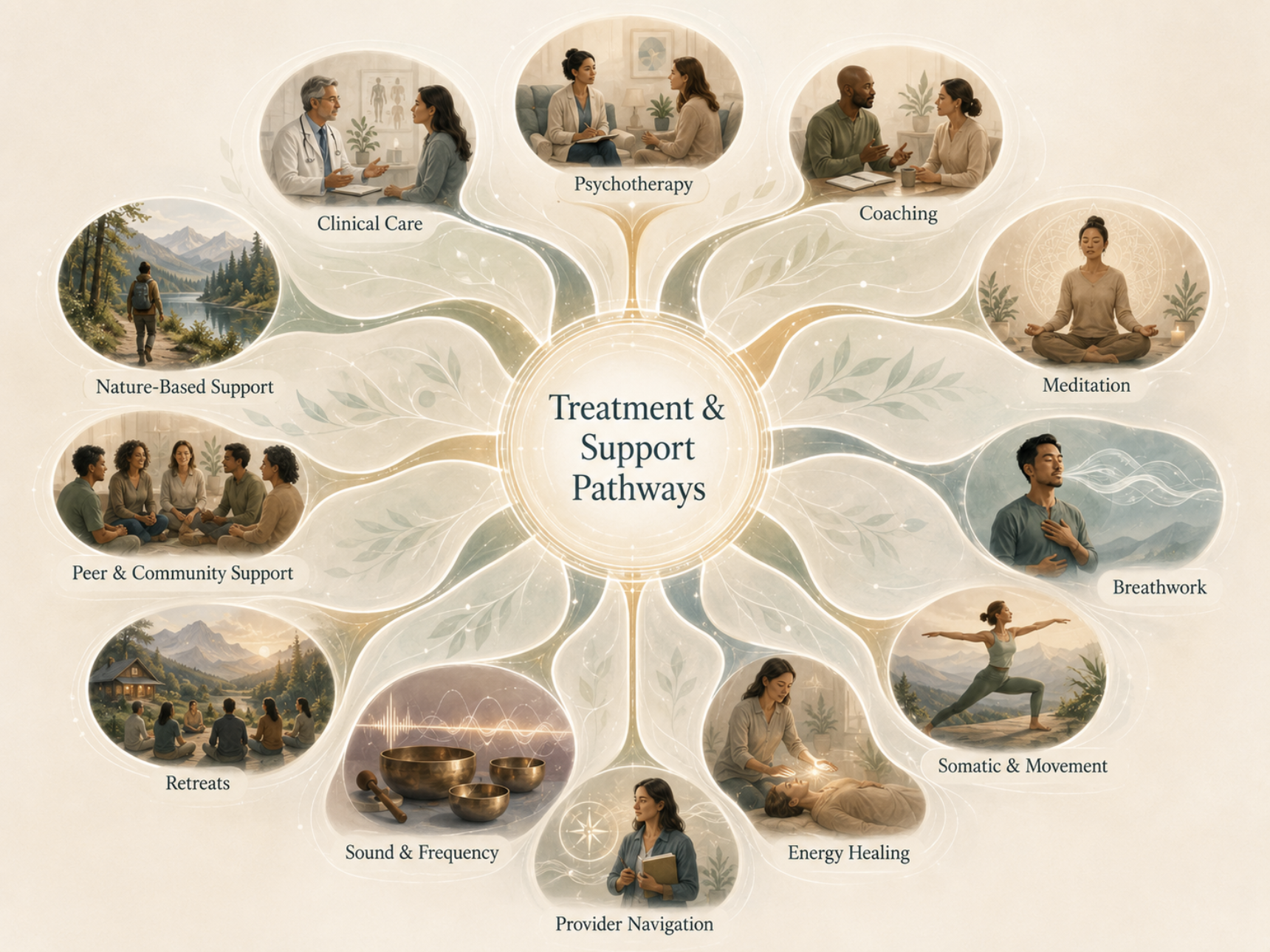
Treatment and support pathways may include clinical care, coaching, meditation, breathwork, somatic practice, sound and frequency work, retreats, peer support, and provider navigation
Contents
1. Overview
2. What treatment and support pathways are
3. Why people seek different pathways
4. Clinical, nonclinical, educational and experiential pathways
5. Psychotherapy and trauma-informed support
6. Coaching, mentorship and personal growth support
7. Psychedelic-assisted, entheogenic and integration pathways
8. Meditation, mindfulness and contemplative practice
9. Breathwork, somatic and nervous-system pathways
10. Energy healing, sound, vibration and frequency-based practices
11. Movement, lifestyle and behavioral health support
12. Retreats, ceremonial settings and immersive experiences
13. Peer, group and community support
14. Provider fit, safety, ethics and informed choice
15. How directories fit into the support landscape
16. Conclusion
17. References
18. Sources
Overview
A treatment or support pathway is a structured or semi-structured route through which a person seeks change. In a medical setting, the pathway may involve assessment, diagnosis, treatment planning, informed consent, intervention, monitoring, and follow-up. In a coaching or wellness setting, it may involve goal clarification, values work, habit formation, accountability, self-reflection, and practical support. In a contemplative, ceremonial, or retreat setting, it may involve preparation, guidance, group process, ritual structure, integration, and community connection. Across settings, the pathway is the pattern of support that links a person's need to a set of practices, relationships, and decisions.4
Because these pathways differ so widely, the first task is classification. A licensed therapist providing trauma treatment is not the same as a life coach helping with goal setting. A physician-supervised ketamine clinic is not the same as an underground psychedelic ceremony. A meditation teacher, Reiki practitioner, qigong instructor, peer-support facilitator, music therapist, integration coach, bodyworker, retreat center, patient navigator, and clinical psychologist may all work with people seeking healing, but they do not have the same training, obligations, legal scope, risk profile, or evidence base.5
A high-quality support ecosystem should not collapse all of these into one category. It should help users compare them. Clinical care is often needed when symptoms are severe, diagnosis is relevant, medications are involved, safety risks are present, or legally regulated treatment is required. Nonclinical support may be useful when the need is education, reflection, lifestyle change, spiritual practice, integration, community, accountability, or personal growth. Some people need both. The practical question is not whether one model is always better than another, but whether the chosen pathway is appropriate for the person's goals, risks, history, resources, and preferences.6
This is especially important because the wellness landscape contains both evidence-supported practices and practices that are meaningful to users but not strongly validated as medical treatments. Meditation, exercise, sleep, psychotherapy, health coaching, music therapy, nature exposure, and peer support have different kinds of evidence. Reiki, subtle-energy work, some frequency technologies, ceremonial tools such as rapé or sananga, plant dietas, Kambo, and many entheogenic traditions may be sought for spiritual, cultural, somatic, or experiential reasons, but each requires careful framing. Some are low-risk for many people when practiced responsibly; others may be physiologically intense, legally restricted, culturally specific, or inappropriate for people with certain medical or psychiatric vulnerabilities.7
What treatment and support pathways are
The phrase treatment pathway usually suggests formal care: a problem is identified, a plan is made, and care proceeds through recognized steps. In mental health, this may involve screening, diagnosis, psychotherapy, medication, crisis planning, referrals, relapse prevention, and continuing support. The phrase support pathway is broader. It includes clinical care but also nonclinical help, education, prevention, peer support, navigation, personal development, spiritual practice, wellness programs, retreats, lifestyle interventions, body-based practices, and integration work.8
Support pathways are therefore not defined only by the intervention. They are also defined by the relationship around the intervention. The same practice can function differently depending on who offers it, what setting it occurs in, and what claims are made. Breathwork can be a relaxation technique, a nervous-system practice, a spiritual discipline, a group catharsis practice, or part of a clinical trauma program. Music can be recreation, a sound bath, vibroacoustic stimulation, or licensed music therapy. Nature exposure can be a walk, a wilderness retreat, an adjunct to psychotherapy, or a culturally grounded ceremony.9
A practical pathway model asks several basic questions. What is the person's goal: symptom relief, diagnosis, safety, recovery, grief support, spiritual exploration, performance, connection, lifestyle change, trauma processing, integration, or meaning-making? What level of risk is present: suicidality, psychosis history, mania, medical instability, medication interactions, substance-use risk, trauma destabilization, coercion, or unsafe group dynamics? What kind of provider is involved: licensed clinician, physician, coach, peer supporter, facilitator, traditional practitioner, spiritual guide, wellness provider, or educator? What is the evidence standard: clinical guideline, systematic review, randomized trial, observational study, traditional use, experiential report, or emerging theory?10
The best support pathway is not always the most intensive one. Some people need urgent clinical care. Some need a skilled therapist. Some need a primary-care referral, a patient navigator, or a decision aid. Others need a coach, a peer group, a meditation teacher, a body-based practice, a retreat, or a practical plan for sleep, movement, nutrition, and daily structure. Many need a sequence: stabilization first, then deeper work; education first, then provider comparison; preparation first, then experience; integration afterward.11
Why people seek different pathways
People seek treatment and support for many reasons. Some are in acute distress, facing depression, anxiety, trauma symptoms, addiction, grief, burnout, isolation, or a crisis of meaning. Others are not seeking treatment for illness but are pursuing growth: more purpose, emotional flexibility, better relationships, spiritual development, creative renewal, healthier habits, or a deeper relationship to the body. The boundary between healing and growth is often porous. A person trying to improve sleep may also be trying to stabilize mood; a person seeking spiritual practice may also be trying to process grief; a person exploring integration after a psychedelic experience may also need trauma-informed therapy.12
Health systems often separate these needs into categories: medical, psychiatric, psychological, behavioral, social, spiritual, or wellness-related. Real human experience rarely stays inside those categories. The World Health Organization's public mental health framework emphasizes social conditions, community-based care, stigma reduction, lived experience, prevention, and broader systems of support. Whole-person health similarly recognizes that biological systems, behavior, environment, and lived context interact over time.13
This broader view helps explain why the support landscape includes so many provider types. A user may seek psychotherapy for trauma, coaching for accountability, qigong for embodied calm, Reiki for spiritual support, a physician for medication review, a sound bath for relaxation, exercise for depression symptoms, a retreat for perspective, peer support for belonging, and a directory for provider discovery. The need may be legitimate even when the best pathway is not obvious.14
People also seek different pathways because access is uneven. Formal mental health services can be expensive, unavailable, stigmatized, culturally mismatched, or difficult to navigate. Some users are not ready for therapy; others have tried standard care and want complementary support. Some want community rather than one-on-one care. Some seek culturally rooted or ceremonial pathways that conventional systems do not provide. A good navigation framework should not shame people for seeking alternatives, but it should help them avoid unsafe substitutions when clinical care is necessary.15
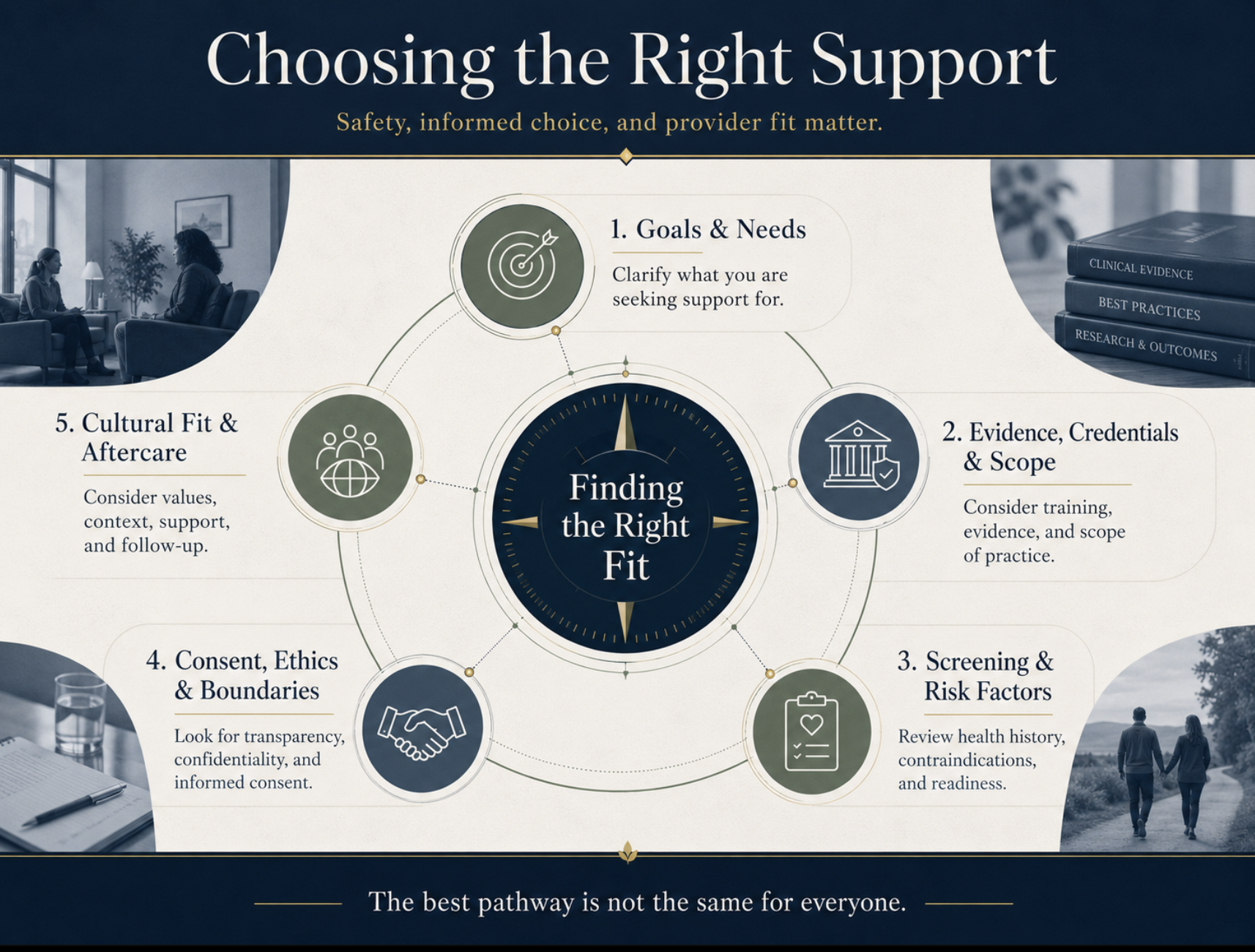
Major pathway categories at a glance
A compact way to understand the landscape is to sort pathways by their primary function. Some pathways diagnose and treat. Some regulate the nervous system. Some build habits. Some create community. Some support meaning-making. Some provide embodied or spiritual experiences. Some help people navigate systems. Most real providers combine more than one function, but the primary function helps users know what they are actually choosing.16
Clinical treatment pathways include primary care, psychiatry, psychotherapy, trauma-focused treatment, medication management, crisis care, and medicalized psychedelic or ketamine services where legal. Their main function is health care. They are the appropriate starting point when diagnosis, safety, medication, severe symptoms, or regulated treatment is central. A directory should make clinical credentials, license status, specialties, and treatment limitations easy to see.17
Psychological and personal-development pathways include psychotherapy, coaching, mentorship, motivational support, values work, goal setting, accountability, positive psychology, and behavioral design. Their main function is to help a person change patterns of thought, behavior, emotion, relationship, or life direction. Some are clinical; others are not. The user should know which is which before beginning.18
Regulation pathways include meditation, slow breathing, grounding, yoga, qigong, somatic awareness, sleep, movement, nature exposure, and some sound or vibroacoustic practices. Their main function is to influence arousal, attention, embodiment, and rhythm. These pathways can be gentle entry points for many users, but they can also become intense depending on duration, technique, group setting, and the person's trauma history.19
Experiential and immersive pathways include retreats, ceremonies, breathwork intensives, sound journeys, guided somatic experiences, plant-medicine settings, fasting, dietas, sweat lodges, and other threshold experiences. Their main function is to create a concentrated container in which ordinary patterns are interrupted. These settings can feel transformative, but they require stronger screening, preparation, consent, and integration than low-intensity education or weekly support.20
Traditional, Indigenous, and ceremonial pathways require an additional lens because the practice may not be reducible to a wellness service. Ayahuasca, peyote, yopo, rapé, sananga, plant dietas, mapacho, and other practices may be embedded in communities, lineages, cosmologies, ethics, songs, restrictions, and relationships to land or ancestry. Future category articles should handle these pathways with respect rather than treating them as interchangeable techniques.21
Energy, subtle-body, sound, and frequency pathways include Reiki, qigong, chakra-based practices, singing bowls, tuning forks, chanting, drumming, music therapy, vibroacoustic therapy, and technology-assisted vibration or frequency sessions. Their main function may be relaxation, spiritual support, somatic awareness, resonance, or experiential care. They need clear language because provider claims range from modest and experiential to expansive and medical.22
Community and navigation pathways include peer support, integration circles, support groups, patient navigation, system navigation, link workers, decision aids, and educational directories. Their main function is orientation. They help people feel less alone, compare options, find services, understand choices, and move from confusion toward the next right step.23
What should not be collapsed into one category
The article should avoid a common mistake: putting everything unusual under one label. Psychedelic therapy, ayahuasca ceremony, Kambo, Reiki, qigong, sound baths, breathwork, meditation, ketamine clinics, and coaching are not variations of the same service. They may all be part of a broad healing landscape, but they differ in legality, mechanism, risk, evidence, cultural context, provider training, and user expectations.24
Psychedelic and entheogenic categories should be separated by both context and substance. Psilocybin education is not the same as MDMA-assisted therapy research; ketamine care is not the same as ayahuasca ceremony; peyote traditions are not the same as an international retreat center; 5-MeO-DMT is not the same as Amanita muscaria; integration coaching is not the same as dosing support. Future category pages should be specific enough to prevent false equivalence.25
Likewise, energy and frequency categories should distinguish traditional practice from technology. A Reiki practitioner, qigong teacher, music therapist, sound-bath facilitator, and vibroacoustic device provider may all use language related to energy or vibration, but they offer different experiences. The user should be able to see whether the service is spiritual, educational, clinical, wellness-oriented, device-based, group-based, or therapeutic.26
Traditional and Indigenous practices should not be stripped of context. A plant dieta is not merely a supplement plan. Rapé is not merely a nasal product. Sananga is not merely an eye drop. Peyote is not merely mescaline. Ayahuasca is not merely DMT. Kambo is not merely a detox trend. Each of these may carry cultural, ceremonial, legal, ecological, and physiological considerations that deserve focused discussion in later articles.27
This root article can name those pathways and build the category architecture, but it should not try to teach users how to perform them or make claims beyond the current source base. That restraint is not weakness; it is how a trustworthy educational hub sets up deeper, better-sourced articles later.28
Clinical, nonclinical, educational, and experiential support
One of the most important distinctions in the support landscape is the difference between clinical and nonclinical care. Clinical care is delivered by licensed professionals acting within a regulated scope. It may involve diagnosis, treatment of mental disorders, prescription medication, crisis assessment, mandated reporting, records, privacy duties, informed consent, and professional ethics. Clinical care is especially important when symptoms are severe, functioning is impaired, risk is elevated, medication or medical conditions are relevant, or the intervention itself carries substantial physiological or psychiatric risk.29
Nonclinical support includes many valuable services, but it should not be confused with medical or psychological treatment. Coaching, mentorship, peer support, wellness education, meditation instruction, energy healing, retreat facilitation, integration coaching, and spiritual guidance may help people clarify values, build practices, feel supported, reflect on experience, or connect with community. But nonclinical providers generally should not diagnose, treat mental disorders, advise on medication changes, make medical claims beyond their scope, or present themselves as a replacement for licensed care when licensed care is indicated.30
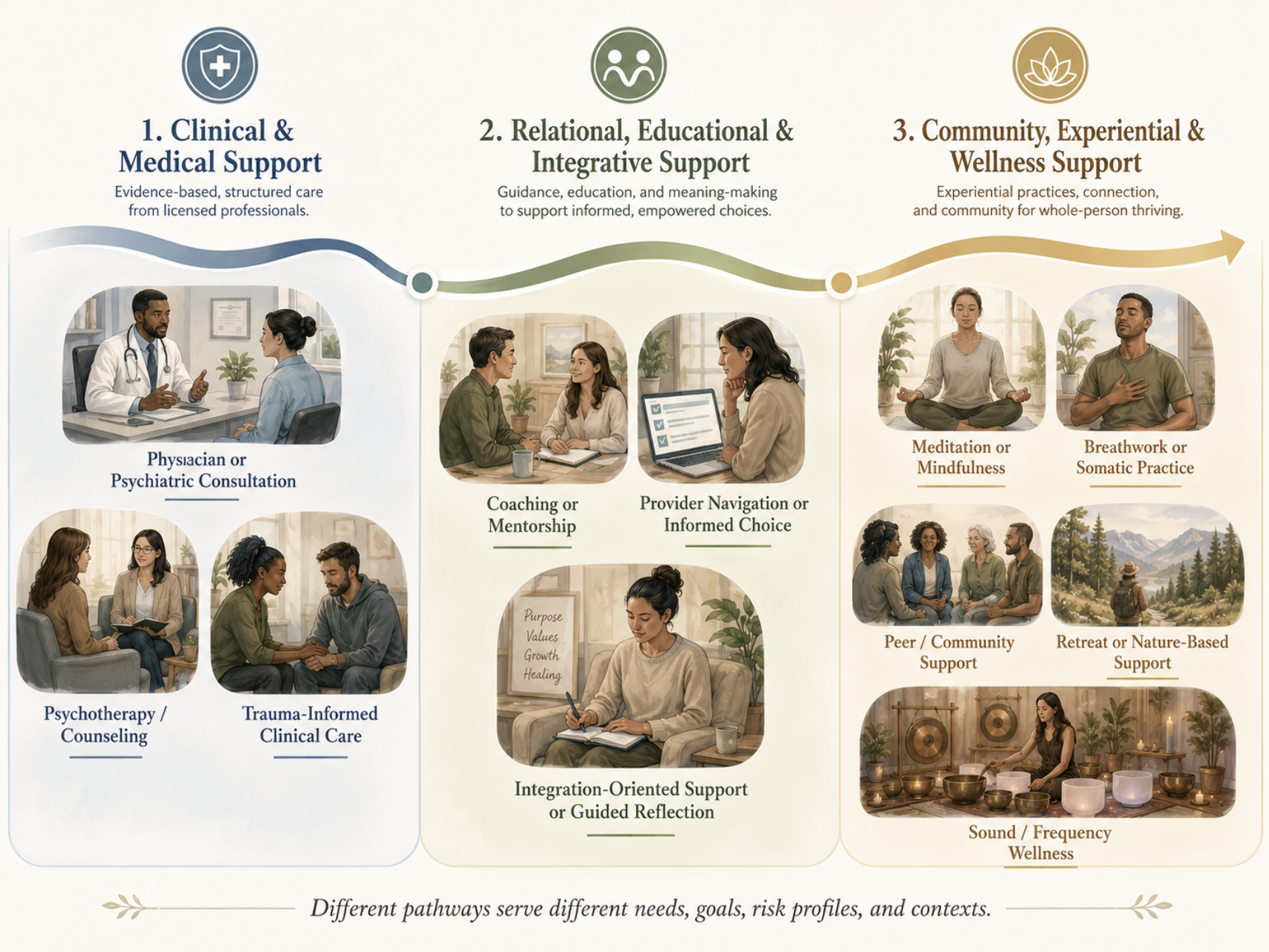
Different
forms of support serve different needs. Clinical care, psychotherapy, coaching,
provider navigation, meditation, breathwork, peer support, retreats, and sound
or frequency-based practices may each play a different role depending on a
person’s goals, risks, context, and readiness.
Educational support helps people understand options before they choose a provider. It may include articles, courses, workshops, webinars, safety guides, preparation materials, integration resources, and category pages that explain provider types. Experiential support is more direct: group circles, retreats, sound sessions, breathwork, body-based practice, guided meditation, ceremony, or immersive wellness programs. A pathway may combine both. For example, a user may first read about integration, then attend a preparation workshop, then work with a provider, then return to an integration group.31
The term integrative health is useful here because it describes the coordinated use of conventional and complementary approaches. Integrative health is not the same as rejecting medical care. In fact, responsible integrative navigation encourages people to communicate with their health-care providers, evaluate evidence, understand risks, and choose complementary practitioners carefully.32 The safest model is not either-or, but appropriate coordination: the right support at the right level, with honest boundaries around what is known and unknown.
Psychotherapy and trauma-informed care
Psychotherapy remains one of the central treatment pathways for mental health concerns. Cognitive behavioral therapy has a broad evidence base across multiple conditions, and trauma-focused therapies are emphasized in clinical guidelines for posttraumatic stress disorder.33 Acceptance and Commitment Therapy, mindfulness-based therapies, psychodynamic approaches, interpersonal therapies, EMDR-related approaches, Internal Family Systems, Gestalt therapy, somatic trauma therapies, and other models may be used by clinicians depending on training, diagnosis, goals, and client preference. Not every approach has the same level of evidence for every condition, but many people encounter these models when searching for support.34
Trauma-informed care is not a single technique. It is a way of designing care around safety, trust, collaboration, choice, empowerment, and awareness of the widespread effects of trauma. A trauma-informed provider recognizes that intense experiences can help some people but destabilize others, that consent must be ongoing, that power dynamics matter, and that the user's sense of control is not a side issue.35 This is especially relevant for body-based work, breathwork, psychedelic support, retreats, group processes, and ceremonial settings, where strong emotions, vulnerability, touch, authority, altered states, or social pressure may be present.
Some psychotherapy pathways are structured and symptom-focused. Others are experiential and meaning-focused. IFS and parts-oriented work may help users relate differently to internal conflict. Gestalt therapy and related experiential approaches may emphasize present-moment awareness, dialogue, embodiment, and unfinished emotional business. Somatic trauma therapies may focus on bodily cues, defensive responses, arousal, dissociation, and the gradual restoration of regulation. The root point is not that one therapy fits everyone, but that users should understand the provider's training, scope, method, and intended outcome.36
Clinical pathways also need informed consent. Informed consent is not merely a signed form; it is a process of understanding options, benefits, risks, uncertainties, alternatives, and the user's right to decide. Shared decision-making models emphasize choice talk, option talk, and decision talk, while decision aids and health-literacy research show that people often need support to understand complex choices.37 This matters in psychotherapy, medication, psychedelic-assisted therapy, body-based work, retreats, and any intervention where the user may be vulnerable or uncertain.
Ethics also matter because users are often seeking help at moments of pain or openness. Professional ethics emphasize competence, avoiding harm, informed consent, boundaries, privacy, responsibility, and respect for people's rights and dignity.38 Even outside licensed professions, the same general principles are useful: do not overstate claims, do not coerce, do not exploit vulnerability, do not blur roles without consent, do not promise cures, and do not substitute charisma for accountability.
Coaching, mentorship, and behavior-change support
Coaching and mentorship occupy a different part of the support landscape. Coaching is generally not psychotherapy, although it may use psychological ideas. Health and wellness coaching is often described as a patient-centered or client-centered process that includes goals, self-discovery, active learning, accountability, and behavior-change support.39 Life coaching, transformational coaching, integration coaching, spiritual mentorship, relationship coaching, executive coaching, and wellness coaching vary widely in training standards and claims, which makes provider comparison especially important.
Coaching can be useful when the main need is motivation, structure, clarity, planning, accountability, values alignment, lifestyle change, or integration of insights into daily behavior. Goal-setting theory, self-determination theory, motivational interviewing, and the behavior-change wheel all help explain why change is not merely a matter of information. People need capability, opportunity, motivation, autonomy, competence, relatedness, specific goals, feedback, and a realistic environment.40
Motivational interviewing illustrates the difference between telling people what to do and helping them explore ambivalence, reasons for change, and commitment. It has been studied across health and social-care contexts, though evidence quality and outcomes vary by population and implementation.41 For a directory user, the practical lesson is that effective support should help people become more active participants in change, not passive recipients of advice.
Personal growth coaching also overlaps with positive psychology. Positive psychology interventions may focus on strengths, gratitude, meaning, optimism, acts of kindness, values, savoring, and well-being.42 These approaches can be helpful for users who are not primarily seeking treatment for a disorder but are trying to move from languishing to flourishing. Yet coaching should remain clear about scope. A coach can support goals, reflection, and habits; a coach should not present themselves as treating PTSD, bipolar disorder, psychosis, eating disorders, or severe depression unless they are also licensed and competent to provide that care.43
Mentorship and spiritual guidance can be especially important in communities where formal therapy does not address meaning, identity, ceremony, vocation, or spiritual development. A mentor may help interpret experience, support ethical practice, or connect a person to lineage and community. But mentorship can also create power imbalances. Clear boundaries, humility, transparency, and referral networks are essential when the work touches trauma, sexuality, money, altered states, or spiritual authority.44
Psychedelic, entheogenic, and integration pathways
Psychedelic and entheogenic pathways are among the most complex areas in the current support landscape. They may include regulated clinical trials, ketamine care, legal psychedelic-assisted therapy where available, ceremonial plant-medicine settings, underground facilitation, preparation coaching, harm reduction, integration therapy, integration circles, education, and post-experience support. The substances and traditions people discuss include psilocybin, LSD, mescaline, peyote, MDMA, MDA, N,N-DMT, ayahuasca, 5-MeO-DMT, Bufo-related practices, 2C-B, ketamine, Amanita muscaria, yopo, and others. They differ dramatically by pharmacology, legality, cultural context, duration, risk, and setting.45
Modern psychedelic research has renewed interest in the treatment potential of substances such as psilocybin and MDMA when administered with screening, preparation, psychological support, controlled settings, and follow-up. Reviews and trials have reported promising findings in areas such as depression and PTSD, but these studies are not the same as unsupervised use or loosely structured commercial offerings.46 Research protocols typically include careful inclusion and exclusion criteria, trained session support, preparation, monitoring, and integration. Human hallucinogen safety guidelines emphasize screening for psychosis risk, preparation, rapport, safe settings, and interpersonal support during sessions.47
The role of psychological support is not incidental. Psychedelic clinical trials often include preparation, session support, and integration, but reporting practices have been inconsistent, making it harder to compare interventions.48 This is one reason the phrase psychedelic-assisted therapy should be used carefully. The drug, dose, therapist role, support model, number of sessions, setting, manual, training, fidelity, and follow-up all matter. A provider page should not reduce the pathway to a substance name.
Integration is a distinct support category because people often need help after powerful experiences. Psychedelic integration may involve making meaning, reflecting on insights, regulating emotions, changing behavior, discussing difficult material, and deciding what not to over-interpret.49 Integration can be offered by therapists, coaches, peer groups, educators, spiritual mentors, or self-guided programs, but the provider's scope matters. A therapist may treat trauma symptoms; a coach may help with values and habits; a peer circle may normalize experience; a spiritual guide may support meaning. These roles should not be blurred without transparency.
Traditional and ceremonial pathways require separate attention. Ayahuasca ceremonies, peyote traditions, plant dietas, rapé, sananga, yopo, mapacho/tobacco practices, and other ceremonial tools often belong to specific cultural, Indigenous, syncretic, or lineage-based contexts. A root educational article can name these as pathways, but detailed category articles should address cultural integrity, preparation, legality, health risks, contraindications, appropriation concerns, and provider accountability. The same applies to Kambo, often styled Kambô, and other venom, peptide, purging, or physiologically intense practices. These should not be casually grouped with meditation or gentle wellness practices. They may involve significant bodily stress and require careful safety evaluation.50
The directory architecture should therefore separate psychedelic and entheogenic pathways into nested categories: clinical psychedelic-assisted therapy, ketamine care, preparation and integration, ceremonial plant medicine, substance-specific education, retreat settings, traditional practices, safety and screening, and provider listings. This allows a broad root article to remain navigable while future category articles do the deeper work.51
Meditation, breathwork, and contemplative practice
Meditation and contemplative practice are core support pathways because they appear across clinical, spiritual, wellness, and retreat settings. Meditation may include mindfulness, breath awareness, loving-kindness, compassion practices, mantra, visualization, contemplative prayer, nondual inquiry, yoga nidra, body scanning, silent retreat, or daily attention training. Mindfulness-based interventions have been studied for stress, anxiety, depression, pain, and other outcomes, with evidence varying by condition, design, and comparator.52
Meditation should not be framed as universally benign or universally effective. Some people benefit from mindfulness training; others may experience distress, dysregulated arousal, dissociation, or other adverse effects, especially with intensive practice or inadequate screening.53 Responsible pathway design should therefore include matching intensity to the person, screening for vulnerability when appropriate, offering support, and avoiding claims that meditation is a simple cure for all conditions.
Breathwork is closely related but distinct. Slow breathing research suggests effects on autonomic, respiratory, cardiovascular, and psychological processes, including heart-rate variability and relaxation-related outcomes.54 Some forms of breathwork are gentle and regulation-oriented, such as slow breathing, resonance-frequency breathing, diaphragmatic breathing, or extended exhale practices. Others are more intense and may involve prolonged activation, emotional release, altered states, or group catharsis. The pathway should distinguish regulation practices from intense experiential breathwork.55
Interoception - the sensing and interpretation of signals from within the body - helps connect meditation, breathwork, somatic therapy, anxiety, trauma, pain, and embodiment.56 Some users need to become more aware of bodily signals; others are overwhelmed by them and need gradual, trauma-informed pacing. A practice that is grounding for one person may be destabilizing for another. This is why provider fit and skill matter.
Contemplative pathways also include spiritual formation and meaning-making. Some users approach meditation to reduce stress; others seek awakening, devotion, insight, moral formation, or relationship with the sacred. A directory should be able to distinguish secular mindfulness, clinical mindfulness-based therapy, Buddhist meditation instruction, yoga-based meditation, Christian contemplation, nondual teaching, and retreat practice without pretending they are identical.57
Somatic, movement, lifestyle, and body-based pathways
Somatic and body-based pathways focus on the body as a site of memory, regulation, awareness, expression, and change. Body psychotherapy, body- and movement-oriented interventions, somatic trauma approaches, dance/movement therapy, yoga, qigong, bodywork, trauma-informed embodiment, and nervous-system-oriented practices all fall within this broad field. Reviews suggest body psychotherapy and movement-oriented interventions may have benefits for some psychological outcomes, but the evidence base varies by modality and population.58
Somatic work matters because distress is not only cognitive. Anxiety, trauma, grief, shame, depression, and stress often appear through breathing, posture, muscle tension, gut sensations, dissociation, pain, fatigue, numbness, or restless activation. A person may understand a problem intellectually but still feel unsafe in the body. Somatic pathways may help users notice cues, build tolerance, complete defensive responses, practice grounding, release tension, or reconnect with agency.59
Movement and physical activity also belong in the treatment-pathway map. Physical activity guidelines emphasize the health importance of movement and reducing sedentary behavior, while reviews suggest physical activity interventions can improve depression, anxiety, and distress in many contexts.60 Movement-based support may include walking, strength training, yoga, qigong, dance, martial arts, mobility work, expressive movement, outdoor activity, or physical rehabilitation. Some practices are clinical or rehabilitative; others are wellness or spiritual practices.
Sleep is another foundational pathway. Consensus recommendations identify a recommended amount of sleep for healthy adults, and poor sleep often interacts with mood, pain, cognition, trauma symptoms, and daily functioning.61 A root article does not need to become a sleep guide, but it should make clear that support pathways are not only dramatic experiences. Sometimes the most effective pathway begins with stabilizing sleep, movement, nutrition, medical care, and daily routine.
Lifestyle and behavioral health support can include nutrition, habit change, stress reduction, substance-use reduction, digital boundaries, social rhythm, sunlight, exercise, sleep hygiene, health coaching, and primary-care coordination. These may sound ordinary compared with retreats or entheogenic experiences, but they are often the base layer that makes deeper work safer and more sustainable.62
Energy, sound, vibration, and frequency-based pathways
Energy-based and subtle-body practices are common in the healing and wellness landscape. Reiki, qigong, chakra-based systems, pranic-style work, polarity-style approaches, intuitive healing, and related practices may be sought for relaxation, spiritual support, emotional release, meaning-making, or a felt sense of energetic balance. These pathways should be named because many users search for them, providers offer them, and directories need categories for them. At the same time, the root article should avoid unsupported medical claims and should distinguish spiritual or experiential benefit from evidence-backed treatment claims.63
Qigong is a useful example because it crosses categories. It may be viewed as movement, meditation, breath practice, energy cultivation, martial lineage, spiritual discipline, or nervous-system support. Reiki may be framed by practitioners as energy healing, but users may experience it as relaxation, ritualized care, touch or near-touch support, spiritual reassurance, or an intentional healing encounter. A good category architecture should allow overlap without confusion.64
Sound, music, vibration, and frequency-based practices form another major pathway. Music interventions and music therapy have been studied in relation to quality of life, stress, and other health-related outcomes, while singing bowl meditation and vibroacoustic therapy have emerging or limited evidence in specific contexts.65 The pathway includes licensed music therapy, sound baths, singing bowls, tuning forks, chanting, drumming, binaural-style audio, guided sound meditation, and group sound experiences.
Technology-assisted somatic and frequency experiences deserve their own future category. Biotune-style mats, vibroacoustic chairs, sound tables, vibration platforms, and guided frequency devices combine auditory input with bodily vibration. These experiences may be marketed as nervous-system support, meditation enhancement, somatic immersion, or relaxation technology. The article should name the category without overclaiming: the user should ask what the device does, what evidence exists, what sensations are expected, what contraindications are considered, whether the provider makes medical claims, and how the session is supported.66
This field is especially vulnerable to vague language. Words such as frequency, vibration, resonance, energy, and quantum are often used loosely. Some uses are metaphorical, some are experiential, some are spiritual, and some refer to measurable physical vibration or sound. A trustworthy directory should help users identify which is which.67
Retreats, ceremony, nature, and immersive settings
Retreats are support pathways because they change the container around experience. A residential retreat may remove a person from ordinary routines, add group structure, increase time in nature, provide intensive practice, and create a sense of threshold. Retreats may focus on meditation, yoga, fitness, trauma recovery, grief, creativity, ayahuasca, psilocybin, breathwork, fasting, silence, music, coaching, men's or women's work, leadership, or spiritual renewal. A systematic review of residential retreats suggests the field is diverse and difficult to evaluate as one category.68
The power of retreats comes partly from immersion, but that is also where risk can increase. Retreat participants may be sleep-deprived, emotionally open, socially influenced, physically far from home, under the authority of facilitators, or participating in intense practices. Responsible retreat pathways should include clear screening, transparent schedules, emergency plans, informed consent, boundaries, staff training, integration support, and realistic claims.69
Nature-based pathways also deserve a place in the map. Reviews of nature exposure and mental health describe associations between natural environments and health-related outcomes, while ecosystem perspectives highlight that nature can be considered part of the context that supports mental health.70 A nature pathway may be as simple as walking outdoors, or as structured as wilderness therapy, forest bathing, outdoor retreats, horticultural programs, adventure therapy, or ceremonial land-based practice.
Ceremonial pathways overlap with retreats but are not identical. Ceremony may involve ritual, prayer, song, lineage, altar work, fasting, plant dietas, tobacco or mapacho traditions, rapé, sananga, drumming, dance, chanting, communal intention, and post-ceremony integration. Some ceremonies involve psychoactive or physiologically intense substances; others do not. Category articles should handle these with respect for cultural context and strong attention to safety and legality.71
Group and immersive pathways can also provide belonging. Many people do not only need a technique; they need witnesses, community, ritual, and a context in which change feels real. But group intensity can also create pressure. A high-quality provider should make participation voluntary, explain risks, avoid humiliation or coercion, and support people who need to step back.72
Peer, community, and navigation support
Peer support is a distinct pathway because it is based on lived experience, mutuality, shared understanding, and practical-emotional support. Peer support may occur in mental health recovery, addiction recovery, psychedelic integration circles, grief groups, chronic illness communities, spiritual communities, online forums, veterans groups, LGBTQ+ support spaces, and local circles. Literature reviews and meta-analyses suggest peer support can be helpful for some mental health outcomes, though effects and evidence quality vary.73
Peer support is not a replacement for clinical care when clinical care is needed, but it can address needs that clinical systems often miss: belonging, hope, normalization, identity, practical tips, and the feeling that someone else has walked a similar road.74 Peer communities can also help users evaluate providers, prepare questions, and recognize red flags. The best peer spaces are clear about boundaries, confidentiality, crisis protocols, and when to refer.
Navigation support is another crucial pathway. Patient navigators, system navigators, link workers, community health workers, and decision aids help people move through fragmented systems. Reviews of patient navigation and system navigation describe efforts to connect people with chronic disease, primary care, community-based services, and social support.75 This matters because people often do not fail to get help because no support exists; they fail because the system is confusing, siloed, expensive, or poorly matched to their needs.
Health literacy and shared decision-making are part of navigation. A person cannot make an informed decision if they do not understand the options, the claims, the risks, the provider's role, or the meaning of evidence.76 Directories, educational articles, provider profiles, comparison tools, and category pages can improve navigation when they are honest, structured, and specific.
Community support also includes faith communities, recovery meetings, mutual-aid groups, cultural organizations, LGBTQ+ affirming groups, harm-reduction organizations, integration circles, and local wellness communities. Some are formal; others are informal. The central question is whether the community increases safety, dignity, belonging, and informed agency, or whether it increases dependence, confusion, shame, or coercion.77
A practical pathway map for users
A user-facing pathway map should begin with the user's current state. If a person is in immediate danger, experiencing active suicidal intent, mania, psychosis, severe withdrawal, domestic violence, medical instability, or inability to function, the first pathway is not a retreat, ceremony, coach, or sound bath. It is urgent clinical, crisis, medical, or protective support. If the person is stable but struggling with symptoms, a licensed therapist, psychiatrist, primary-care clinician, or integrated care team may be appropriate. If the person is stable and seeking growth, spiritual exploration, integration, performance, community, or lifestyle change, nonclinical pathways may be appropriate as long as claims and boundaries remain clear.78
The second layer is the goal. Some goals are symptom goals: fewer panic attacks, less depression, better sleep, reduced trauma intrusions, improved functioning, or decreased substance use. Some are process goals: emotional regulation, embodied awareness, communication, grief expression, self-compassion, or healthier habits. Some are meaning goals: purpose, belonging, forgiveness, spiritual clarity, relationship to death, or a new life direction. Some are experiential goals: a retreat, ceremony, meditation intensive, breathwork session, sound immersion, or body-based release. A good directory should let users search by both provider type and goal type.79
The third layer is intensity. Low-intensity pathways may include reading, courses, introductory meditation, gentle breathwork, peer support, coaching, walking groups, basic movement, or sound relaxation. Moderate-intensity pathways may include ongoing therapy, structured coaching, group process, somatic work, residential retreats, or guided integration. High-intensity pathways may include trauma processing, psychedelic-assisted therapy, underground or ceremonial psychedelic experiences, intensive breathwork, long silent retreats, Kambo, fasting, plant dietas, or other physiologically or psychologically demanding practices. Intensity is not the same as quality. The best pathway is the level of intensity a person can actually integrate.80
The fourth layer is support before, during, and after. Many adverse outcomes are not caused only by the practice itself, but by poor preparation, weak screening, over-intensity, inadequate support, or lack of integration afterward. A user considering a powerful retreat, psychedelic experience, intense breathwork, somatic trauma work, or physiologically demanding practice should ask what happens before the session, who is present during it, what training they have, what happens if the user becomes destabilized, and what support exists afterward.81
The fifth layer is fit. Fit includes the provider's scope, but also the user's identity, values, culture, language, trauma history, spiritual orientation, and personal preferences. Some users need a highly structured clinical provider. Some need a culturally competent therapist. Some need an LGBTQ+ affirming group. Some need a faith-compatible approach. Some need a provider who understands psychedelic experiences without encouraging unsafe use. Some need a practitioner who can explain exactly what a device, ceremony, or body-based process does. Fit is not a luxury; it is part of safety and effectiveness.82
Sequencing, combination, and integration
Many pathways work best in sequence rather than isolation. Stabilization may come before exploration. Education may come before provider selection. Preparation may come before retreat or ceremony. Integration should follow powerful experiences. Clinical support may run alongside coaching or community support. A person may begin with sleep, movement, and therapy; later add meditation or qigong; later attend a retreat; then use coaching to turn insights into habits. Another person may begin with peer support, then seek a navigator, then choose a therapist.83
Sequencing is especially important when a pathway involves altered states, strong emotion, social vulnerability, or bodily intensity. Psychedelic and entheogenic experiences, Kambo, plant dietas, silent retreats, holotropic-style breathwork, somatic trauma work, and intense group processes can all open material that may be difficult to integrate. Without preparation and support, a dramatic experience may become confusing, inflated, destabilizing, or forgotten. With appropriate integration, the same experience may become part of slower, more grounded change.84
Combination also requires communication. If a user is working with a physician, therapist, coach, ceremonial facilitator, bodyworker, and peer group, those providers may not know about each other. Some users prefer privacy, but safety improves when relevant providers understand major risks, medications, diagnoses, and recent intense experiences. At minimum, users should be encouraged to tell medical and mental health providers about complementary practices, supplements, substances, and intense retreat or ceremony plans when those details could affect safety.85
Integration should be understood broadly. It can mean making sense of a psychedelic experience, but it can also mean bringing a therapy insight into a relationship, translating a meditation retreat into daily practice, letting a grief ritual change how one lives, turning coaching goals into habits, or following up a sound or somatic session with rest and reflection. Integration is where extraordinary experiences become ordinary life change.86
Provider fit, safety, ethics and informed choice
Evidence standards should be proportional to the claim. If a provider claims to treat PTSD, depression, addiction, chronic pain, or another health condition, a user should expect a different level of evidence, training, and accountability than if the provider claims to offer relaxation, education, meditation instruction, spiritual support, or personal growth. Clinical guidelines, systematic reviews, randomized trials, observational studies, traditional knowledge, mechanism research, and experiential reports are not interchangeable.87
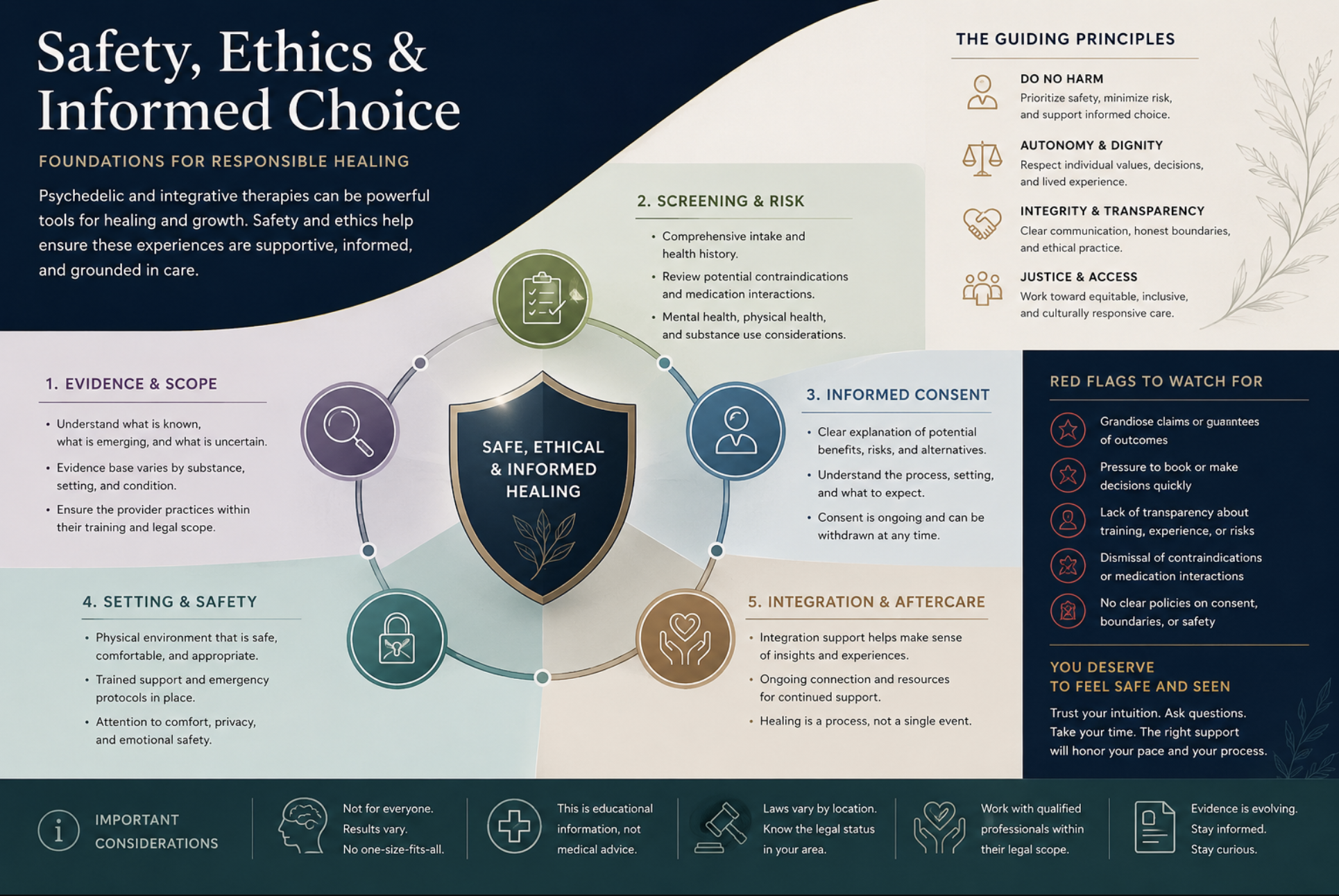
Safe and
ethical support depends on informed choice. Evidence, provider scope, consent,
screening, boundaries, legality, cultural context, and aftercare all matter
when evaluating whether a pathway is appropriate for a person’s needs.
This does not mean only randomized trials matter. Some pathways are hard to study with standard clinical designs, and some ceremonial or spiritual practices are not primarily medical interventions. But the claim should match the evidence. A singing bowl session can be described as a sound meditation experience without claiming to cure trauma. A Reiki session can be described as energy-based spiritual support without claiming to replace cancer treatment. A plant-medicine retreat can describe its tradition and support structure without promising guaranteed healing.88
Safety requires attention to contraindications. Psychedelic experiences may be inappropriate for people with certain psychiatric histories, medications, cardiovascular risks, or unstable conditions. Breathwork may be inappropriate or require modification for some medical or trauma-related vulnerabilities. Meditation can produce adverse experiences for some people. Kambo, venom, purging, and intense physiological practices may carry medical risks. Bodywork and somatic practices may activate trauma. Retreats may intensify vulnerability.89 A responsible pathway should include screening, consent, preparation, support, emergency planning, and referral capacity.
Legality matters because legal status shapes risk. Some substances are approved or permitted in specific medical, religious, research, or jurisdictional contexts; others are prohibited. Some providers operate in regulated clinical systems, while others operate in gray-market, religious, ceremonial, international, or underground contexts. A directory should not pretend these contexts are the same. Users need to know whether a pathway is legal where it is offered, what protections exist, and what risks they assume.90
Provider fit includes more than credentials. Credentials matter, but so do lived experience, cultural humility, specialization, transparency, communication, boundaries, trauma awareness, referral relationships, and the provider's ability to say no. A strong provider profile should help users understand who the provider serves, what they do, what they do not do, what training they have, what risks they screen for, how they handle crises, what their fees are, and what preparation or integration is available.91
Red flags include guaranteed cures, pressure to stop medication without medical supervision, secrecy about training, vague claims of universal healing, sexualized boundary violations, excessive guru dynamics, coercive group pressure, discouraging outside relationships, refusal to discuss risks, lack of emergency planning, and claims that legal or medical concerns do not matter.92 Green flags include informed consent, clear scope, transparent pricing, realistic claims, referral networks, trauma-informed practice, cultural respect, ethical boundaries, and a willingness to explain evidence and uncertainty.93
How directories fit into the support landscape
A directory can do more than list providers. It can organize the support landscape into categories that users can understand. A broad article like this creates the educational root. Beneath it, category articles can explain specific pathways: trauma-informed therapy, coaching, psychedelic integration, ketamine care, ayahuasca preparation, plant dietas, Kambo, meditation, breathwork, Reiki, qigong, sound and vibroacoustic technology, retreats, peer support, lifestyle support, and patient navigation. Beneath those category articles, provider listing pages can show paying providers in each category.94
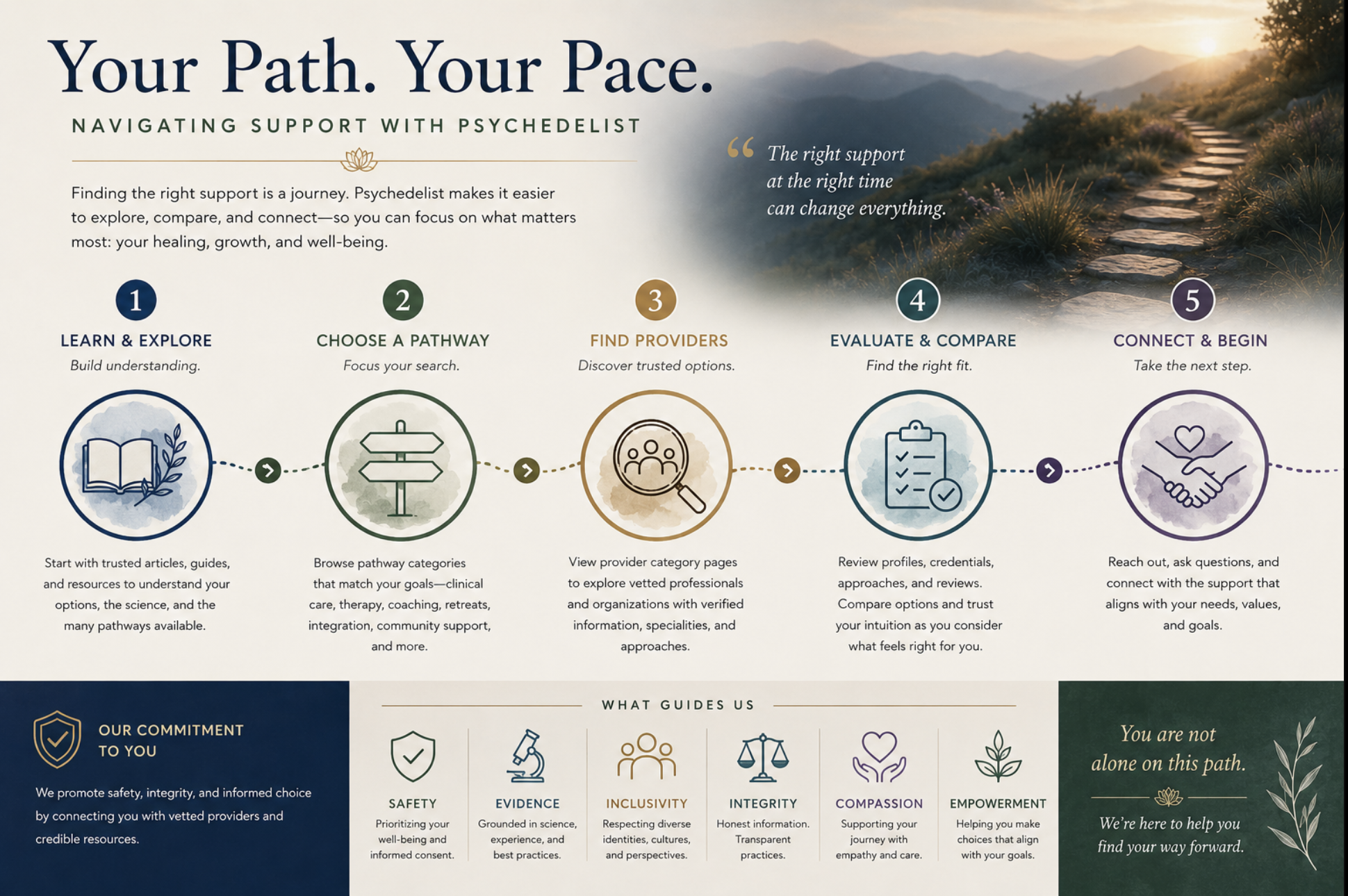
Directories
help turn a complex support landscape into a more navigable journey, moving
from education to pathway categories, provider comparison, fit evaluation, and
connection with appropriate support.
This structure matters commercially and educationally. Long root articles are best used for SEO, authority, and navigation. They help users and search engines understand the ecosystem. They are not necessarily the best paid-ad landing pages because paid traffic should generally move efficiently toward provider discovery, category listings, and commercial conversion. Category provider pages and premium provider showcase pages can carry that role more directly.95
A sensible architecture might look like this: a foundation article introduces healing, wellness, and growth; this article maps treatment and support pathways; category articles explain specific pathways; category provider pages list paying providers; premium provider showcase pages give deeper visibility to individual premium listers. Basic subscription listers may appear on relevant category pages, while premium listers may receive dedicated educational-promotional articles or landing pages.96
The directory also has a trust function. In a field full of overlapping claims, a structured directory can help users ask better questions: Is this clinical or nonclinical? Is it legal? What evidence supports it? What risks are screened? What preparation is required? What happens afterward? Is the provider trained for trauma? Does the practice belong to a cultural lineage? Is there a crisis plan? Are the claims proportionate?97
This approach also avoids forcing every pathway into one funnel. Someone seeking psychotherapy should be routed differently from someone seeking a sound bath, a qigong class, an integration circle, a ketamine clinic, a Reiki practitioner, a retreat center, or a plant-medicine education article. The directory's job is to preserve distinctions while making movement between categories possible.98
How users should read provider pages
Once a user reaches a provider page, the same pathway logic should continue. The profile should not simply say that a provider offers healing, transformation, or wellness. It should help the user identify the pathway, the provider role, the expected process, the intensity level, the risks considered, and the next step. A therapist profile should make license and specialties visible. A coach profile should clarify nonclinical scope. A retreat profile should explain preparation, schedule, staff, screening, lodging, integration, and emergency planning. A ceremonial profile should be especially clear about legality, cultural context, safety, and participant expectations.99
Good provider pages should also separate services from claims. A provider may offer integration coaching, breathwork, Reiki, ketamine support, qigong, sound healing, or a retreat. That tells the user what the service is. The claim is what the provider says the service can do. Claims should be proportionate: relaxation, education, reflection, spiritual support, community, nervous-system practice, or personal growth are different from claims to treat a disorder or cure a disease.100
Users should also look for exclusions. High-quality providers know who they do not serve. A psychedelic facilitator may exclude certain psychiatric histories or medications. A breathwork provider may exclude pregnancy, seizure risk, or cardiovascular concerns for intense formats. A meditation retreat may warn users with trauma or dissociation histories about intensive practice. A Kambo practitioner may require medical screening. A therapist may refer out when the presenting issue is outside their competence. Refusal can be a sign of maturity rather than a lack of service.101
The most useful category pages can compare providers without pretending they are identical. A category page for retreats might include meditation retreats, plant-medicine retreats, yoga retreats, trauma retreats, men's work, and wellness resorts, but filters should help the user distinguish them. A category page for sound and frequency might distinguish licensed music therapists, sound-bath facilitators, vibroacoustic technology providers, and spiritual sound practitioners. A category page for psychedelic support might distinguish legal clinical care, integration, education, retreat preparation, and ceremonial support.102
This also helps paid listing strategy. Basic listers can be included in category provider pages where users compare options. Premium listers can receive deeper showcase articles that educate around a specific pathway while highlighting the provider's differentiators, process, safety standards, and fit. This makes the commercial pathway more useful to the user and more valuable to the provider.103
Relationship to future category articles
The root article should intentionally leave room for nested content. A future article on coaching can discuss health coaching, integration coaching, transformational coaching, motivational interviewing, goal setting, accountability, and scope boundaries. A future article on trauma-informed therapies can cover CBT, ACT, EMDR, IFS, Gestalt, somatic therapy, parts work, and clinician selection in more detail. A future article on meditation can distinguish mindfulness, contemplation, mantra, loving-kindness, nondual practice, silent retreat, and adverse-effect monitoring.104
A future article on psychedelic and entheogenic support can separate clinical research, regulated therapy, ketamine care, preparation, integration, ceremonial settings, harm reduction, and substance-specific education. Substance-specific pages can later address psilocybin, LSD, mescaline, peyote, MDMA, MDA, N,N-DMT, ayahuasca, 5-MeO-DMT, Bufo, ketamine, Amanita muscaria, yopo, 2C-B, and related topics with better sources for each.105
A future article on traditional and ceremonial practices can address plant dietas, rapé, sananga, mapacho, yopo, ayahuasca preparation, peyote traditions, cultural lineage, reciprocity, legality, and screening. A future Kambo article can separately address frog secretion practices, bioactive peptides, safety concerns, contraindications, practitioner training, and the difference between ceremonial claims and medical claims.106
A future sound and frequency article can distinguish music therapy, recreational sound baths, singing bowls, vibroacoustic therapy, tactile sound devices, frequency mats, chairs, somatic audio technologies, and guided frequency sessions. A future energy-healing article can distinguish Reiki, qigong, chakra work, pranic approaches, subtle-body frameworks, spiritual support, and evidence boundaries.107
This is the purpose of the root: not to finish every category, but to create the map. A person who arrives here should leave with a clearer sense of the landscape and a better idea of which pathway to explore next.108
Conclusion
Treatment and support pathways for healing, wellness, and growth are diverse because human needs are diverse. Some people need evidence-based clinical care. Some need trauma-informed therapy. Some need coaching, peer support, lifestyle change, meditation, movement, or nature. Some seek spiritual practice, energy healing, ceremony, sound, vibration, retreats, or psychedelic integration. Some need help deciding where to begin. A useful pathway model does not flatten these differences. It organizes them.109
The central principles are simple: match the pathway to the person, match the provider to the need, match the claim to the evidence, match the intensity to the user's capacity, and match the experience to preparation and integration. Healing and growth can involve insight, but they also require safety, consent, context, and follow-through.110
For Psychedelist, this article functions as an educational hub. It supports a broader architecture in which users can move from general education to pathway-specific articles, then to category provider pages, and eventually to provider profiles or premium showcase pages. That structure respects both sides of the mission: helping users make informed decisions and helping legitimate providers become discoverable in the categories where they belong.111
The next stage is not to make this article carry every commercial burden. Its job is to define the map. The category articles can then narrow the conversation, answer the specific questions users have inside each pathway, and lead them toward provider pages where comparison and conversion make more sense. When the architecture works, a person can start with a broad question such as what kind of support do I need, move into a specific category such as integration coaching, trauma therapy, Reiki, qigong, sound and frequency work, retreats, or plant-medicine preparation, and then find providers whose services, scope, values, and safety practices match that search. That path keeps the educational layer useful, the commercial layer efficient, and the user experience coherent from first question to final provider selection.112
References
[1] For the broad public mental health framing and the importance of community-based care, see Source [1].
[2] For whole-person health and the biopsychosocial model, see Sources [2] and [3].
[3] For patient-centered care, integrative health definitions, informed choice, and consumer caution, see Sources [4]-[8].
[4] For general pathway framing across clinical, nonclinical, and integrative settings, see Sources [1]-[8].
[5] For scope, competence, informed consent, and ethical boundaries, see Sources [8] and [9].
[6] For complementary and integrative health terminology, see Sources [5] and [6].
[7] For proportional claims and the need to distinguish evidence levels, see Sources [5], [6], [8], and [9].
[8] For formal mental health care and trauma-informed support, see Sources [10]-[12].
[9] For breathwork, music, nature, and retreat categories as distinct pathway examples, see Sources [35], [36], [43]-[49].
[10] For shared decision-making, informed consent, decision aids, and health literacy, see Sources [7], [8], [51], and [52].
[11] For navigation and system-level support, see Sources [50] and [55].
[12] For mental health, flourishing, psychological flexibility, and positive psychology, see Sources [1], [15], [20], and [23].
[13] For mental health systems, whole-person health, and social determinants, see Sources [1]-[4].
[14] For the diversity of support types and whole-person framing, see Sources [2], [5], and [6].
[15] For barriers, navigation, and community-based health and social services, see Sources [50], [52], and [55].
[16] For pathway functions across clinical care, behavior change, body-based practice, nature, music, peer support, and navigation, see Sources [1]-[55].
[17] For clinical treatment, ethics, and trauma care, see Sources [8]-[12].
[18] For behavior change, coaching, motivation, and positive psychology, see Sources [16]-[23].
[19] For regulation through meditation, breathwork, interoception, movement, sleep, and nature, see Sources [31]-[42], [47], and [49].
[20] For retreats and immersive experiences, see Source [48].
[21] For culturally specific and ceremonial categories, see Sources [5], [6], [8], [9], [24], and [48].
[22] For sound, music, singing bowls, and vibroacoustic therapy, see Sources [43]-[46].
[23] For peer support and system navigation, see Sources [50], [53]-[55].
[24] For not collapsing unlike modalities into one category, see the scope, evidence, and ethics principles in Sources [5]-[9].
[25] For substance-specific and psychedelic context distinctions, see Sources [24]-[30].
[26] For energy and frequency terminology requiring clear claim boundaries, see Sources [5], [6], and [43]-[46].
[27] For traditional and ceremonial context requiring future focused sourcing, see Sources [5], [6], [8], [9], and [24].
[28] For the root article functioning as a category map, see the navigation logic in Sources [50]-[55].
[29] For clinical practice guidelines, trauma care, and ethics, see Sources [9]-[12].
[30] For distinctions between complementary, alternative, and integrative approaches, see Sources [5] and [6].
[31] For decision support, navigation, and health literacy, see Sources [50]-[52] and [55].
[32] For NCCIH guidance on coordinating complementary and conventional approaches, see Sources [5] and [6].
[33] For CBT evidence and PTSD treatment guidance, see Sources [10] and [11].
[34] For ACT, psychological flexibility, and related clinical models, see Sources [13]-[15].
[35] For trauma-informed principles, see Source [12].
[36] For body psychotherapy, body-oriented PTSD interventions, and interoception, see Sources [37]-[39].
[37] For informed consent, shared decision-making, decision aids, and health literacy, see Sources [7], [8], [51], and [52].
[38] For professional ethics, competence, informed consent, and avoiding harm, see Source [9].
[39] For definitions and features of health and wellness coaching, see Source [18].
[40] For motivation, behavior change, self-determination, and goal setting, see Sources [20]-[22].
[41] For motivational interviewing evidence, see Sources [16] and [17].
[42] For positive psychology interventions, see Source [23].
[43] For coaching scope and health-behavior support, see Sources [18] and [19].
[44] For ethical boundaries and provider responsibility, see Source [9].
[45] For hallucinogen safety and examples of psychedelic substances, see Source [24].
[46] For psilocybin-assisted therapy and MDMA-assisted therapy research, see Sources [26], [27], and [29].
[47] For safety safeguards in human hallucinogen research, see Source [24].
[48] For reporting practices around psychological support in psychedelic trials, see Source [30].
[49] For psychedelic integration definitions and practices, see Source [25].
[50] For the need to distinguish ceremonial, physiological, and clinical contexts, see Sources [5], [6], [8], [24], and [25].
[51] For psychedelic-assisted psychotherapy models and associated interventions, see Source [28].
[52] For meditation programs and mindfulness-based interventions, see Sources [31], [32], and [34].
[53] For meditation-related adverse effects, see Source [33].
[54] For slow breathing psychophysiology, see Sources [35] and [36].
[55] For resonance-frequency breathing and breathing-related regulation, see Sources [35] and [36].
[56] For interoception and mental health, see Source [37].
[57] For mindfulness and contemplative intervention overviews, see Sources [31], [32], and [34].
[58] For body psychotherapy and body- and movement-oriented interventions, see Sources [38] and [39].
[59] For interoception and body-based mental health pathways, see Source [37].
[60] For physical activity and mental health outcomes, see Sources [40] and [41].
[61] For adult sleep recommendations, see Source [42].
[62] For behavior change, coaching, movement, and lifestyle-related support, see Sources [18]-[22], [40], and [41].
[63] For evidence boundaries in complementary and integrative health, see Sources [5] and [6].
[64] For qigong and body-mind overlap as pathway framing, see Sources [2], [5], [35], [37], and [38].
[65] For music interventions, music therapy, singing bowls, and vibroacoustic therapy, see Sources [43]-[46].
[66] For vibroacoustic therapy and technology-assisted somatic sound experiences, see Source [46].
[67] For clear claim boundaries in emerging wellness technologies, see Sources [5], [6], [8], and [9].
[68] For residential retreats, see Source [48].
[69] For safety, consent, and trauma-informed retreat design, see Sources [8], [9], [12], and [48].
[70] For nature exposure and mental health, see Sources [47] and [49].
[71] For ceremonial pathway framing and the need for contextual caution, see Sources [5], [6], [8], [24], and [48].
[72] For group support, peer support, and recovery orientation, see Sources [53] and [54].
[73] For peer-support literature, see Sources [53] and [54].
[74] For peer support outcomes and cautions about evidence quality, see Source [54].
[75] For patient navigation and system navigation, see Sources [50] and [55].
[76] For health literacy and shared decision-making, see Sources [7], [51], and [52].
[77] For community-based services and system navigation, see Source [55].
[78] For risk stratification and appropriate routing to clinical or crisis support, see Sources [1], [8], [9], [11], and [12].
[79] For goal type, motivation, behavior change, and values-based support, see Sources [13], [15], [20]-[23].
[80] For intensity matching across meditation, breathwork, psychedelic, retreat, and body-based pathways, see Sources [24], [33], [35], [36], [38], [39], and [48].
[81] For preparation, support, and integration around intense experiences, see Sources [24], [25], [28], [30], and [33].
[82] For provider fit, shared decision-making, ethics, and health literacy, see Sources [7]-[9], [51], and [52].
[83] For sequencing support across navigation, coaching, clinical care, and community-based services, see Sources [18]-[22], [50], and [55].
[84] For integration and post-experience support, see Source [25].
[85] For communication with health-care providers about complementary practices, see Source [6].
[86] For the broader meaning of integration as sustained behavior and life change, see Sources [20]-[23] and [25].
[87] For evidence standards across clinical and complementary health, see Sources [5], [6], [10], [11], and [31]-[34].
[88] For music, sound, and complementary practice claim boundaries, see Sources [5], [6], [43]-[46].
[89] For safety concerns across psychedelic, breathwork, meditation, and body-based pathways, see Sources [24], [33], [35], [36], [38], and [39].
[90] For legal and ethical care boundaries, see Sources [8] and [9].
[91] For provider fit, shared decision-making, and health literacy, see Sources [7], [8], [51], and [52].
[92] For ethical red flags and avoiding harm, see Source [9].
[93] For informed consent and ethical practice principles, see Sources [8] and [9].
[94] For system navigation and directory-like support concepts, see Sources [50] and [55].
[95] For the distinction between SEO education and provider navigation architecture, this is a strategic application of the pathway model supported by Sources [50], [52], and [55].
[96] For category navigation and patient support logic, see Sources [50]-[52] and [55].
[97] For informed decision-making across provider types, see Sources [7], [8], [51], and [52].
[98] For pathway differentiation and navigation support, see Sources [5], [6], [50], and [55].
[99] For provider transparency, informed consent, ethics, and health literacy, see Sources [7]-[9], [51], and [52].
[100] For matching claims to evidence and complementary-health caution, see Sources [5] and [6].
[101] For screening and safety in psychedelic, meditation, breathwork, and body-based contexts, see Sources [24], [33], [35], [36], [38], and [39].
[102] For category comparison and system navigation logic, see Sources [50], [52], and [55].
[103] For the provider-page architecture as an application of navigation and decision-support principles, see Sources [50]-[55].
[104] For future psychotherapy and meditation category development, see Sources [10]-[15] and [31]-[34].
[105] For future psychedelic category development, see Sources [24]-[30].
[106] For future ceremonial and physiologically intense practice categories, see Sources [5], [6], [8], [9], and [24].
[107] For future sound, frequency, and energy-healing category development, see Sources [43]-[46] and [5]-[6].
[108] For the root article as a map rather than a deep dive, see the navigation and decision-support logic in Sources [50]-[55].
[109] For the diversity of clinical, wellness, contemplative, community, and navigation pathways, see Sources [1]-[55].
[110] For safety, consent, and follow-through as recurring principles, see Sources [7]-[12], [24], [33], [50]-[52], and [55].
[111] For the article's directory function as a pathway from education to provider discovery, see Sources [50], [52], and [55].
[112] For the relationship between education, navigation, decision support, and provider discovery, see Sources [50]-[55].
Sources
[1] World mental health report: transforming mental health for all. Geneva: World Health Organization; 2022. (source page)
[2] National Center for Complementary and Integrative Health. NCCIH Strategic Plan FY 2021-2025: Mapping a Pathway to Research on Whole Person Health. Bethesda, MD: U.S. Department of Health and Human Services, National Institutes of Health, 2021. (source page)
[3] Engel, George L. “The Need for a New Medical Model: A Challenge for Biomedicine.” Science 196, no. 4286 (1977): 129-136. (source page)
[4] Institute of Medicine. Crossing the Quality Chasm: A New Health System for the 21st Century. Washington, DC: National Academy Press, 2001. (source page)
[5] National Center for Complementary and Integrative Health. “Complementary, Alternative, or Integrative Health: What’s In a Name?” National Center for Complementary and Integrative Health, National Institutes of Health, last updated April 2021. (source page)
[6] National Center for Complementary and Integrative Health. “Are You Considering a Complementary Health Approach?” National Center for Complementary and Integrative Health, National Institutes of Health, last updated August 2016. (source page)
[7] Elwyn, Glyn, Dominick Frosch, Richard Thomson, Natalie Joseph-Williams, Amy Lloyd, Paul Kinnersley, Emma Cording, Dave Tomson, Carole Dodd, Stephen Rollnick, Adrian Edwards, and Michael Barry. “Shared Decision Making: A Model for Clinical Practice.” Journal of General Internal Medicine 27, no. 10 (2012): 1361-1367. (source page)
[8] Hall, Daniel E., Allan V. Prochazka, and Aaron S. Fink. “Informed Consent for Clinical Treatment.” CMAJ 184, no. 5 (2012): 533-540. (source page)
[9] American Psychological Association. Ethical Principles of Psychologists and Code of Conduct. Washington, DC: American Psychological Association, 2017. (source page)
[10] Hofmann, Stefan G., Anu Asnaani, Imke J. J. Vonk, Alice T. Sawyer, and Angela Fang. “The Efficacy of Cognitive Behavioral Therapy: A Review of Meta-analyses.” Cognitive Therapy and Research 36, no. 5 (2012): 427-440. (source page)
[11] American Psychological Association. APA Clinical Practice Guideline for the Treatment of Posttraumatic Stress Disorder (PTSD) in Adults. Washington, DC: American Psychological Association, 2025. (source page)
[12] Substance Abuse and Mental Health Services Administration. SAMHSA’s Concept of Trauma and Guidance for a Trauma-Informed Approach. HHS Publication No. (SMA) 14-4884. Rockville, MD: Substance Abuse and Mental Health Services Administration, 2014. (source page)
[13] Hayes, Steven C., Michael E. Levin, Jennifer Plumb-Vilardaga, Jennifer L. Villatte, and Jacqueline Pistorello. “Acceptance and Commitment Therapy and Contextual Behavioral Science: Examining the Progress of a Distinctive Model of Behavioral and Cognitive Therapy.” Behavior Therapy 44, no. 2 (2013): 180-198. (source page)
[14] A-Tjak, Jacqueline G. L., Michelle L. Davis, Nexhmedin Morina, Mark B. Powers, Jasper A. J. Smits, and Paul M. G. Emmelkamp. “A Meta-Analysis of the Efficacy of Acceptance and Commitment Therapy for Clinically Relevant Mental and Physical Health Problems.” Psychotherapy and Psychosomatics 84, no. 1 (2015): 30-36. (source page)
[15] Kashdan, Todd B., and Jonathan Rottenberg. “Psychological Flexibility as a Fundamental Aspect of Health.” Clinical Psychology Review 30, no. 7 (2010): 865-878. (source page)
[16] Rubak, Sune, Annelli Sandbæk, Torsten Lauritzen, and Bo Christensen. “Motivational Interviewing: A Systematic Review and Meta-analysis.” British Journal of General Practice 55, no. 513 (2005): 305-312. (source page)
[17] Frost, Helen, Pauline Campbell, Margaret Maxwell, Ronan E. O’Carroll, Stephan U. Dombrowski, Brian Williams, Helen Cheyne, Emma Coles, and Alex Pollock. “Effectiveness of Motivational Interviewing on Adult Behaviour Change in Health and Social Care Settings: A Systematic Review of Reviews.” PLOS ONE 13, no. 10 (2018): e0204890. (source page)
[18] Wolever, Ruth Q., Leigh Ann Simmons, Gary A. Sforzo, Diana Dill, Miranda Kaye, Elizabeth M. Bechard, Mary Elaine Southard, Mary Kennedy, Justine Vosloo, and Nancy Yang. “A Systematic Review of the Literature on Health and Wellness Coaching: Defining a Key Behavioral Intervention in Healthcare.” Global Advances in Health and Medicine 2, no. 4 (2013): 38-57. (source page)
[19] Boehmer, Kasey R., Neri A. Álvarez-Villalobos, Suzette Barakat, Humberto de Leon-Gutierrez, Fernando G. Ruiz-Hernandez, Gabriela G. Elizondo-Omaña, Héctor Vaquera-Alfaro, Sangwoo Ahn, Gabriela Spencer-Bonilla, Michael R. Gionfriddo, Juan M. Millan-Alanis, Marwan Abdelrahim, Larry J. Prokop, M. Hassan Murad, and Zhen Wang. “The Impact of Health and Wellness Coaching on Patient-Important Outcomes in Chronic Illness Care: A Systematic Review and Meta-analysis.” Patient Education and Counseling 117 (2023): 107975. (source page)
[20] Ryan, Richard M., and Edward L. Deci. “Self-Determination Theory and the Facilitation of Intrinsic Motivation, Social Development, and Well-Being.” American Psychologist 55, no. 1 (2000): 68-78. (source page)
[21] Michie, Susan, Maartje M. van Stralen, and Robert West. “The Behaviour Change Wheel: A New Method for Characterising and Designing Behaviour Change Interventions.” Implementation Science 6 (2011): 42. (source page)
[22] Locke, Edwin A., and Gary P. Latham. “Building a Practically Useful Theory of Goal Setting and Task Motivation: A 35-Year Odyssey.” American Psychologist 57, no. 9 (2002): 705-717. (source page)
[23] Sin, Nancy L., and Sonja Lyubomirsky. “Enhancing Well-Being and Alleviating Depressive Symptoms With Positive Psychology Interventions: A Practice-Friendly Meta-Analysis.” Journal of Clinical Psychology 65, no. 5 (2009): 467-487. (source page)
[24] Johnson, Matthew W., William A. Richards, and Roland R. Griffiths. “Human Hallucinogen Research: Guidelines for Safety.” Journal of Psychopharmacology 22, no. 6 (2008): 603-620. (source page)
[25] Bathje, Geoff J., Eric Majeski, and Mesphina Kudowor. “Psychedelic Integration: An Analysis of the Concept and Its Practice.” Frontiers in Psychology 13 (2022): 824077. (source page)
[26] Mitchell, Jennifer M., et al. “MDMA-Assisted Therapy for Moderate to Severe PTSD: A Randomized, Placebo-Controlled Phase 3 Trial.” Nature Medicine 29 (2023): 2473-2480. (source page)
[27] Mitchell, Jennifer M., Michael Bogenschutz, Alia Lilienstein, Charlotte Harrison, Sarah Kleiman, Kelly Parker-Guilbert, Marcela Ot’alora G., et al. “MDMA-Assisted Therapy for Severe PTSD: A Randomized, Double-Blind, Placebo-Controlled Phase 3 Study.” Nature Medicine 27 (2021): 1025-1033. (source page)
[28] Cavarra, Mauro, Alessandra Falzone, Johannes G. Ramaekers, Kim P. C. Kuypers, and Carmela Mento. “Psychedelic-Assisted Psychotherapy—A Systematic Review of Associated Psychological Interventions.” Frontiers in Psychology 13 (2022): 887255. (source page)
[29] Perez, Natacha, Florent Langlest, Luc Mallet, Marco De Pieri, Othman Sentissi, Gabriel Thorens, Federico Seragnoli, Daniele Zullino, Matthias Kirschner, Stefan Kaiser, Marco Solmi, and Michel Sabé. “Psilocybin-Assisted Therapy for Depression: A Systematic Review and Dose-Response Meta-Analysis of Human Studies.” European Neuropsychopharmacology 76 (2023): 61-76. (source page)
[30] Brennan, William, Alex R. Kelman, and Alexander B. Belser. “A Systematic Review of Reporting Practices in Psychedelic Clinical Trials: Psychological Support, Therapy, and Psychosocial Interventions.” Psychedelic Medicine 1, no. 4 (2023): 218-229. (source page)
[31] Goyal, Madhav, Sonal Singh, Erica M. S. Sibinga, Neda F. Gould, Anastasia Rowland-Seymour, Ritu Sharma, Zackary Berger, Dana Sleicher, David D. Maron, Hasan M. Shihab, Padmini D. Ranasinghe, Shauna Linn, Shonali Saha, Eric B. Bass, and Jennifer A. Haythornthwaite. “Meditation Programs for Psychological Stress and Well-being: A Systematic Review and Meta-analysis.” JAMA Internal Medicine 174, no. 3 (2014): 357-368. (source page)
[32] Hofmann, Stefan G., and Angelina F. Gómez. “Mindfulness-Based Interventions for Anxiety and Depression.” Psychiatric Clinics of North America 40, no. 4 (2017): 739-749. (source page)
[33] Britton, Willoughby B., Jared R. Lindahl, David J. Cooper, Nicholas K. Canby, and Roman Palitsky. “Defining and Measuring Meditation-Related Adverse Effects in Mindfulness-Based Programs.” Clinical Psychological Science 9, no. 6 (2021): 1185-1204. (source page)
[34] Zhang, Dexing, Eric K. P. Lee, Eva C. W. Mak, C. Y. Ho, and Samuel Y. S. Wong. “Mindfulness-Based Interventions: An Overall Review.” British Medical Bulletin 138, no. 1 (2021): 41-57. (source page)
[35] Zaccaro, Andrea, Andrea Piarulli, Marco Laurino, Erika Garbella, Danilo Menicucci, Bruno Neri, and Angelo Gemignani. “How Breath-Control Can Change Your Life: A Systematic Review on Psycho-Physiological Correlates of Slow Breathing.” Frontiers in Human Neuroscience 12 (2018): 353. (source page)
[36] Russo, Marc A., Danielle M. Santarelli, and Dean O’Rourke. “The Physiological Effects of Slow Breathing in the Healthy Human.” Breathe 13, no. 4 (2017): 298-309. (source page)
[37] Khalsa, Sahib S., Ralph Adolphs, Oliver G. Cameron, Hugo D. Critchley, Paul W. Davenport, Justin S. Feinstein, Jamie D. Feusner, et al. “Interoception and Mental Health: A Roadmap.” Biological Psychiatry: Cognitive Neuroscience and Neuroimaging 3, no. 6 (2018): 501-513. (source page)
[38] Rosendahl, Sophie, Heribert Sattel, and Claas Lahmann. “Effectiveness of Body Psychotherapy. A Systematic Review and Meta-Analysis.” Frontiers in Psychiatry 12 (2021): 709798. (source page)
[39] van de Kamp, Minke M., Mia Scheffers, Janneke Hatzmann, Claudia Emck, Pim Cuijpers, and Peter J. Beek. “Body- and Movement-Oriented Interventions for Posttraumatic Stress Disorder: A Systematic Review and Meta-Analysis.” Journal of Traumatic Stress 32, no. 6 (2019): 967-976. (source page)
[40] World Health Organization. WHO Guidelines on Physical Activity and Sedentary Behaviour. Geneva: World Health Organization, 2020. (source page)
[41] Singh, Ben, Timothy Olds, Rachel Curtis, Dorothea Dumuid, Rosa Virgara, Amanda Watson, Kimberley Szeto, Edward O’Connor, Ty Ferguson, Emily Eglitis, Aaron Miatke, Catherine E. M. Simpson, and Carol Maher. “Effectiveness of Physical Activity Interventions for Improving Depression, Anxiety and Distress: An Overview of Systematic Reviews.” British Journal of Sports Medicine 57, no. 18 (2023): 1203-1209. (source page)
[42] Watson, Nathaniel F., M. Safwan Badr, Gregory Belenky, Donald L. Bliwise, Orfeu M. Buxton, Daniel Buysse, David F. Dinges, James Gangwisch, Michael A. Grandner, Clete Kushida, Raman K. Malhotra, Jennifer L. Martin, Sanjay R. Patel, Stuart F. Quan, and Esra Tasali. “Recommended Amount of Sleep for a Healthy Adult: A Joint Consensus Statement of the American Academy of Sleep Medicine and Sleep Research Society.” Sleep 38, no. 6 (2015): 843-844. (source page)
[43] McCrary, J. Matt, Eckart Altenmüller, Clara Kretschmer, and Daniel S. Scholz. “Association of Music Interventions With Health-Related Quality of Life: A Systematic Review and Meta-analysis.” JAMA Network Open 5, no. 3 (2022): e223236. (source page)
[44] de Witte, Martina, Ana da Silva Pinho, Geert-Jan Stams, Xavier Moonen, Arjan E. R. Bos, and Susan van Hooren. “Music Therapy for Stress Reduction: A Systematic Review and Meta-analysis.” Health Psychology Review 16, no. 1 (2022): 134-159. (source page)
[45] Goldsby, Tamara L., Michael E. Goldsby, Mary McWalters, and Paul J. Mills. “Effects of Singing Bowl Sound Meditation on Mood, Tension, and Well-being: An Observational Study.” Journal of Evidence-Based Complementary & Alternative Medicine 22, no. 3 (2017): 401-406. (source page)
[46] Kantor, Jiří, Elsa A. Campbell, Lucia Kantorová, Jana Marečková, Vojtěch Regec, Kristýna Karasová, Dagmar Sedláčková, and Miloslav Klugar. “Exploring Vibroacoustic Therapy in Adults Experiencing Pain: A Scoping Review.” BMJ Open 12 (2022): e046591. (source page)
[47] Jimenez, Marcia P., Nicole V. DeVille, Elise G. Elliott, Jessica E. Schiff, Grete E. Wilt, Jaime E. Hart, and Peter James. “Associations Between Nature Exposure and Health: A Review of the Evidence.” International Journal of Environmental Research and Public Health 18, no. 9 (2021): 4790. (source page)
[48] Naidoo, Dhevaksha, Adrian Schembri, and Marc Cohen. “The Health Impact of Residential Retreats: A Systematic Review.” BMC Complementary and Alternative Medicine 18 (2018): 8. (source page)
[49] Bratman, Gregory N., Christopher B. Anderson, Marc G. Berman, Bobby Cochran, Sjerp de Vries, Jon Flanders, Carl Folke, Howard Frumkin, James J. Gross, Terry Hartig, Peter H. Kahn Jr., Ming Kuo, Joshua J. Lawler, Phillip S. Levin, Therese Lindahl, Andreas Meyer-Lindenberg, Richard Mitchell, Zhiyun Ouyang, Jenny Roe, Lynn Scarlett, Jeffrey R. Smith, Matilda van den Bosch, Benedict W. Wheeler, Mathew P. White, Hua Zheng, and Gretchen C. Daily. “Nature and Mental Health: An Ecosystem Service Perspective.” Science Advances 5, no. 7 (2019): eaax0903. (source page)
[50] McBrien, Kerry A., Noah Ivers, Lianne Barnieh, Jacob J. Bailey, Diane L. Lorenzetti, David Nicholas, Marcello Tonelli, Brenda Hemmelgarn, Richard Lewanczuk, Alun Edwards, Ted Braun, and Braden Manns. “Patient Navigators for People with Chronic Disease: A Systematic Review.” PLOS ONE 13, no. 2 (2018): e0191980. (source page)
[51] Stacey, Dawn, Krystina B. Lewis, Maureen Smith, Meg Carley, Robert J. Volk, Elisa E. Douglas, Lissa Pacheco-Brousseau, Jeanette Finderup, Janet Gunderson, Michael J. Barry, Carol L. Bennett, Paulina Bravo, Karina Steffensen, Amédé Gogovor, Ian D. Graham, Shannon E. Kelly, France Légaré, Henning Sondergaard, Richard Thomson, Logan Trenaman, and Lyndal Trevena. “Decision Aids for People Facing Health Treatment or Screening Decisions.” Cochrane Database of Systematic Reviews 2024, no. 1 (2024): CD001431. (source page)
[52] Muscat, Danielle M., Heather L. Shepherd, Don Nutbeam, Lyndal Trevena, and Kirsten J. McCaffery. “Health Literacy and Shared Decision-making: Exploring the Relationship to Enable Meaningful Patient Engagement in Healthcare.” Journal of General Internal Medicine 36, no. 2 (2021): 521-524. (source page)
[53] Shalaby, Reham A. Hameed, and Vincent I. O. Agyapong. “Peer Support in Mental Health: Literature Review.” JMIR Mental Health 7, no. 6 (2020): e15572. (source page)
[54] Smit, Dorien, Clara Miguel, Janna N. Vrijsen, Bart Groeneweg, Jan Spijker, and Pim Cuijpers. “The Effectiveness of Peer Support for Individuals with Mental Illness: Systematic Review and Meta-analysis.” Psychological Medicine 53 (2023): 5332-5341. (source page)
[55] Teggart, Kylie, Sarah E. Neil-Sztramko, Abbira Nadarajah, Amy Wang, Caroline Moore, Nancy Carter, Janet Adams, Kamal Jain, Penelope Petrie, Aref Alshaikhahmed, Shreya Yugendranag, and Rebecca Ganann. “Effectiveness of System Navigation Programs Linking Primary Care with Community-Based Health and Social Services: A Systematic Review.” BMC Health Services Research 23 (2023): 450. (source page)