A Guide to Psychedelic Retreats and Immersive Experiences
Models, Safety, Preparation, Integration and Evidence
An evidence-grounded guide to understanding different retreat models, evaluating the people and practices behind an experience, and planning for what happens before, during, and afterward.
September 2026
Numbered citations correspond to passage-specific entries in the References section. The alphabetized Source List gives the full publication details and access links for each work.
Contents
1. Begin with the experience and the system around it
2. The main retreat and experience models
3. Why context matters: set, setting, relationships, and
meaning
4. What the evidence can and cannot tell us
5. Different substances mean different experiences and
risks
6. Safety is a system, not a reassuring adjective
7. Screening, health conditions, and medication
decisions
8. The rest of the program matters: adjuncts, fasting,
and “detox” claims
9. Who is responsible? People, competence, and
accountability
10. Consent, touch, privacy, and the use of power
11. Preparation before arrival: understanding, choice,
and support
12. Travel, accommodation, accessibility, and the full
cost
13. During the retreat: what a supported process can
look like
14. Integration: making room for what follows
15. When difficulties continue: support without
minimization
16. Indigenous knowledge, reciprocity, and ecological
responsibility
17. Legal distinctions: permission for what, where, and
for whom?
18. A practical framework for comparing programs
19. Common questions and misleading shortcuts
20. From understanding the landscape to evaluating an
individual experience
References
Source List
1. Begin with the experience—and the system around it
A psychedelic retreat can be presented as a chance to step away from ordinary life, participate in ceremony, explore consciousness, reconnect with other people, or work with experiences that have been difficult to approach in everyday settings. Research with retreat participants describes motivations ranging from curiosity and spiritual exploration to self-understanding and hopes for relief from psychological distress. Those motivations can overlap within one person. They do not, however, establish that the program being purchased is equipped to provide treatment, or that a powerful experience will lead to lasting benefit. [1] [2]
The most useful starting question is therefore not simply, “Which retreat offers the substance I am interested in?” It is: What experience is being offered, by whom, under what authority, with what safeguards, and with what support afterward? A retreat is a setting and an organized service. A psychedelic is a substance or group of substances. A ceremony is a social and cultural practice. Psychotherapy and medical treatment are professional activities. These may intersect, but none is a substitute for identifying the others. [3] [4] [5]
 Ceremonial space at Aya Madre Healing Center [Iquitos, Peru] Photo Courtesy of Aya Madre Healing Center Retreat.
This guide examines that whole arrangement. It explains the major models, the strengths and limits of the evidence, important differences between substances, and the practical work of evaluating preparation, supervision, consent, integration, and accountability. Its purpose is to help adults understand what they are considering before moving into more specific retreat and immersive-experience pages. It does not recommend a particular business, certify a program, or decide whether an individual should take a psychedelic.
A note on safety and scope. This is educational information, not individualized medical, psychiatric, or legal advice. Reading a guide cannot establish eligibility. Medication decisions belong with appropriately qualified prescribing professionals, not with a generic retreat checklist. Severe physical symptoms, immediate danger, or an inability to remain safe require urgent professional help rather than waiting for a ceremony or integration process to finish. The cited sources describe both potentially beneficial experiences and adverse outcomes; neither side should be erased. [6] [7] [8] [9] [10]
The promise is not imaginary, but it needs a precise description
Some people describe psychedelic experiences as unusually meaningful. They report changes in how they relate to themselves, other people, difficult emotions, spirituality, or the natural world. Naturalistic studies have documented associations between participation and improvements in self-reported well-being, social connectedness, and psychological symptoms. Qualitative interviews also describe changes in identity, priorities, and behavior. These are legitimate subjects of research and can matter deeply to the people involved. [11] [12] [13] [14]
The question is what follows from those observations. A report that someone felt less depressed after a retreat is not the same as a controlled demonstration that the retreat treated a depressive disorder. A participant’s account of spiritual significance is not made meaningless because it is not a clinical outcome. Conversely, a meaningful experience does not establish the accuracy of every belief formed during it, the competence of the person leading it, or the absence of harm. Different claims require different kinds of evidence. [15] [16] [17]
This distinction protects both scientific accuracy and personal agency. It allows a reader to take an experience seriously without accepting inflated promises. A program can make space for uncertainty, ambivalence, disappointment, and changing interpretations. It does not need to promise that everyone will heal, discover a hidden truth, dissolve their ego, or return as a different person. The ethics of consent become especially important when an experience might change the very preferences by which a participant later judges it. [17] [18]
What this guide means by an immersive experience
Here, an immersive experience means an organized setting that concentrates attention, time, relationships, and activities around a particular process. It may last a day, a weekend, or longer. It may include overnight accommodation, group meetings, music, contemplative practices, nature activities, or individual support. “Immersive” describes the format; it is not a claim about treatment quality, scientific validation, or legal status. The online retreat landscape contains many such combinations rather than one standardized model. [3]
Nor does immersion necessarily require a drug. Some readers may be exploring meditation, carefully adapted breathwork, a culturally grounded practice, psychotherapy, or another structured retreat without psychedelic administration. Research on those activities must be evaluated on its own terms. For example, evidence concerning particular breathing interventions does not validate every intensive breathwork method, and certainly does not establish the safety of combining it with a psychedelic. [19]
The freedom to choose a non-drug option, defer a decision, or decide against participation is part of a meaningful decision process. A program’s persuasive story should not become a requirement to act. The comparison questions in this guide are a practical synthesis of research, ethics literature, and relevant regulations—not a validated scoring system that can certify a retreat as safe. [20] [21] [22]
How to use the guide
Readers at the beginning of their search can start with the models and evidence sections. Readers already considering a program may find screening, staffing, consent, travel, and the final comparison framework especially useful. Those helping someone after a difficult experience can turn directly to integration and continuing difficulties. The numbered citations correspond to entries in the References, which identify supporting pages, sections, or provisions. The alphabetized Source List afterward gives the full bibliographic details and publication or official-source links.
Legal examples are bounded by jurisdiction and by the versions identified in the references. The legal sources were checked for this edition on September 7, 2026, but a later booking or journey needs a fresh check. A scientific paper’s publication year also does not tell the reader when its data were collected. Throughout this guide, historical study findings are distinguished from a statement about what every retreat does now. [23] [24] [25] [26] [27] [28]
2. The main retreat and experience models
The word “retreat” can conceal more than it reveals. Two organizations may offer the same substance while differing in purpose, leadership, participant selection, legal basis, clinical capability, cultural relationships, and aftercare. Conversely, programs using different substances may share a residential wellness format. A useful comparison therefore begins with the model of service, not with scenery, price, or a single label. [3] [29]
The categories below are descriptive, not a hierarchy from inferior to superior. They overlap, and individual organizations may combine them. The task is to understand the combination accurately rather than assume that one appealing feature stands for the whole program.
Traditional and Indigenous community contexts
Traditional practices belong to particular peoples, places, histories, relationships, and systems of knowledge. Their purposes may extend beyond the individual goals familiar in Western wellness language. Healing can be understood in relation to family, community, land, spirituality, responsibility, and cultural continuity. Reducing those practices to a substance plus a facilitator misses much of what makes them meaningful. [30] [31] [32]
A visitor-facing retreat that borrows songs, clothing, terminology, or a ceremonial form is not automatically equivalent to participation in a community’s own practice. It is important to ask which tradition is being represented, who recognizes the practitioners’ authority, who has consented to the commercial use of knowledge, and how the relevant community participates in decisions and benefits. Indigenous-led scholarship emphasizes governance and reciprocity, not merely respectful-looking presentation. [33] [31]
Respect for a tradition does not require a participant to abandon bodily autonomy or ignore a medical emergency. Equally, attention to medical risk should not become an excuse to describe all non-Western knowledge as superstition or to treat community authority as irrelevant. Cultural legitimacy, ethical conduct, clinical capability, and legal permission are distinct questions. Each deserves an answer in its own terms. [34] [30] [35]
Religious and sacramental organizations
Some organizations understand psychedelic use as a sacrament within an ongoing religious life, rather than as a product for personal development. Commitments, membership, doctrine, ritual participation, and community obligations can be central. Joining such a setting involves more than selecting an intervention. A prospective participant should understand what participation means and whether the organization expects continuing commitments. [3] [36] [37]
Religious identity also does not resolve legality by itself. In the United States, the Supreme Court’s O Centro decision addressed a particular claimant’s sacramental use of hoasca under the Religious Freedom Restoration Act. It did not declare every psychedelic church, ceremony, or fee-based retreat exempt from controlled-substance law. The specific authorization or legal basis matters, as do its conditions and the people and activities it covers. [38]
Religious freedom and informed choice are compatible. A participant should be able to ask how religious teaching interacts with psychological interpretation, health decisions, confidentiality, and the right to decline. A sincere spiritual setting does not need to characterize reasonable questions as a lack of faith. That is an ethical implication of protecting autonomy, not a judgment about the truth of a religion. [22] [39]
Commercial ceremonial and wellness retreats
Many publicly advertised retreats combine ceremonies with accommodation, meals, group discussions, yoga, meditation, body-oriented practices, or time outdoors. A landscape study of organizations marketing in English found that most emphasized general wellness, although their language and offerings varied considerably. Some described spiritual frameworks; others emphasized transformation, self-exploration, or psychological benefits. [3]
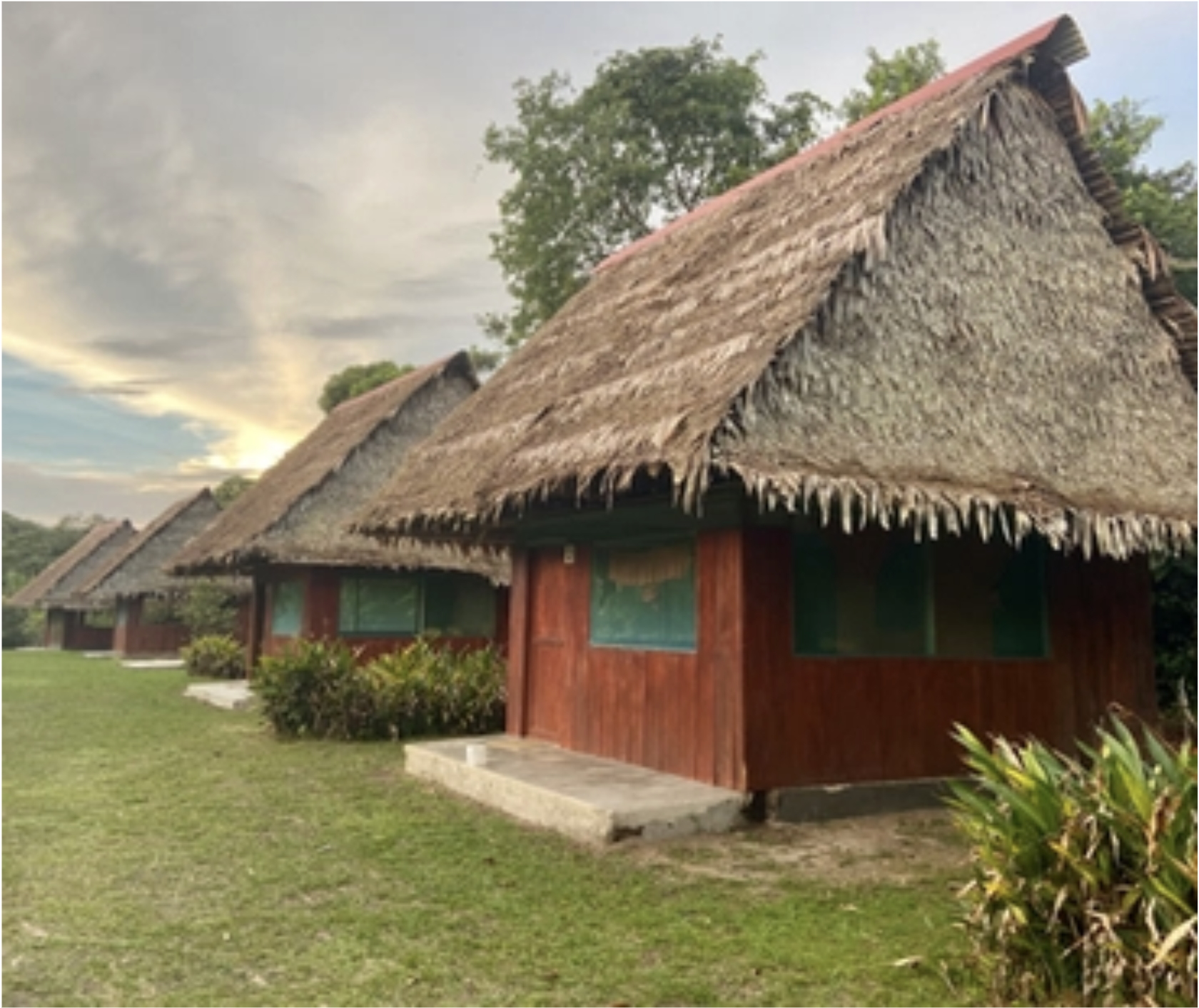 Guest lodging at Ayahuasca Selva Madre Retreat [Jirón, Peru]
The practical question is what lies behind the package. Does “support” mean an experienced nonclinical facilitator, a licensed therapist acting within a professional role, an on-call clinician, or peers who attended a previous retreat? Does “integration included” mean one closing circle, a scheduled series of individual meetings, or access to a large online group? Are additional substances and activities optional, and are they evaluated separately for risks? Provider interviews show why those details cannot be inferred from a broad marketing label. [40]
Commercial operation is not, by itself, proof of exploitation. People need compensation for skilled work, accommodation, and other services. But financial incentives can conflict with a participant’s needs when screening occurs only after a large nonrefundable payment, every difficulty leads to another purchase, or declining a ceremony jeopardizes access to care. Transparent terms and separation between sales and safety decisions are therefore important evaluation questions. [21] [22] [39]
Regulated adult-service models
Oregon’s psilocybin services system and Colorado’s natural medicine framework provide examples of state-regulated access that should not be collapsed into ordinary retreat tourism or conventional medical practice. Their rules define licenses, professional duties, preparation and administration processes, documentation, and other safeguards. A provider’s actual license and operating conditions must be checked rather than inferred from a statement that the state has “legalized psychedelics.” [41] [42]
In Oregon, a psilocybin facilitator license is not itself a medical or psychotherapy license. The rules distinguish facilitation from other professional activities and address the circumstances in which a person with another license may provide additional services. Colorado separately recognizes facilitator and clinical facilitator roles; the latter depends on relevant secondary professional licensure and its scope. These distinctions affect what assessment, treatment, and follow-up a participant can reasonably expect. [43] [42]
A regulated session can be embedded in a larger travel or wellness itinerary, but the surrounding package does not acquire a blanket authorization from the licensed component. Accommodation, excursions, other substances, and unrelated services each need to be understood separately. The right question is not simply whether the organization has a license, but whether the particular people, location, products, and services being offered fall within it. [44] [45]
Clinical, medically supervised, and clinical-adjacent programs
Some residential or immersive programs include medical assessment, psychotherapy, or administration of a drug under a prescriber’s care. Others use clinical language without providing a clearly defined clinical service. “Medically supervised” can describe very different arrangements, from a clinician continuously present with appropriate equipment to someone available remotely. It should prompt questions about actual duties, qualifications, coverage, and emergency capability—not close the inquiry. [46] [47] [48]
Ketamine-based programs and ibogaine programs require particular care in this comparison. Their pharmacology, evidence, legal positions, and medical risks differ from those of classic psychedelic ceremonies. A well-designed nonmedical retreat is not necessarily equipped for an intervention requiring intensive medical assessment or monitoring. Nor does a medical professional’s involvement establish that a whole program has been tested for a claimed outcome. [8] [49] [47]
The separate clinical-care pathway is the appropriate place for detailed comparisons of diagnosis-specific treatment, prescribing, and medically supervised protocols. This retreat guide addresses clinical overlap so readers can identify it accurately, not so every retreat can be redescribed as a treatment center.
Research retreats and investigational programs
A research study may take place in a retreat-like environment. The mindfulness-retreat study discussed later is an example. Such a setting can include randomization, eligibility restrictions, defined products, measurement schedules, independent research oversight, and limits on what participants receive. An inviting venue does not erase those scientific obligations. [50] [51]
“Research-informed” is different from “part of an authorized clinical trial.” A business may cite papers without collecting systematic data or operating under an approved protocol. A person considering research participation should receive the study’s own consent information and understand that participation is designed to answer a research question, not guarantee personal benefit. FDA guidance on clinical investigations is guidance for that research process, not a badge of approval that any retreat can adopt. [52]
Residential versus day programs; groups versus individuals
Length and group size are dimensions within these models, not independent proof of quality. Residential formats can allow more time for preparation, rest, and relationship-building, but can also intensify dependence on the organization for transport, food, communication, and emotional support. A day program may be less logistically immersive while still requiring careful preparation and discharge arrangements. The landscape study documents substantial variation in duration and format without establishing an optimal length. [3]
Group settings can provide shared understanding and companionship. They can also produce pressure to participate, disclose, or interpret an experience similarly to others. Individual sessions may provide more focused attention but still contain power imbalances and boundary risks. Observational evidence concerning group connectedness should not be converted into a claim that one format is universally safer or more effective. [53] [18] [39]
|
Model or description |
What to establish |
What not to assume |
|
Traditional or Indigenous context |
Particular community, authority, relationships, consent, and benefit-sharing |
That a borrowed ceremony proves community authorization |
|
Religious or sacramental setting |
Religious commitments and the exact legal basis for the activity |
That religious identification creates a universal exemption |
|
Commercial wellness or ceremonial retreat |
Actual services, staff roles, screening, costs, and follow-up |
That “healing” or “therapeutic” means licensed treatment |
|
State-regulated services |
Current licenses, location, permitted activities, and professional scope |
That state authorization changes federal law or approves every component |
|
Clinical or medically supervised program |
Responsible clinicians, assessment, monitoring, continuity, and evidence |
That one clinician’s involvement validates the whole program |
|
Research participation |
Study authorization, protocol, consent, and participant protections |
That research participation guarantees treatment benefit |
These distinctions synthesize the retreat research, clinical
guidance, ethics literature, and jurisdiction-specific sources. They are
categories for asking better questions, not ratings of particular providers. [50][3][29][5][22][54][38][41][42]
3. Why context matters: set, setting, relationships, and meaning
Psychedelic experiences do not occur in a vacuum. Pharmacology matters, but so do expectations, emotional state, the physical environment, the conduct of other people, and the meanings available within a culture. The term set and setting is useful because it draws attention to those conditions. It becomes misleading when it is used to imply that a sufficiently positive mindset can neutralize a dangerous drug interaction or make an unsafe organization safe. [55] [56] [57]
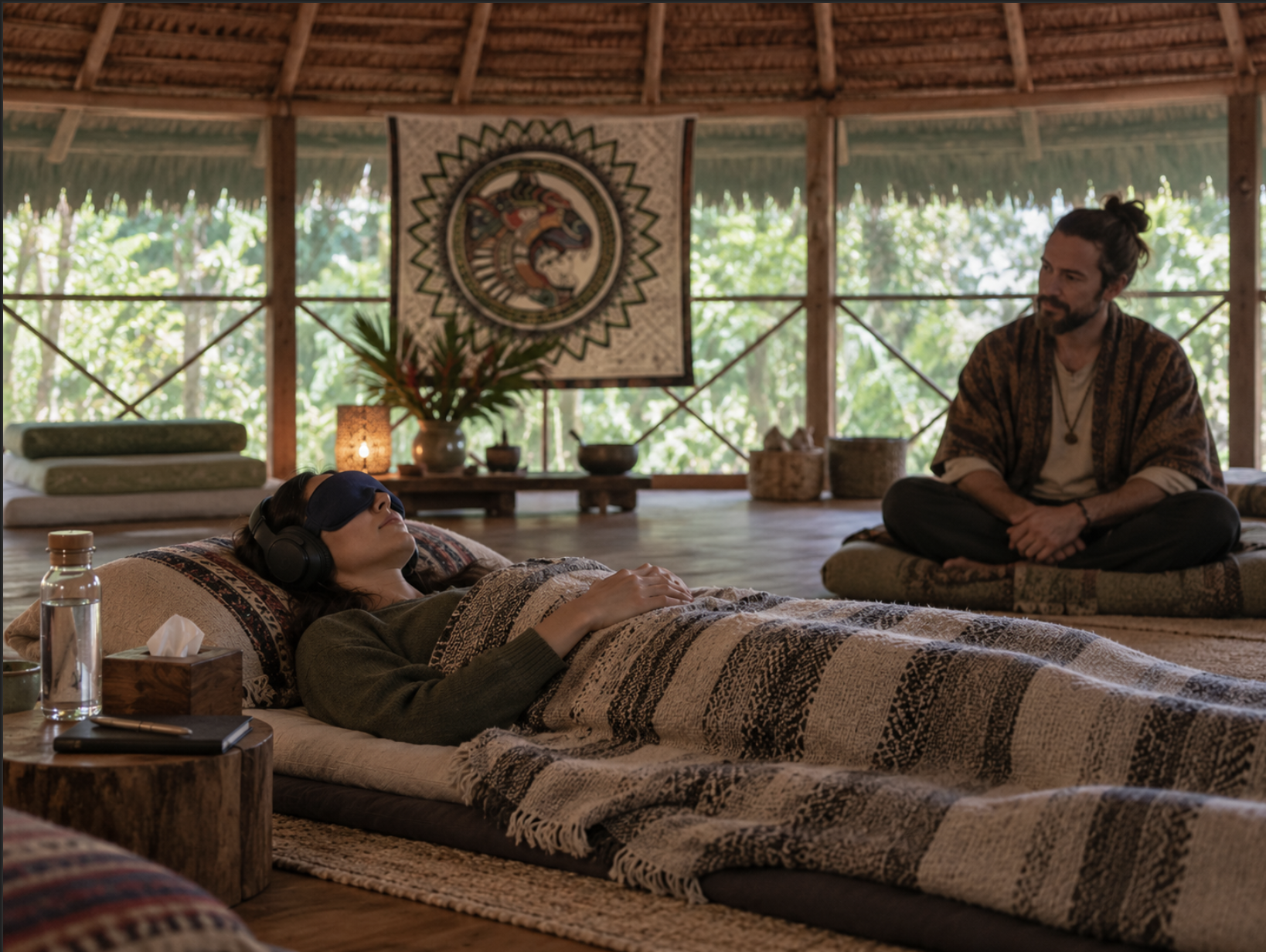 Set and setting include both the participant’s internal state and the physical, social and relational environment surrounding the experience.
Set is not a test of moral readiness
“Set” commonly refers to the person’s psychological and social starting conditions: expectations, intentions, concerns, prior experiences, current distress, relationships, and ways of making sense of events. These are not simply positive or negative. A person can be hopeful and frightened, curious and uncertain, spiritually committed and skeptical. Preparation should make room for that complexity rather than demand an ideal emotional state. [56] [58] [22]
It is especially important not to blame an adverse experience on a participant’s failure to surrender, insufficient positivity, or hidden resistance. Context can influence an experience without making the participant responsible for every outcome. The provider remains responsible for appropriate boundaries, honest information, competent support, and responding to health concerns. Studies of challenging and extended experiences also show that difficulty cannot be reduced to one simplistic explanation. [59] [60] [39]
Intentions can orient attention, but they are not instructions that a drug must obey. Wanting insight into grief does not ensure that grief becomes the central theme. Wanting calm does not prevent fear. A flexible intention leaves room for an experience to be confusing, ordinary, or unlike the stories a person has heard. The goal of preparation is not to engineer a particular revelation or teach a participant to reinterpret every outcome as success. [61] [58] [18]
Setting includes more than a beautiful room
The physical setting includes light, sound, temperature, movement, bathrooms, privacy, accessibility, and the ability to obtain help. The social setting includes who is present, how they behave, what authority they hold, and whether someone can ask for a change without embarrassment. The broader setting includes the organization’s values, commercial incentives, cultural claims, and relationship to local law and community. [56] [4] [30]
A forest, beach, or mountain landscape may be meaningful to a participant, but scenic surroundings are not a substitute for manageable hazards and reliable emergency access. Conversely, a plain room can offer privacy, predictable conditions, and adequate support. The relevant comparison concerns the environment’s actual functions, not whether it looks sufficiently spiritual or medical in photographs. Research safety guidance and regulated-service rules both attend to practical environmental conditions. [62] [63] [45]
Some seemingly small details have significant consequences for agency. Can someone use a bathroom without crossing an unsafe path? Is there a private space for a conversation? Can a participant communicate in a language they understand? Can they reduce stimulation without being interpreted as uncooperative? These questions translate general safety and consent principles into the everyday experience of being at a retreat. They do not establish a universal architectural standard. [20] [64] [22]
Group connection can help—and can also exert pressure
Kettner and colleagues studied communitas, a sense of togetherness and shared humanity, in naturalistic group psychedelic settings. Greater reported communitas was associated with later improvements in well-being and social connectedness. The study is useful precisely because it takes the interpersonal dimension seriously, rather than treating everyone’s experience as an isolated pharmacological event. [11]
However, an association does not show that group bonding caused the improvements, that every participant benefited, or that strong group feeling reliably identifies a trustworthy leader. People can feel deeply connected while still needing privacy, disagreement, or distance. A cohesive group can make it easier to ask for help, but it can also make it harder to say, “This was not good for me.” The ethical task is to preserve both belonging and the right not to conform. [53] [22] [39]
Group agreements are therefore most useful when they are concrete. They can address confidentiality, unsolicited advice, physical contact, interruptions, pressure to share, and how to request individual support. A statement that the group is a “family” does not explain those boundaries. A participant should not have to earn care through emotional disclosure or demonstrate loyalty by adopting the group’s explanation of events. [64] [22] [65]
Music, ritual, and interpretation
Music and ritual can organize attention and give experiences a shared structure. In traditional settings they may have meanings and obligations that cannot be understood merely as techniques for producing a psychological effect. In other settings they may be selected for comfort, atmosphere, or a particular therapeutic theory. Understanding which role they serve is part of informed participation. [56] [30] [32]
This also raises questions about interpretation. Does a facilitator offer possibilities, or declare what a participant’s images must mean? Are spiritual explanations presented as one framework, or as facts that override the participant’s judgment? Can a person retain their own religious, secular, or uncertain position? Qualitative work on transformation and consent makes these questions particularly important when an experience can feel exceptionally convincing. [66] [18]
A responsible conversation can honor a powerful experience while distinguishing what was felt, what is inferred, and what has independent evidence. That distinction matters when an experience seems to reveal facts about another person, a medical condition, a past event, or an obligation to make a major life change. The person does not need to dismiss the experience in order to allow time, discussion, and corroboration. [66] [67] [22]
Context is part of the intervention, not a guarantee
The practical implication is that a retreat should be evaluated as a complete arrangement: substance, preparation, people, environment, activities, interpretation, and aftercare. It is not enough to borrow an efficacy result for one molecule and place it beside a photograph of a ceremony. Naturalistic research can help study these arrangements, but many studies do not describe them adequately enough to support precise comparisons. [3] [16] [61]
That uncertainty should invite better questions rather than either romantic certainty or blanket dismissal. A participant may value a setting for cultural, spiritual, relational, or personal reasons that are not reducible to a symptom score. Those reasons can coexist with demands for truthful claims, appropriate support, and clear limits on what the organization knows. [30] [31] [32]
4. What the evidence can—and cannot—tell us
There is no single body of evidence called “psychedelic retreat science” that validates every retreat. The relevant literature includes controlled clinical trials, naturalistic surveys, prospective observational studies, qualitative interviews, ethnography, toxicology, professional guidance, and legal materials. Each can answer some questions better than others. Treating them as interchangeable produces both exaggerated benefit claims and misleading claims about danger. [68] [69] [70]
A practical evidence map
A randomized clinical trial is designed to compare specified conditions in selected participants. A prospective naturalistic study can examine change over time in a real-world setting, but people usually choose the experience themselves and many influences change together. A retrospective survey can reveal experiences that deserve attention, while being vulnerable to recall and selection biases. A qualitative interview can illuminate meaning, agency, and unmet needs without estimating how common an outcome is. [69] [70] [71] [72]
A case report or case series can identify a serious safety signal even when it cannot establish the rate of that event. A professional guideline can articulate responsible practice without proving that every recommendation has been tested in a trial. A law defines permissions and duties, not the clinical effectiveness of a service. An Indigenous organization’s statement is an authoritative primary source for that organization’s position, not a replacement for a population study or the voice of all communities. [73] [74] [75] [76] [41]
|
Evidence type |
Especially useful for |
Important limit |
|
Controlled clinical trial |
Comparing a specified intervention and comparator |
Selected participants and protocol may differ greatly from a retreat |
|
Prospective naturalistic study |
Observing changes and contextual associations over time |
Self-selection and concurrent influences complicate causal claims |
|
Retrospective survey |
Identifying reported benefits, harms, and patterns |
Recall, recruitment, and missing respondents affect interpretation |
|
Qualitative or ethnographic research |
Understanding meaning, relationships, culture, and agency |
Does not by itself estimate prevalence or treatment effectiveness |
|
Case reports and toxicology |
Detecting and investigating potential hazards |
Cannot yield an overall risk rate without an appropriate denominator |
|
Guidelines, regulations, and primary statements |
Practice expectations, legal duties, or organizational positions |
Authority in one domain is not proof in every other domain |
This map is a reading aid. The value of a source depends on
the question, not simply on whether it occupies a higher or lower position in a
universal hierarchy. Cultural meaning and institutional authority, for example,
cannot be settled by a symptom-reduction trial. [70][75][35]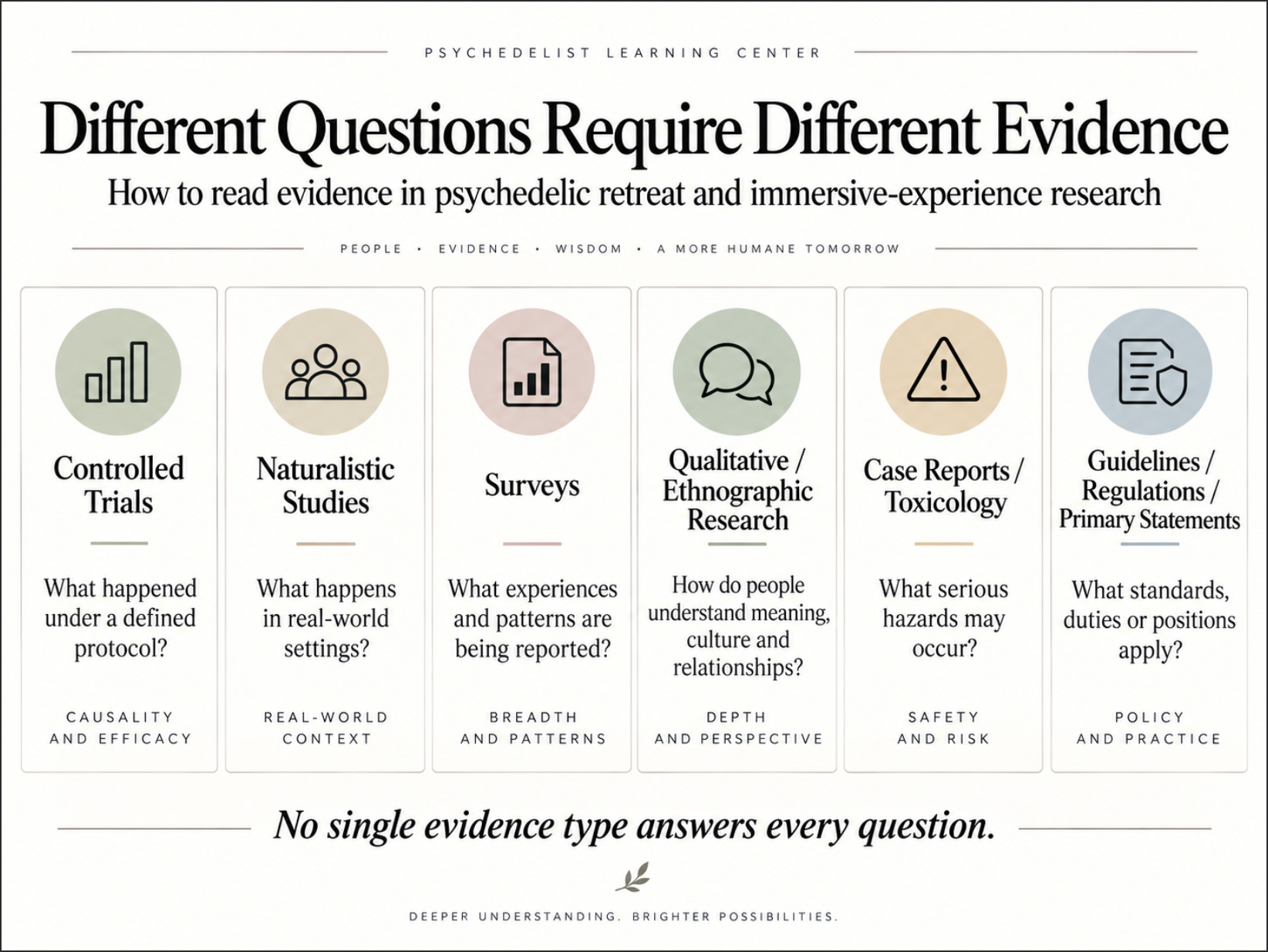
What the retreat landscape study actually found
The 2025 landscape analysis identified 298 organizations advertising psychedelic retreats to English-speaking consumers, encompassing 648 distinct retreat offerings and 440 physical locations. Its underlying online information was collected from July through December 2023. Ayahuasca was the most commonly offered substance, followed by psilocybin and San Pedro. Duration, price, geographical reach, organizational identity, and the number of offerings varied substantially. [77]
Those findings establish diversity, not a current census. The sample was shaped by what could be found online and in English. It does not represent every community practice, private organization, language group, or unadvertised experience. Nor did reading a website verify that an organization consistently implemented its advertised safeguards. An absent description on a website is not always proof that a practice is absent; an impressive description is not proof that it occurs. [77]
The study also distinguishes organizations offering several substances across their business from a particular retreat combining several substances. That distinction matters. A company with separate ayahuasca and psilocybin programs is not the same as an itinerary offering both to the same participant. For an actual booking, the complete planned experience needs to be clarified rather than inferred from the organization’s overall menu. [77]
What the safety-practices study adds
McGuire and colleagues’ 2026 paper examined interviews with representatives of 49 publicly advertised retreat organizations. The interviews took place in 2023. All reported collecting medical histories, but practices differed in how information was used, which conditions led to exclusion, who provided health oversight, and how preparation and integration were arranged. The paper describes reported practices, not independent inspections or a trial of their effectiveness. [24]
One particularly important finding concerned medication washouts: 43 organizations required or recommended them, with substantial variation. That is evidence that the practice was widespread in this sample—not evidence that the recommendations were medically appropriate. A study of what providers do must not be misread as guidance about what a participant should do with prescribed medication. [78] [9]
The staffing findings require similar care. The paper discusses organizations working with people who were licensed health professionals or had emergency training. Those categories should not be collapsed into “a doctor on site.” Only 21 organizations reported working with a licensed health professional, and physician presence was reported by a smaller subset. Even the presence of a qualified professional does not specify continuous coverage, responsibility, available equipment, or whether that professional directs decisions. [46]
All interviewed organizations described some form of integration, but its format, cost, optionality, and the qualifications of those delivering it varied. The lesson is not that the word is meaningless. It is that a prospective participant needs the service described in concrete terms: who, when, how often, in what format, at what cost, and with what referral capacity. [79]
Naturalistic outcomes are informative but difficult to attribute
Carvalho and colleagues’ scoping review mapped 103 naturalistic studies. Cross-sectional surveys were common, ayahuasca was especially prominent, and contextual details were inconsistently reported. These limitations make it difficult to compare experiences that share a substance name but differ in preparation, music, group structure, facilitator involvement, additional activities, and follow-up. [70]
A retreat can change many things at once: daily demands, sleep opportunities, social contact, expectations, environment, substance exposure, and access to supportive attention. An observed improvement afterward may involve several of those changes. Without an appropriate comparator, it is difficult to know how much each contributed or what would have happened without attendance. This does not make the improvement unreal; it limits the claim that can be made about its cause. [15] [16] [61]
Longitudinal research improves on asking someone only how they remember feeling beforehand, but it still faces attrition. People who respond to follow-up may differ from those who do not. Participants with very positive experiences may be more eager to respond; those with difficulties may either seek a chance to report them or disengage entirely. A trustworthy interpretation asks how the sample was recruited, how many were followed, and whose experience may be missing. [80] [16] [81]
Large sample size does not automatically solve these problems. The Global Ayahuasca Survey provides valuable information about context, perceived outcomes, and adverse experiences, but it remains a self-selected survey. Several papers can analyze different aspects of the same underlying project; those papers should not be counted as independent replications merely because they have different titles. [82] [83]
Two controlled examples that help define the boundary
In the Goodwin trial, 233 adults with treatment-resistant depression received a defined synthetic psilocybin formulation in one of three dose groups with psychological support. The primary comparison favored the highest-dose group over the low-dose control at three weeks, while the longer-term findings and adverse events required a more qualified interpretation. This is evidence about that studied intervention, not about every mushroom product, facilitator, retreat setting, or participant seeking personal growth. [84]
Palhano-Fontes and colleagues studied ayahuasca in 29 patients with treatment-resistant depression using a randomized placebo-controlled design. The study found short-term antidepressant effects under its clinical conditions. Its small sample, short principal follow-up, defined procedures, and clinical population matter. The result cannot establish that a multi-night commercial retreat treats every disorder listed on its website. [85]
These trials are useful in a retreat guide because they explain why a person might be interested in psychedelic experiences and why clinical research attracts attention. They also illustrate what is lost when an advertisement reduces a trial to “science proves our medicine heals depression.” Product, population, support, comparator, follow-up, and outcome definition are part of the evidence—not optional footnotes. [52] [69] [86] [85]
What placebo-controlled retreat studies suggest
A small study of 30 experienced participants in ayahuasca group retreats compared ayahuasca with placebo and found that depression, anxiety, and stress measures improved over time in both groups. The authors examined the contribution of context and expectations. The study does not prove that pharmacology is irrelevant; it shows why improvement after a retreat cannot automatically be assigned to the drug alone. [87]
Another small controlled study combined psilocybin with a structured mindfulness retreat and examined self-consciousness, brain connectivity, and later psychosocial changes. It provides a valuable research example of a deliberately structured immersive setting. It does not establish that ordinary retreats reproduce the same conditions, or that a brain-imaging result demonstrates permanent repair, enlightenment, or superior functioning. [88]
Safety evidence needs the right denominator
Hinkle and colleagues’ review analyzed adverse-event information from 114 studies involving 3,504 participants in monitored research or clinical settings. Serious events were not reported in the healthy samples included in that analysis, but occurred in some participants with preexisting neuropsychiatric disorders. Many studies had weaknesses in systematic adverse-event assessment or reporting. “Not reported” is not identical to “could not occur.” [89]
The review of acute psilocybin effects by Yerubandi and colleagues included six randomized trials and 528 participants. It identified increased risks of several acute symptoms, including headache, nausea, anxiety, dizziness, and elevated blood pressure, depending on the outcome examined. These results help describe treatment-day effects in the studied populations. They do not supply a reliable rate of serious complications in unregulated retreats or answer every question about delayed problems. [90]
At the other end of the evidence spectrum, Evans and colleagues recruited 608 people who reported extended difficulties after psychedelic use. Their accounts illuminate anxiety, disconnection, problems making sense of experiences, and unmet support needs. Because difficulty was part of recruitment, the proportion with a particular problem cannot be applied to all users. Similarly, Carbonaro and colleagues asked respondents about their most challenging mushroom experience; that design does not measure the risk per ordinary session. [91] [10]
A balanced conclusion is more useful than either “these substances are safe” or “the surveys prove most people are harmed.” Risk depends on the substance, person, setting, co-exposures, and available response, while the evidence itself differs in what it measures. Some hazards, especially ibogaine-related cardiac concerns, warrant a distinct level of attention rather than being averaged into a general psychedelic category. [92] [7] [8] [49]
Reading an outcome claim before trusting it
When a program reports a success rate, ask what success means. Is it satisfaction, completion, a participant’s impression, change on a validated scale, remission of a diagnosed condition, reduced substance use, or something else? When was it measured? Were all participants contacted? Who assessed the outcome? Were harms and dropouts included? Was the information collected independently? A percentage without those details is difficult to interpret. [80] [16]
There is also a difference between evidence for a substance, evidence for a class of services, and evidence for a particular organization. A provider cannot establish the effectiveness of its own package simply by listing respected journals. Equally, a program may be honest about limited evidence while providing clear information, appropriate boundaries, and responsible support. Scientific modesty should not be mistaken for a lack of care; exaggerated certainty should not be mistaken for expertise. [50] [93] [48]
5. Different substances mean different experiences and risks
A retreat’s substance list is not simply a menu of alternative routes to the same result. Compounds differ in pharmacology, duration, physical effects, interaction risks, and the evidence available about them. Plant preparations also vary in their constituents and cultural roles. The names used in marketing may refer to a molecule, a plant, a mixture, a religious sacrament, or an experience associated with a particular tradition. Clarifying those differences is a basic part of informed consent. [55] [94] [95] [96] [18]
The following descriptions are orientation, not instructions
for selecting doses or combining substances. A provider should identify what is
actually offered, the source and preparation, the route of administration, any
additional ingredients, and the processes used to understand composition and
potency. A familiar name cannot substitute for that information. [97]
[94]
[21]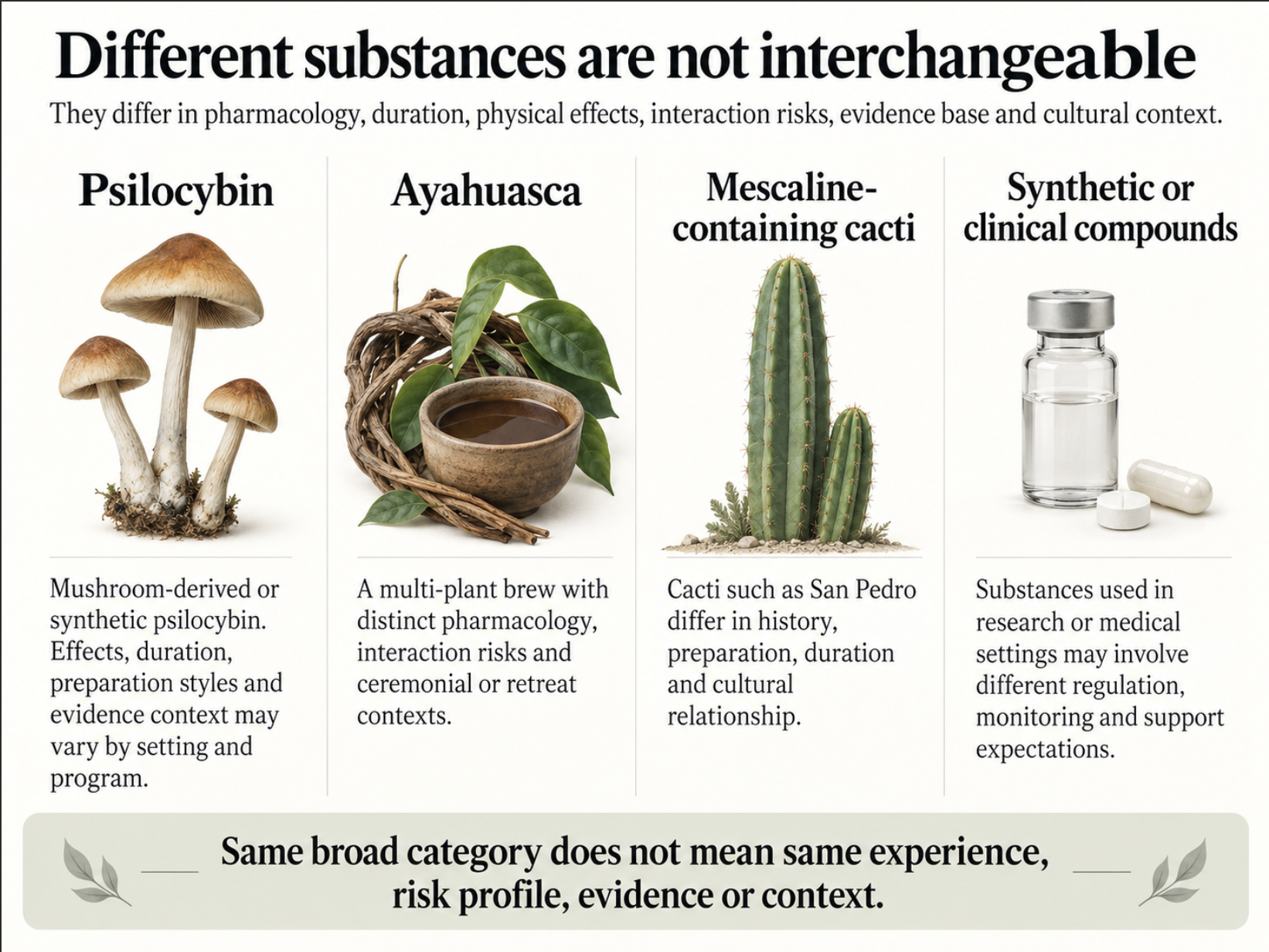
Psilocybin: research evidence is not a mushroom-retreat guarantee
Psilocybin is converted in the body to psilocin, a compound associated with its psychedelic effects. Experiences can include changes in perception, emotional intensity, sense of self, time, and meaning. Clinical research usually studies a defined product and protocol, while retreats may use fungal material or other preparations whose composition and practical administration differ. Those distinctions matter when a retreat cites a study using a pharmaceutical formulation. [55] [86] [98]
Participants may seek insight, connection, or relief from psychological distress. The clinical literature provides reasons to investigate those possibilities, including the depression trial discussed earlier. It also documents acute adverse effects and the importance of screening, preparation, supervision, and follow-up. A program’s use of psilocybin does not establish that its approach has the same benefits or safeguards as the studied intervention. [6] [99] [100]
“Natural mushrooms” and a measured active compound are not interchangeable units of information. A reader does not need a dosing formula to recognize that product identity, potency assessment, and an individualized professional decision process are more informative than a promise of a standard journey. Similarly, calling an experience a “microdose” or “gentle dose” does not answer questions about the product, interactions, participant vulnerability, or the intended degree of impairment. [97] [55] [101]
In a regulated Oregon service setting, rules address product testing, labeling, permitted products, and service delivery. Those rules apply within that system; they should not be assumed to describe products at an unrelated retreat elsewhere. When comparing programs, identify the actual regulatory and quality-control arrangements rather than transferring assurances from a different jurisdiction. [101]
Ayahuasca: a preparation, a practice, and multiple contexts
Ayahuasca commonly refers to a brew involving the Banisteriopsis caapi vine and a DMT-containing plant admixture, although recipes, names, and meanings vary. Beta-carbolines in the preparation inhibit monoamine oxidase activity and affect the way orally consumed DMT is metabolized. The whole preparation cannot be understood simply as “natural DMT,” and its effects cannot be separated from the other constituents and the setting in which it is used. [94] [102]
The context may be Indigenous, religious, mestizo healing, contemporary commercial ceremony, or a hybrid. These are not interchangeable versions of one timeless practice. Research on ayahuasca tourism and globalization describes how practices are adapted to visitors and how Western expectations can reshape what is offered. A prospective participant should understand which practice they are entering and how the organization represents its relationships to local practitioners and communities. [4] [103] [104]
Vomiting and nausea are prominent in reports of ayahuasca use, and some traditions interpret aspects of the experience through purification or cleansing. Respecting that interpretation does not establish that vomiting removes toxins or heals disease. Nor should a cultural explanation prevent a provider from recognizing concerning physical symptoms or obtaining medical care. A physical event can have personal or ritual meaning and still require health assessment. [105] [7] [106]
Ayahuasca also deserves a particularly careful medication review because of its pharmacology. Interaction risks cannot be addressed by a generic instruction to stop all psychiatric medication for a set period. The particular medicine, preparation, other exposures, medical history, and consequences of changing treatment all matter. A retreat’s customary practice is not a substitute for individualized advice from a qualified clinician. [105] [107] [108]
The Global Ayahuasca Survey and other naturalistic studies contain reports of both benefits and adverse experiences. Some participants regarded difficult periods as part of subsequent growth, while others needed support. It would be inaccurate to translate all reported difficulties into psychiatric diagnoses, just as it would be inaccurate to conclude that a positive later interpretation makes every harm acceptable. [12] [109]
DMT and 5-MeO-DMT are not the same substance
The similarity of the names can create confusion. N,N-DMT and 5-MeO-DMT are chemically related but distinct compounds with different pharmacological and experiential profiles. Ayahuasca is also not interchangeable with an isolated DMT exposure. Labels such as “DMT experience,” “toad medicine,” or “bufo ceremony” should be clarified rather than treated as sufficiently precise descriptions. [55] [94] [95]
5-MeO-DMT experiences can be very rapid and intense, with profound changes in the sense of self and ordinary orientation. A brief acute phase does not mean that supervision is less important or that psychological adjustment is complete when the most obvious effects end. The literature describes reactivations and other subacute experiences, alongside reports of benefit and potential adverse reactions. [95]
A naturalistic survey of 362 people who used 5-MeO-DMT in a particular group setting found self-reported improvements among respondents who described depression or anxiety. That finding is relevant to research, but it is not a randomized demonstration that a retreat treats either condition. A 2024 review of three early clinical trials, totaling 78 participants, reported no serious adverse events in those small studies. That is too limited a basis for a general promise of safety in a commercial setting. [13] [110]
Combining 5-MeO-DMT with monoamine oxidase inhibitors raises particular concerns in the interaction literature. A program offering several substances during one stay should have a medically defensible assessment of the entire sequence, not separate assurances that each substance is safe when considered alone. The absence of a known problem in a provider’s previous guests does not establish the safety of a combination. [95] [108]
There is also a sourcing question. 5-MeO-DMT may be associated with secretion from the Sonoran Desert toad or with synthetic material. The review literature raises ecological and animal-welfare concerns about expanding demand for toad-derived material. “Natural” does not establish superior safety, cultural authenticity, or a need to obtain material from animals. An ethical sourcing discussion should not become a recommendation to use a particular product. [111]
Mescaline, San Pedro, and peyote
Mescaline is a psychedelic compound found in certain cacti. San Pedro and peyote are different plants with distinct histories, cultural relationships, and conservation questions. Referring to both as mescaline does not erase those differences, just as identifying a chemical constituent does not define the meaning of a ceremony. [96] [30] [112]
The modern therapeutic evidence for mescaline is less developed than the popular language around “heart opening” or other predictable effects may suggest. A review of the literature describes substantial historical interest and continuing research questions. Participants should be cautious about programs that turn a commonly reported experiential quality into a guaranteed emotional outcome or a treatment claim. [113]
A study of long-term peyote use among Navajo members of the Native American Church found no significant deficits on the psychological and cognitive measures examined compared with a minimally exposed comparison group. The authors explicitly cautioned about generalizing beyond the studied context. The result is not evidence that a short tourist ceremony reproduces the same social setting, nor does it settle legal, ecological, or community-consent questions. [114]
IPCI’s position is especially important here: the organization frames peyote conservation in relation to Indigenous sovereignty, sacred use, land access, and protection from commercial exploitation. Its submission should be read as an Indigenous-led organization’s position, not reduced to a consumer preference for one cactus over another. Substituting a different plant is not a complete answer to questions about appropriation, stewardship, or respectful participation. [115]
Iboga and ibogaine require a distinct medical discussion
Iboga-related traditions and contemporary ibogaine treatment businesses should not be treated as one category. Ibogaine is a psychoactive alkaloid associated with Tabernanthe iboga and is used in some settings with the aim of interrupting problematic substance use. The medical literature describes serious cardiac concerns, including effects on cardiac ion channels and prolongation of the QT interval, which can create a risk of dangerous arrhythmias. [116]
This is not a small variation on the risk profile of an ordinary wellness retreat. A forensic review identified 19 deaths temporally associated with ibogaine ingestion outside West Central Africa from 1990 through 2008. Contributory medical conditions and other substances were important in many cases. The series cannot establish a mortality rate, and temporal association is not identical to sole causation, but it clearly undermines claims that the intervention is inherently harmless. [73]
A monitored observational study of 14 patients with opioid use disorder found clinically important QTc prolongation, bradycardia, and severe transient ataxia. Half reached a QTc above 500 milliseconds during observation, and some abnormalities persisted beyond the initial monitoring period. No torsades de pointes occurred in that small study, but the finding does not mean that medical screening or monitoring removes the hazard. [117]
A person considering an ibogaine program needs assessment by appropriately qualified medical and addiction professionals, attention to ongoing treatment needs, and a credible plan for complications and continuity of care. A normal-looking environment, reassuring testimonial, single test result, or promise of a “reset” is not enough. The evidence discussed here does not establish a one-session cure for addiction or justify replacing ongoing care with a retreat package. [8] [118] [49]
Readers seeking a detailed comparison of ibogaine treatment programs should use a dedicated medical-safety resource and individualized clinical advice. The role of this guide is to make the boundary unmistakable: an intervention with documented cardiac hazards should not disappear into a generic menu of consciousness experiences.
Ketamine, MDMA, LSD, and mixed offerings
Ketamine is pharmacologically distinct from classic serotonergic psychedelics and has a different clinical and regulatory history. A ketamine program should be evaluated as a health service with clearly identified prescribing, assessment, monitoring, and follow-up responsibilities. An immersive setting may accompany that service, but it does not replace those responsibilities or establish the effectiveness of additional wellness components. [119] [47]
MDMA and LSD also should not be treated as interchangeable with psilocybin or ayahuasca. Research involving one compound, population, and treatment structure does not validate another compound in a different setting. Where a retreat advertises a less familiar substance, the absence of a detailed discussion in this guide should be taken as a reason to seek substance-specific evidence, not as reassurance that risks are minor. [55] [119] [57]
The key information is the complete offering: each substance, every optional add-on, any proposed sequence, and the qualifications of whoever decides whether participation is appropriate. “Our facilitators have done this many times” is not the same as a documented understanding of interaction risks or the capability to manage an emergency. [29] [9] [21]
6. Safety is a system, not a reassuring adjective
Safety discussions often focus on whether a substance is physically toxic or whether a participant might have a frightening experience. Those are important questions, but they are incomplete. Risks can arise from the interaction between the substance, a person’s health, other drugs, the environment, supervision, power relationships, and what happens after departure. A retreat can perform well in one area and poorly in another. [6] [89] [120] [60] [39]
A useful model distinguishes prevention, recognition,
response, and continuity. Prevention includes screening and a manageable
environment. Recognition means noticing when events exceed what staff can
responsibly support. Response means obtaining the right help without delay.
Continuity concerns what happens after the immediate session, including
records, follow-up, referrals, and accountability. This is a practical
synthesis of the safety and professional-guidance sources, not a guarantee that
any system eliminates risk. [121] [5]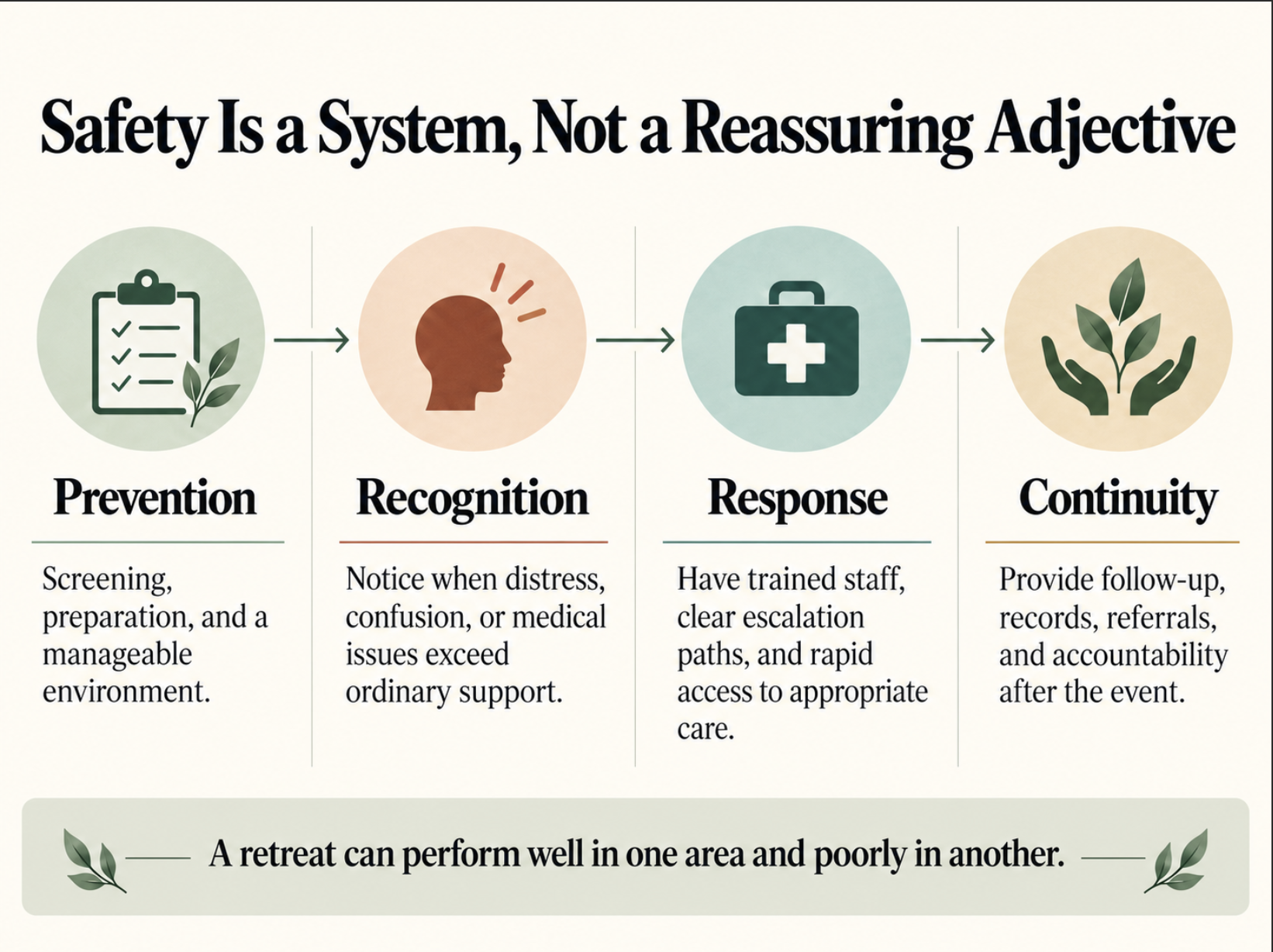
Acute psychological effects and distress
Fear, confusion, intense emotion, altered perception, and changes in the sense of self can occur during psychedelic experiences. These states may be experienced as meaningful, frightening, both, or neither. Their significance cannot be determined solely by how dramatic they look to other people. A quiet participant may still be distressed, and a person who cries or expresses strong emotion is not automatically experiencing a medical emergency. Competent support requires attention to the individual rather than a rigid script. [122] [59] [64]
The phrase “a challenging experience” can help avoid labeling every difficult moment a failure. It can also become a way of minimizing an event that involved panic, injury, humiliation, abandonment, or a boundary violation. A provider should not require a participant to accept a positive interpretation before receiving care. Later meaning and immediate protection are different tasks. [59] [60] [39]
Some distress can be supported through calm presence and reducing unnecessary stimulation, within the provider’s competence. Some situations require medical or psychiatric evaluation. A retreat should be able to explain how staff distinguish these possibilities, who makes that decision, and what they do when uncertainty remains. A commitment to preserving a ceremony must never become a rule against outside help. [122] [123] [124] [125]
Physical effects and medical events
The relevant physical concerns differ across substances. Clinical and naturalistic reports describe symptoms such as nausea, vomiting, headache, dizziness, changes in blood pressure or heart rate, and impaired coordination. Some may be anticipated within a protocol; others may indicate a more serious problem, particularly in a vulnerable person or with an interacting exposure. The fact that an effect is familiar to a facilitator does not make it benign in every participant. [90] [7] [8] [117]
Severe chest symptoms, difficulty breathing, seizures, loss of consciousness, serious injury, or marked deterioration need an urgent professional response. A participant should not be expected to determine the cause while impaired. These examples are reasons to seek emergency assessment, not a complete diagnostic checklist and not instructions for staff to manage a complication without appropriate clinical training. [7] [8] [118] [123]
Emergency readiness includes mundane operational details. Is communication reliable? Can a vehicle or emergency team reach the site? Is the receiving service identified? Who stays with the participant, and who remains responsible for other guests? How will the actual substances and known medications be communicated? A vague statement that a hospital is nearby is not the same as a workable transfer plan. [20] [123] [124]
Environmental and supervision risks
Impaired coordination, altered attention, and disorientation can make otherwise ordinary surroundings hazardous. Research safety guidance emphasizes controlled environments and preventing unsupervised movement into danger. For a retreat, this translates into questions about roads, water, balconies, fires, uneven terrain, bathrooms, and privacy—not an assumption that nature is unsafe or that indoor settings are automatically safe. [126] [120]
Sufficient staffing means more than a favorable ratio in an advertisement. It involves whether staff are available, competent, able to communicate, and capable of responding when more than one person needs help. A group’s head count may include cooks, drivers, trainees, or people not assigned to participant supervision. Ask how roles are counted and how coverage changes during breaks, overnight periods, illness, or an emergency. This is a practical application of the variability documented in provider reports. [46] [64]
The team’s own state also matters. Some traditions have particular practices involving ceremonial leaders’ use of medicine; regulated and clinical frameworks may require different arrangements. A prospective participant should not assume all models use the same rules. The essential questions are who remains able to provide reliable practical supervision, who can activate emergency care, and whether the plan complies with the governing law and professional duties. [126] [30] [127] [128]
Delayed and persistent difficulties
Not every important outcome is visible before checkout. People may report continuing anxiety, sleep problems, changes in perception, feeling unreal or disconnected, confusion about identity or belief, or difficulties returning to ordinary relationships. Studies of extended difficulties demonstrate that these experiences deserve attention even when no immediate medical crisis occurred during administration. They do not establish that such problems are inevitable or common in every setting. [95] [81]
A retreat’s safety process should therefore reach beyond its closing circle. Can participants report concerns after leaving? Who responds, how quickly, and with what qualifications? Is the organization prepared to recommend independent help instead of insisting that only its own facilitators understand the experience? Is there a process for learning from negative outcomes? Follow-up can reveal problems that enthusiastic departure-day feedback misses. [129] [81] [123]
Interpersonal harm belongs in the safety picture
A technically well-run session can still be unsafe if the setting permits sexual misconduct, coercion, financial exploitation, discriminatory treatment, or misuse of private information. These are not secondary concerns to be considered only after pharmacology. Psychedelic vulnerability can increase the importance of boundaries and accountability, including in environments that describe themselves as therapeutic. [130] [39]
The existence of a code of ethics is only the beginning. Ask how concerns are reported, whether someone outside the immediate facilitation team can receive them, what happens if a leader is accused, and how the participant is protected from retaliation. Care should not depend on preserving the institution’s reputation. A participant’s later gratitude does not retroactively authorize conduct that violated their boundaries. [131] [132]
7. Screening, health conditions, and medication decisions
Screening is not a formality between paying a deposit and being admitted. Its purpose is to determine whether the proposed experience is appropriate for this person, in this setting, with the available level of support. Responsible screening can lead to more information, a referral, a different arrangement, a delay, or a decision not to proceed. A process that always ends in acceptance deserves scrutiny. [6] [133] [134] [135]
Information collection is not the same as evaluation
The safety-practices study found that all interviewed organizations collected medical histories, but their exclusion criteria and practices varied. A long questionnaire can look impressive while leaving unclear who reads it, what expertise they bring, or how they resolve concerns. The relevant question is what happens to the information after submission. [40]
A prospective participant should know who is responsible for evaluation and what additional assessment may be needed. Are current medications reviewed by someone qualified to understand them? Can the program request records or communicate with a treating clinician with consent? What happens when a condition falls outside a facilitator’s competence? Clinical guidance and regulated-service rules emphasize scope and referral rather than assuming that every facilitator can answer every health question. [133] [134] [135]
Accuracy matters in both directions. Participants should not be encouraged to omit diagnoses, conceal medication use, or minimize symptoms to qualify. Programs also should not imply that an online form gives comprehensive medical clearance. The consequences of incomplete information can include an inappropriate setting or an unrecognized interaction. A clear privacy explanation helps people disclose relevant information without fear that it will become group material or marketing content. [9] [133] [130]
Mental health needs require particular care
Research protocols and clinical guidance commonly consider a history of psychosis, mania, bipolar-spectrum illness, current instability, suicidality, and certain family histories when evaluating risk. The exact criteria vary by substance and protocol. These concerns should not be reduced to an internet checklist that declares every person with a diagnosis permanently eligible or ineligible. They require an appropriately qualified assessment of the actual situation. [6] [136] [133]
The psychosis literature includes reports associated with ayahuasca or DMT in people with identifiable vulnerabilities and some without known prior risk factors. That supports caution, not a precise individual prediction. Absence of a previous diagnosis is not proof of absence of risk. Conversely, having experienced trauma or psychological distress does not mean a person is incapable of informed choice. The question is whether the proposed service can responsibly address the person’s needs. [136] [18] [34]
A retreat is not an appropriate substitute for urgent assessment when someone is in an acute psychiatric crisis or cannot remain safe. A promised breakthrough should not postpone needed care. Programs serving people who hope to address depression, trauma, or addiction should be especially clear about whether they provide clinical treatment, who is responsible for it, and how they respond to deterioration. [6] [8] [123]
People already in therapy or psychiatric care may benefit from discussing the proposed experience with their clinicians, including the possibility that the clinician has concerns or limited familiarity with psychedelics. The goal is not to obtain a rubber stamp. It is to make relevant information available and protect continuity. A provider who demands a complete break with existing care as a condition of belonging raises an important autonomy and safety concern. [137] [138] [130]
Physical health and special circumstances
Medical history can matter even when a retreat’s stated purpose is spiritual or recreational. Cardiovascular concerns, blood-pressure problems, seizure history, liver or other systemic disease, recent illness, and conditions affecting mobility or safe self-care may change what assessment and support are needed. The relevance differs by substance; ibogaine’s cardiac hazards are not adequately addressed by a general psychedelic questionnaire. [6] [107] [8] [49] [133]
Pregnancy, breastfeeding, and other circumstances with limited safety evidence should not be treated as safe because a product is natural or traditionally used. A lack of controlled research is a reason for a careful clinical discussion, not a basis for reassurance. Oregon’s informed-consent material, for example, explicitly notes uncertainty about risks during pregnancy or feeding with breast milk. That is an Oregon disclosure requirement, not a complete clinical answer for every substance. [139]
Accessibility also belongs in screening and planning. A person may need assistance with movement, communication, personal care, sensory access, or managing a disability. Those needs should be discussed respectfully and specifically, without assuming that disability itself makes participation inappropriate. It is equally important not to promise access that the actual site, staffing, or legal framework cannot provide. Regulated rules distinguish some support-person functions from facilitator functions. [140] [141]
Medication review is not a universal washout schedule
The interaction literature includes antidepressants, antipsychotics, mood stabilizers, anxiolytics, other prescribed drugs, and recreational substances. Findings vary: some combinations may alter intensity, some may present safety concerns, and some have limited or inconsistent human evidence. The available studies do not justify one simple rule for everyone taking a psychiatric medicine. [57]
Three questions need to be separated. First, could there be a pharmacological interaction? Second, could the medicine change the subjective or therapeutic response? Third, what might happen if the person reduces or stops the medicine? A retreat that focuses only on making an experience more intense may neglect the health consequences of destabilizing an existing treatment. [57] [133]
Do not stop, reduce, restart, or substitute prescribed medication on the strength of this guide or a generic retreat instruction. The prescribing clinician should be involved in individualized decisions. A provider may decide that its program cannot accommodate a person’s current treatment; that is different from instructing the person to change treatment to fit the program. [9] [137]
A signed statement that a participant accepts risk does not turn an unqualified person into a prescriber. Nor does asking for “medical clearance” resolve every issue unless the clinician knows the proposed substances, additional activities, setting, and relevant responsibilities. The scope and content of a consultation matter more than the existence of a form. [133] [22] [135]
Multiple substances and repeated ceremonies
Some organizations offer several psychedelic substances or additional psychoactive practices during one stay. The landscape and provider studies show that these arrangements are part of the market, but do not establish that they are safe or more effective. Each proposed exposure should be understood within the complete itinerary, including earlier substances, current medications, sleep, physical condition, and the available response to complications. [77] [78] [9]
A participant should not be expected to agree in advance that they will complete every ceremony regardless of how they respond. More sessions are not automatically more therapeutic, and a difficult first experience does not prove that another exposure is necessary to “finish the work.” The sources reviewed here do not establish an optimal commercial-retreat sequence or number of administrations for individual growth or symptom relief. [16] [21] [142]
It is useful to ask whether later participation is genuinely optional, whether a qualified person reassesses concerns, and whether declining changes access to accommodation or support. These are practical consent questions. A full itinerary should not become a commitment that overrides changing health needs. [21] [142]
8. The rest of the program matters: adjuncts, fasting, and “detox” claims
A psychedelic may be the headline attraction while the surrounding package adds other meaningful exposures. These can include tobacco snuffs, frog secretions, intensive breathwork, fasting, heat-based practices, supplements, and strenuous activities. The safety evaluation must address the actual combination. Evidence about a psychedelic alone does not validate every practice bundled with it. [77] [78] [143] [144] [19] [9]
Kambo is not a classic psychedelic or an established cleansing treatment
Kambo involves secretions from the frog Phyllomedusa bicolor and is sometimes presented in wellness language as cleansing or preparation. It is not a classic serotonergic psychedelic. A review of acute poisoning cases describes potentially serious toxicity and underscores why “natural” is not a sufficient safety claim. This evidence does not establish a therapeutic detoxification benefit. [143]
A participant should be told exactly what a proposed adjunct involves, why it is offered, who is qualified to evaluate its risks, and whether participation is optional. An explanation that it “opens the body for the medicine” is not equivalent to clinical evidence of benefit or a medical assessment. A dangerous reaction should not be dismissed as proof that cleansing is working. [143] [22]
The same principle applies to seemingly preparatory practices more broadly: they need their own justification. A retreat should not be able to avoid scrutiny by calling an intervention a ritual add-on rather than part of the main program.
Rapé, tobacco, and other preparations
Rapé is a name used for diverse snuff preparations. In a chemical analysis of sampled products, researchers documented substantial variation and identified nicotine and other potentially harmful constituents in tobacco-containing products. The analysis also included preparations without tobacco. It would therefore be inaccurate to assume either that every product is nicotine-free or that every preparation bearing the name has the same composition. [144]
The practical question is ingredient disclosure. “Sacred tobacco” describes a cultural or ceremonial relationship; it does not eliminate pharmacological exposure. A participant should not have to infer what a product contains from the way it is presented. The chemical study is relevant to identifying exposure and uncertainty, not to predicting a specific person’s clinical outcome from a particular product. [144]
Breathwork and non-drug practices
Some breathing interventions have been associated with reductions in stress and other psychological outcomes in randomized studies. Fincham and colleagues’ meta-analysis found encouraging results while noting limitations and the need for stronger research. Different methods were studied, and the findings do not establish that every practice described as breathwork has the same effects or risk profile. [145]
Gentle, adaptable breathing instruction should not be conflated with intense or prolonged hyperventilation-based practices. Nor does evidence for a standalone intervention automatically support combining it with a psychedelic, heat exposure, fasting, or a physically demanding schedule. The provider should describe the actual method and how suitability is assessed, rather than cite the general benefits of breathing. [19]
Non-drug options can offer worthwhile ways to explore attention, emotion, or connection without psychedelic administration. They should be evaluated honestly, not presented as risk-free because no controlled drug is involved, or as second-class choices for people who are supposedly afraid to do deeper work. [19] [130]
Diets, fasting, and physical preparation
Some traditions have dietary practices with cultural, spiritual, or relational meanings. Those meanings deserve accurate explanation. They should not be presented as universally established biomedical requirements, and a culturally significant diet should not be reduced to a simplistic claim about clearing toxins or guaranteeing an experience. Ethnographic and pharmacological sources describe diversity rather than one standard ayahuasca diet. [105] [146] [147]
A practical evaluation asks whether food restrictions, fasting, supplement use, or other preparation could interact with a participant’s medical needs. Who can discuss accommodations? What happens if a person cannot safely follow a prescribed restriction? A program should not pressure someone to ignore individualized health advice to demonstrate commitment to the retreat. That conclusion follows from basic safety and informed-consent principles, not from a universal diet protocol in the evidence. [133] [22] [148]
The same reasoning applies to “detox” marketing. The term should be translated into a specific claim: what substance is supposedly being removed, by what mechanism, with what evidence, and with what risk? For someone physically dependent on a drug or alcohol, changing use is a clinical issue rather than a wellness challenge. A retreat should accurately distinguish supportive accommodation from medically responsible management. [8] [149] [21]
Optional must mean optional
Consent to a retreat is not consent to every intervention introduced after arrival. Optional activities should be described before payment and reconsidered without pressure when the participant is present. This includes substances, bodywork, fasting, group disclosure, recordings, and physical challenges. A person should not discover only after traveling that refusing an add-on is treated as disrespect, resistance, or a failure to participate properly. [21] [142]
A useful decision rule is to evaluate each component independently and then evaluate the combination. A compelling cultural explanation, promising paper, or positive previous experience with one component cannot stand in for the rest of that work. [16] [9] [22]
9. Who is responsible? People, competence, and accountability
A retreat is experienced through relationships. The person answering an initial inquiry, the person reviewing health information, the ceremonial leader, the overnight support worker, and the person offering integration may all be different. A recognizable founder or an impressive advisory board does not tell a participant who will actually be present. Understanding responsibility means identifying the working team and the limits of each role. [46] [20] [48]
Experience is relevant, but not sufficient by itself
A person can have extensive personal experience with psychedelics without being competent to screen participants, recognize a medical emergency, respond to trauma, maintain boundaries, or organize safe group care. Conversely, a professional healthcare credential does not automatically establish competence in psychedelic facilitation or familiarity with a particular ceremonial context. Appropriate competence concerns the actual work being performed. [48] [150]
Phelps's proposed therapist-training framework describes qualities including empathetic presence, the ability to support trust, knowledge of psychedelic effects, self-awareness, and ethical integrity. It also considers how practitioners work with spiritual material and complementary techniques. These are useful dimensions for examining preparation and supervision, but the framework is not a universal licensing standard or proof that a person displaying the vocabulary has developed the skills. [151]
For a prospective participant, a practical conversation might explore how a facilitator responds when someone disagrees with an interpretation, declines an activity, becomes frightened, or needs care outside the facilitator's scope. Answers grounded in specific responsibilities and referral arrangements are more informative than claims to have guided thousands of journeys. Experience should be accompanied by reflection, supervision, and the ability to acknowledge limits. [48] [152]
Traditional expertise should also be described on its own terms. Who taught the practitioner? What responsibilities come with that training? What community recognizes the role? Those questions should not be replaced with a demand for an invented Western certificate. At the same time, traditional recognition does not establish medical licensure or competence to manage a particular health condition. Respecting different kinds of expertise requires identifying them accurately. [30] [31]
Titles should be translated into verifiable roles
The terms guide, facilitator, coach, healer, therapist, physician, and clinical facilitator are not interchangeable. Some are descriptive or commercial labels; some are regulated titles within a particular jurisdiction. A certificate from a private training program is different from a government-issued license, and neither should be described as something it is not. Oregon and Colorado illustrate how specific legal definitions can govern facilitator roles, while clinical practice involves additional scope-of-practice considerations. [48] [43] [42]
Ask for the full name, professional title, relevant jurisdiction, and license information of anyone being presented as a healthcare professional. Ask what that person will actually do during the retreat. A physician who occasionally advises an organization is not necessarily the physician responsible for participants. A psychotherapist providing a later optional call is not automatically supervising the administration session. [46] [48]
The same clarity should apply to trainees and volunteers. Being present as a trainee can be a legitimate part of an organized educational program, but participants should know the person's status, supervision, and access to confidential information. Agreeing to receive services from a qualified practitioner is not identical to agreeing to be observed by students. Regulated frameworks make this distinction explicit. [153] [154]
Medical involvement needs an operational description
The phrase "medical support" can mean a clinician on site, a remote consultation, an arrangement with a nearby clinic, a staff member with first-aid training, or little more than the availability of a public ambulance service. These are materially different. The retreat-provider study found varied forms of health-professional and emergency-response involvement; it did not establish one consistent standard across organizations. [46]
An operational description identifies who makes screening decisions, who can assess new symptoms, who is physically present during administration, and what happens overnight or between ceremonies. It also explains whether a clinician has reviewed the complete itinerary, including additional substances and practices. A contact number alone does not answer those questions. [46] [133]
For a program involving substantial medical risk, the gap between the services advertised and the services available can become decisive. Ibogaine research, for example, documents cardiac concerns even in screened and monitored participants. The appropriate response is not to treat an attractive facility or a general medical affiliation as sufficient reassurance. It is to establish the relevant clinical responsibility, monitoring capability, emergency pathway, and continuity of care. [8] [118] [49]
No article can audit that capability from a website. Written information can clarify an organization's claims, but actual competence and implementation require more than the presence of a policy. This is why transparency is a starting point for evaluation rather than a certificate of safety.
Staffing is about attention, coverage, and backup
A staff-to-participant ratio is useful information, but it is not a complete safety measure. The relevant questions include how many staff are available at the same time, what roles they hold, whether any are also participating, how breaks are covered, and what happens when two people need individual attention simultaneously. A nominal ratio can look favorable while failing to describe the actual distribution of attention. [46] [20] [64]
A group also needs a plan for an individual who requires quiet, privacy, or more intensive support. Who stays with that person, and who remains responsible for the rest of the group? Is there an appropriate space? Can a participant receive help without being exposed to public interpretation or treated as a disruption? These questions translate general safety principles into the realities of group care. [126] [64] [65] [155]
The evidence base does not establish a universal safe ratio for all substances, populations, doses, settings, and activities. A numerical requirement in a state rule applies within that rule's framework; it should not be exported as a scientific guarantee for every retreat. Adequacy depends on the participants and the services actually offered. [65] [155]
Accountability should survive disagreement
A responsible arrangement explains how concerns can be raised, who reviews them, what records exist, and what independent avenues are available. Participants should not have to bring a complaint only to the person whose conduct is in question. The ethics literature on psychedelic care identifies the importance of power imbalances, professional boundaries, and institutional responses to misconduct. [131] [132]
Ask how the organization handles a report of unwanted touch, a screening error, an unexpected adverse event, or misleading marketing. Does it distinguish an unfavorable review from a safety complaint? Does it preserve relevant information? Does it explain the role of external regulators or professional boards where they apply? These are practical questions about accountability, not assumptions that every organization has the same legal reporting obligations. [131] [132] [156] [125]
It is equally important to avoid putting responsibility for preventing misconduct on the participant. A person can ask careful questions and still encounter wrongdoing. The duty to maintain appropriate conduct belongs to the practitioner and organization. A participant's admiration, vulnerability, desire to please, or altered state does not excuse a boundary violation. [132]
10. Consent, touch, privacy, and the use of power
Informed consent is not merely a signature collected before a ceremony. It is a process through which a person understands what is proposed, can ask questions, recognizes meaningful alternatives, and can make decisions without coercion. Psychedelic contexts make the process especially important because an experience may affect perception, judgment, emotional openness, and the ability to communicate preferences. [21] [22]
A consent process can acknowledge that some aspects of an experience cannot be fully predicted without making uncertainty an excuse for vagueness. A participant may not know exactly what an altered state will feel like, but they can still be told what substances and procedures are planned, who will be present, what support is available, what the known risks and uncertainties are, and what boundaries will apply. [18]
Consent begins before the financial commitment
A person should receive material information early enough to use it. Learning after paying a large nonrefundable deposit that a program requires medication changes, an additional substance, a religious commitment, or group disclosure can constrain a decision that was supposed to be voluntary. Clear description of services, costs, risks, and withdrawal arrangements is therefore part of meaningful choice, not simply customer service. [21] [22] [157]
The conversation should distinguish participation in the overall retreat from consent to individual components. A person might agree to accommodation and preparation but decline administration. They might agree to a group ceremony but not to being filmed. They might welcome verbal support but not touch. These are separate decisions and should be recorded and respected separately. [21] [142] [158] [157]
Financial arrangements need similar clarity. What happens if screening indicates the program is unsuitable? What happens if illness develops shortly before travel? What support remains available if a participant decides not to take another dose? A refund policy cannot remove all disappointment, but it can prevent avoidable pressure and ambiguity. These are suggested comparison questions; the specific legal rights depend on the contract and jurisdiction. [22] [159]
A person can change their mind without proving a reason
Preparation can establish preferences and boundaries, but it cannot convert later silence or compliance into unlimited consent. A participant may withdraw consent to touch or another optional activity. They should not have to demonstrate that their refusal is rational enough, spiritually informed enough, or consistent with the intention they set earlier. Consent is not a reward for correctly interpreting the experience. [21] [142] [158] [160]
At the same time, withdrawing consent cannot instantly reverse a substance already taken. Lee and colleagues discuss the ethical difficulty of consent in an unpredictable and potentially transformative treatment. A realistic explanation must distinguish stopping an optional intervention from ending pharmacological effects. The program still needs to provide appropriate support and respond to safety needs. [18]
Advance discussion can make communication easier. Participants can identify words or gestures for requesting space, asking for support, or stopping touch. Staff can explain how they will check in without repeatedly overwhelming the person. Such arrangements support communication; they do not entitle staff to ignore clear discomfort because a particular phrase was not used. [161] [162] [160]
Supportive touch is optional, not a test of trust
Touch may be experienced as grounding or comforting, but it may also feel distracting, intrusive, or unsafe. Ham and colleagues analyzed 39 interviews with 18 participants from a psilocybin-assisted therapy trial that permitted protocol-defined supportive touch. Participants' responses varied, and acceptability was closely related to preparation, consent, the therapeutic relationship, and sensitivity to individual experience. This qualitative study does not show that touch is necessary or that it improves outcomes for everyone. [163]
A useful discussion describes the forms of touch being proposed, the body areas involved, who may initiate it, and how it will stop. It also considers alternatives: verbal reassurance, a change in distance, a quiet presence, or another agreed form of support. The purpose is to make choice usable, not to persuade the participant to accept contact. [161] [162]
In regulated systems, additional restrictions may apply. Oregon and Colorado have specific rules concerning advance consent and permitted forms of touch; their requirements are not identical. The relevant rules should be checked rather than replaced with an organization's general statement that it uses "therapeutic touch." Neither a private certificate nor a participant's request expands a practitioner's legal scope. [164] [160]
An important safeguard is to establish the permissible scope before administration rather than negotiate broader contact in the altered state. That does not mean a participant loses the right to say no. It means a prior agreement should not be used as a platform for escalation when decision-making and communication may be more difficult. Emergency contact needed to prevent immediate injury is a separate matter and should be explained without making the exception so broad that it swallows ordinary boundaries. [161] [142] [160]
Sexualized conduct is not therapeutic permission
The literature on sexual violations in psychedelic-assisted therapy describes conditions that can make exploitation particularly serious: unequal power, intense trust, altered states, vulnerability, and the authority attributed to a practitioner. These concerns are relevant to evaluating retreat relationships even though the professional and legal structures may differ. [39]
A claim that sexual contact will release blocked energy, complete a healing process, or demonstrate trust does not turn exploitation into treatment. Nor does an account of profound mutual connection erase a practitioner's responsibilities. The participant should not be asked to keep conduct secret because others supposedly cannot understand the spiritual context. Ethical standards address relationships and power, not only overt force. [161] [165]
Boundaries matter after the retreat as well. Intense attachment, gratitude, disappointment, or a desire for continuing guidance can make the transition home emotionally complicated. A provider should explain how ongoing communication, social contact, referrals, and personal relationships are handled. Legal rules may specify particular prohibitions or time periods; expiry of a legal minimum should not be presented as proof that a relationship is ethically unproblematic. [131] [166] [167] [168]
A person who experiences unwanted contact or other misconduct does not owe the organization continued participation or a particular interpretation of what happened. Independent support may be important, and an institution's account should not be treated as the only legitimate account. Responsibility for a violation rests with the person who committed it and with any institutional failures, not with a participant who was unable to resist or articulate a boundary. [132]
Trauma-informed does not mean trauma treatment
SAMHSA's trauma-informed framework emphasizes recognizing trauma, attending to safety, and avoiding practices that can recreate disempowerment. It distinguishes an organization-wide trauma-informed approach from interventions specifically intended to treat traumatic stress. That distinction remains useful when evaluating retreat claims. [169]
A provider can adopt respectful, choice-preserving practices without being qualified to diagnose or treat posttraumatic stress disorder. The label "trauma-informed" should therefore be translated into observable processes: how consent is obtained, how privacy is protected, how a participant can decline, how staff respond to distress, and how specialist referrals are arranged. It is not evidence that a psychedelic retreat is an established trauma treatment. [48] [170]
Strong emotion should not become a reason to force catharsis, confrontation, restraint, or public disclosure. Likewise, emerging images or a powerful sense of recognition should not be treated by a facilitator as independent verification of historical events. A participant deserves room to reflect without being pressed toward a diagnosis, memory claim, or worldview supplied by someone else. Non-directive and ethically bounded practice is particularly relevant when people are highly receptive to suggestion. [171] [131] [130]
Privacy includes the group, the record, and the camera
Privacy is not exhausted by a promise that staff will be discreet. Who receives the intake form? Where are health records stored? Do volunteers, visiting practitioners, external integration providers, or technology services have access? Are sessions photographed or recorded? Can identifiable material later be used in promotion or training? These questions should be answered before participation. [64] [172] [173]
Consent to a recording for one purpose should not be treated as consent to all purposes. Safety review, practitioner supervision, research, and advertising are distinct uses. A person may be comfortable with one and not another. The retention period, access arrangements, and limits on later withdrawal should be explained accurately, without promises the organization cannot keep. [174] [173]
Group confidentiality has inherent limits because other participants are not the same as regulated professionals. A group agreement can set expectations, but it cannot guarantee that every participant will comply. Colorado's rules expressly recognize this problem. Sharing circles should therefore allow people to choose the depth of disclosure rather than making detailed personal testimony a condition of belonging. [175]
The ethical question is not whether publicity might help others discover the retreat. It is whether the person depicted or described has freely consented to the specific use, with appropriate understanding and without the pressures of the immediate experience. An emotionally charged testimonial should not substitute for a considered decision about public exposure. [131] [132]
11. Preparation before arrival: understanding, choice, and support
Preparation is often described as setting an intention. That can be one useful part of the process, but it is too narrow a definition. Preparation also includes understanding the program, assessing suitability, clarifying communication and boundaries, planning practical support, and knowing what happens if the experience does not match expectations. It should begin early enough for those decisions to affect whether participation occurs. [171] [58] [22]
A well-prepared person is not someone who has eliminated uncertainty or learned the correct way to have an experience. Preparation is more realistically about making uncertainty manageable and choice meaningful. It should reduce avoidable surprises without scripting an outcome that the participant then feels obliged to produce. [15] [58]
Clarify the goal without turning it into a promise
A person may be seeking reflection, connection, spiritual exploration, a change in habits, or relief from distress. Naming that goal helps identify whether the proposed setting and staff are appropriate. Someone primarily seeking treatment for a serious health condition needs a different discussion from someone considering a general experiential retreat. The provider should be able to explain where its role begins and ends. [1] [2] [58]
An intention can be open-ended: making space to reflect on a difficult transition, approaching emotions with curiosity, or understanding a recurring pattern. It need not become a demand to recover a particular memory, achieve a mystical state, forgive someone, stop a medication, or make a major life decision. An expectation that a single event must deliver transformation can increase disappointment and make it harder to report a mixed experience honestly. [15] [17] [18]
Preparation should also consider alternatives. A person might choose ordinary psychotherapy, a culturally grounded community activity, a non-drug retreat, time away without an intensive program, or no intervention at this point. The existence of alternatives is part of consent; considering them does not imply that a person has failed to commit. [21] [22]
Discuss the range of possible experiences
A program should explain that effects can include changes in perception, emotion, bodily sensation, attention, and sense of self, with substantial variation between people and occasions. A quiet experience, an emotionally difficult one, an unfamiliar spiritual interpretation, or an absence of the anticipated breakthrough can all require thoughtful support. A promotional montage is not an adequate orientation. [171] [55] [59] [17]
It is especially useful to discuss what staff will do when someone is frightened or confused. Will they offer calm reassurance? How is a request for less interaction handled? What are the limits of confidentiality? How is an emergency distinguished from distress that can be supported in the setting? The purpose is not to rehearse every possible event, but to replace vague trust with an understandable plan. [171] [123]
The program should avoid presenting suffering as a required route to benefit. Some difficult experiences are later interpreted positively; others are associated with continuing difficulties. The challenge literature does not establish that a worse experience is a better treatment or that the participant must remain in an unsafe situation to obtain growth. [59] [81]
Meet the relevant people and establish communication
A preparatory conversation with the person who will actually provide support is more informative than communication only with a sales representative. It gives both parties an opportunity to identify expectations, language needs, cultural assumptions, and practical concerns. Where substitutions are possible, participants should know how they will be informed and how consent will be revisited. [58] [176] [157]
A participant can discuss preferences about music, proximity, touch, silence, spiritual language, and group participation. Not every preference will be possible in every program, but the response can reveal whether the organization treats the person as an active participant or simply expects them to fit the format. Preferences should be discussed alongside safety needs rather than treated as absolute guarantees. [171] [58] [162]
Communication needs may include interpretation, hearing or visual accommodations, access to assistive devices, or help understanding documents. The broader principle is that a signature is not meaningful evidence of understanding when the information was inaccessible. Accessibility and cultural responsiveness are explicit concerns in professional guidance and regulated services. [21] [177] [140]
Prepare the return, not only the departure
Preparation should include a plan for the period after the retreat. Who knows where the person will be? Who can be contacted if support is needed? What professional care is already in place? What obligations will be waiting at home? A final group circle cannot substitute for anticipating those practical questions. [129] [137] [178]
This is also an opportunity to agree how existing care will continue. A participant should not feel required to conceal the retreat from a treating professional in order to preserve the retreat's preferred story. Honest communication about substances, symptoms, and ongoing treatment can be important to subsequent assessment. The harm-reduction and integration literature supports nonjudgmental professional engagement rather than making care contingent on approval of the decision to participate. [138]
Research does not establish one preparation package or number of hours that guarantees a good outcome. A 2026 meta-analysis of controlled clinical studies found an association between more preparation therapy and larger reductions in depressive symptoms, but preparation time was not randomized and the result was not a trial of commercial retreats. It supports taking preparation seriously, not selling a particular duration as an evidence-proven formula. [179]
The practical test is whether preparation changes the quality of the decision. By the end, the participant should better understand the program, its uncertainties, its limits, and their options. Feeling reassured can be helpful, but informed confidence is different from being persuaded that nothing can go wrong. [21] [22]
12. Travel, accommodation, accessibility, and the full cost
The conditions around a retreat can determine whether the support described on paper is usable. A remote setting may feel private and restorative while making transport, communication, and emergency access more complicated. A short program may be easier to fit into a work schedule while leaving little time to assess an unexpected reaction before departure. These are tradeoffs to examine, not reasons to assume that one location or duration is inherently best. [180] [20]
The questions in this section are practical planning recommendations derived from the safety, consent, and continuity principles discussed earlier. They are not a validated travel-safety instrument, an insurance interpretation, or a finding that a particular amenity improves psychedelic outcomes. Their purpose is to make the non-pharmacological parts of the decision visible. [121] [21] [22]
Location is more than the destination on the website
Ask for the actual place where services will occur, not just the country or the town used in advertising. Is the organization based in one country while operating a retreat in another? Does it use a permanent facility or rent different venues? Which entity receives payment, supplies accommodation, and provides the experience? The landscape study found that organizational bases and retreat locations did not always coincide. [180]
Location also affects the emergency plan. The relevant issue is not merely the distance to a hospital on a map, but how transport would be arranged, who would accompany the person, what information would travel with them, and who remains responsible for other participants. An organization should be able to discuss its real circumstances rather than offer a generic promise of access to care. [62] [20] [123]
A secluded setting can be attractive without isolation becoming a requirement. Consider whether participants retain access to their identification, essential belongings, independent communication, and a practical way to leave. A request to reduce phone use for reflection is different from obstructing outside contact or withholding documents. This distinction follows from autonomy and safeguarding principles; it is not a claim that every remote retreat restricts communication. [21] [130] [132]
Accommodation should match the actual support needs
Shared sleeping areas, bathrooms, meals, noise, lighting, and the distance between rooms and staff may matter during an emotionally or physically demanding stay. Ask how someone can rest or obtain privacy without becoming effectively unattended when support is needed. The setting should be understood in relation to the person, not judged only through photographs. [62] [20]
A program can describe whether people may remain in their rooms between activities, how staff can be contacted, and how privacy is balanced with necessary monitoring. It should explain any room-sharing requirements and whether support is available outside scheduled sessions. Overnight accommodation does not by itself imply overnight clinical observation. [79] [64]
Food and activity arrangements need similar scrutiny. Are dietary restrictions described before arrival? Can medical or disability-related needs be accommodated? Are physically demanding activities genuinely optional? The reasonable question is not whether a retreat can meet every need, but whether it will disclose its limitations before a participant commits. [133] [148]
Accessibility is part of the service, not an afterthought
Accessibility can involve physical movement, sensory needs, communication, cognition, language, and access to professional support. An attractive description such as "inclusive" does not establish that a bathroom, path, administration area, or emergency vehicle can accommodate an individual's needs. The relevant conversation should be specific and respectful. [64] [140]
Someone may need an interpreter, a support person, assistive equipment, or information presented in a different format. The organization should explain what is permitted, what is available, and whether additional consent or confidentiality arrangements are required. Oregon's framework, for example, addresses client support persons and accessibility within a defined licensed system. That does not establish equivalent arrangements at every retreat. [140]
Being told that a need cannot be accommodated can be disappointing, but an honest limitation is more useful than an assurance that the experience will make the need irrelevant. Disability should not be framed as a lack of readiness or willingness. Similarly, a cultural or religious preference should be explored without making assumptions about what every person from a particular background wants. [21] [148]
Compare the whole financial arrangement
A headline price may cover accommodation and ceremonies while excluding transport, screening consultations, translation, private support, extra nights, and post-retreat services. Other programs may bundle some of those items. The study of publicly advertised retreats documented wide variation in prices and incomplete online disclosure, but its historical data are not a current pricing guide. [180]
A useful comparison separates the program fee from possible additional costs and from the financial consequences of changing plans. Request the refund and cancellation policy, the conditions under which a program can cancel, and what happens when screening or a new health concern prevents participation. Where installment payments, financing, or third-party collection are involved, the terms deserve careful attention before signing. [22] [159]
Do not treat price as a proxy for safety, cultural legitimacy, or likelihood of benefit. A high price can reflect accommodation, location, marketing, exclusivity, or a range of services. A low price may be consistent with a community model, but it can also leave questions about staffing or follow-up. The package has to be examined rather than inferred from the amount charged. [180] [120]
The same caution applies to guarantees and refunds tied to outcomes. An organization cannot establish clinical effectiveness by promising another ceremony or credit if a participant does not feel transformed. A financial offer does not answer the underlying evidence and suitability questions. [15] [21] [22]
Insurance, transport, and an independent exit plan
Insurance coverage should be confirmed with the insurer for the actual activity, destination, and dates. Ask about relevant exclusions, emergency treatment, medical evacuation, and cancellation, and seek written clarification. An operator's assurance that "travel insurance covers it" is not an interpretation of the participant's policy. This is a practical verification step, not a statement that all policies include or exclude psychedelic-related events.
Plan arrival and departure around the program's actual responsibilities rather than assuming that a scheduled end time establishes readiness to travel. Ask how discharge decisions are made, what happens if someone is not ready to leave, and who pays for additional accommodation or care. Regulated and professional frameworks treat transportation and continuity as matters to plan in advance. [64] [181] [182]
An independent contact and a realistic alternative accommodation or transport plan can help preserve choice. They do not need to be expressions of mistrust. They are ways to avoid a situation in which a person feels unable to decline because the organization controls every practical aspect of the stay. The importance of that choice follows from informed-consent and safeguarding principles. [130] [132]
13. During the retreat: what a supported process can look like
There is no universal retreat sequence. A residential ceremonial program may differ substantially from a licensed day service, a contemplative retreat, or a medically supervised intervention. The account below describes functions that a participant can look for, not a promise that every program follows the same timetable or that these steps establish clinical equivalence. [180] [29] [64]
Arrival should confirm the agreement, not replace it
Arrival is an opportunity to confirm who is present, what has changed, how to obtain help, and whether the participant still wishes to proceed. Any material change in substance, staff, location, group format, or planned activity should be discussed. A person should not be expected to treat an unexpected substitution as something they already consented to when booking. [21] [142]
Health and safety information may also need updating. New illness, medication changes, poor sleep, or distress since screening can be relevant to whether a session should occur. Reassessment is different from repeating a form without considering its answers. A responsible process allows postponement or referral rather than making the schedule the overriding consideration. [171] [133]
Orientation can explain bathrooms, quiet spaces, emergency exits, communication arrangements, confidentiality expectations, and how participants can decline optional activities. These ordinary details can matter more than an elaborate opening ceremony when someone later needs assistance. They also make the program's promises concrete enough to question. [62] [176] [183]
The setting can support attention without controlling meaning
Music, lighting, a comfortable position, silence, and the presence of other people can influence the experience. Their effects are not identical for everyone. A setting can offer options and explain constraints while avoiding the claim that a particular playlist, room design, or ritual guarantees a particular psychological result. Set-and-setting scholarship emphasizes context, not a universal environmental recipe. [171] [56]
The facilitator's role may be quiet and responsive in one model and more active or ceremonially structured in another. What matters is that the role was accurately described and remains bounded by consent, competence, and safety. A participant should not be surprised to find that a supposedly non-directive service involves strong interpretation or demands for public participation. [58] [130]
A culturally grounded ritual may have shared meanings that are not reducible to individual preference. The appropriate response is transparency before participation: explain what the ritual requires, what can be adapted, and whether the setting is suitable for the visitor's expectations. Cultural specificity is not a reason to promise a completely customized experience, nor a reason to hide unavoidable features until the person is already altered. [30] [31] [32]
A strong experience does not establish a strong outcome
Some people encounter vivid perceptions, intense emotions, changes in their sense of self, or a powerful feeling of connection. Others describe subtler changes, ordinary thoughts, physical discomfort, confusion, or little of what they expected. The evidence does not provide a single correct experiential sequence that everyone should complete. [55] [59] [14]
It is useful to separate intensity from meaning and meaning from longer-term benefit. An intense event can be meaningful without resolving a clinical condition. A less dramatic event is not necessarily a failure. Nor should the participant be encouraged to seek greater intensity simply to match other people's accounts. Research associations between aspects of experience and later outcomes do not establish that intensifying the experience will improve the outcome for a particular person. [15] [11] [14]
That distinction can reduce social pressure in groups. A participant who does not report visions or profound insight should not feel required to create a narrative. A person who feels unsettled should not be expected to adopt the group's celebratory interpretation. Meaning can remain provisional, and some experiences may not lead to a clear story at all. [17] [21] [18]
Distress needs responsive support, not automatic interpretation
Frightening or confusing experiences may respond to calm presence, reassurance, and adjustments that were discussed beforehand. Foundational research-safety guidance emphasizes supportive interpersonal care and an appropriately managed environment. It also recognizes that medical or psychiatric assessment may be necessary when the situation exceeds ordinary session support. [122]
The distinction should not depend solely on whether a facilitator believes the experience is spiritually important. Significant physical symptoms, dangerous behavior, or an inability to maintain safety need appropriate assessment. A program must be willing to interrupt its preferred narrative and seek help. Protecting the ceremony's atmosphere or reputation is not a reason to delay care. [122] [7] [8] [123]
At the same time, not every emotional reaction should be treated as an emergency or forcibly suppressed. Support should be proportionate, respectful, and informed by training. The relevant skill is discerning what is happening and responding appropriately, including recognizing uncertainty and obtaining professional help when needed. Neither indiscriminate alarm nor indiscriminate reassurance is adequate. [122] [123]
Between sessions, there is still a duty of care
A multi-day itinerary can include rest, meals, group discussion, personal reflection, and further ceremonies. Those intervals are not simply empty time. The organization should explain how participants can report emerging concerns, how additional participation is reconsidered, and what care is available outside the formal administration period. [79] [137]
People may differ in how much conversation or group activity they want. Some may welcome connection; others may need privacy. An invitation to share can coexist with a real option not to speak. Group cohesion is not evidence that every participant's needs are being met, and a single person's difficulty should not be dismissed because most others appear satisfied. [53] [71] [64]
A later ceremony should remain a new decision, not an obligation created by the first one. Staff should not characterize declining as evidence of resistance that must be overcome. The source base does not establish that continuing a commercial sequence is necessary to resolve an unpleasant response. [16] [21] [142]
Departure should include a handover
A closing ritual or expression of gratitude can be meaningful, but it is not the same as a discharge process. The participant should know whom to contact, what follow-up is included, when it will occur, and how to seek help independently. Any relevant record of substances or significant events should be available in an understandable form, subject to applicable rules and privacy protections. [137] [181] [182]
Where clinical care has been involved, continuity needs to address the treating professional and any ongoing plan. Where the retreat is nonclinical, it should be especially clear that an integration contact is not necessarily equipped to manage a medical or psychiatric complication. Referrals should match the need rather than automatically directing every concern back to the same retreat team. [137] [178]
The end of the booked stay is an administrative date, not proof that the person has completed all psychological adjustment. A thoughtful handover makes room for benefit, uncertainty, and difficulty after departure without suggesting that the retreat must remain the participant's permanent source of authority. [71] [178] [184]
14. Integration: making room for what follows
Integration is widely used in psychedelic settings, but it does not name one standardized intervention. It can refer to reflection, emotional processing, applying insights, reconnecting with daily life, strengthening relationships, obtaining clinical care, or making sense of experiences within a spiritual or cultural tradition. Bathje and colleagues' conceptual analysis illustrates this diversity. A provider should describe what its own use of the term means. [185]
That diversity is not necessarily a weakness. Different
people may need different forms of support. The problem arises when a broad,
appealing term is used to conceal an undefined service or to imply that every
activity described as integration has demonstrated therapeutic efficacy. The
call for evidence-based integration asks for clearer models and empirical
evaluation rather than assuming that popularity establishes effectiveness. [186]
Integration can involve reflection, relationships, practical changes, community support or professional care; it is not one standardized intervention.
Integration can serve more than one purpose
For someone who had a positive experience, integration might involve considering how a sense of connection relates to ordinary relationships and responsibilities. For someone who feels uncertain, it might provide a place to explore competing interpretations without rushing to closure. For someone experiencing significant symptoms or loss of function, the priority may be assessment and appropriate treatment rather than extracting a lesson. These functions overlap, but they should not be collapsed. [71] [178] [184]
A helpful distinction is between support for meaning and adjustment and care for a clinical problem. A sharing circle, a coach, a community elder, and a licensed clinician can offer different kinds of help. None should be assumed to replace all the others. The person's needs and the provider's competence determine the appropriate role. [67] [138] [185]
Integration also need not be administered by the same organization that provided the retreat. Independent support can be particularly valuable when a person feels uncomfortable with the group's interpretation or has concerns about conduct. An approach that demands loyalty to the retreat as a condition of understanding the experience can undermine the autonomy it claims to support. [178] [130] [132]
What the research supports, and what it leaves open
Professional guidance generally gives preparation and follow-up important roles. Conceptual and clinical models describe plausible reasons to provide them. Those recommendations should be distinguished from proof that a specific integration package causes better outcomes than alternatives. Greń and colleagues' call for evidence-based integration highlights the need to study those questions directly. [67] [187] [188] [189]
The 2026 analysis by Florineth and colleagues examined psychological therapy quantity in 12 controlled psychedelic-assisted therapy trials involving 733 participants. More preparation therapy was associated with greater reduction in depressive symptoms, while the analysis did not identify a comparable association for all other therapy-quantity measures. These were comparisons across studies, not random assignment to different amounts of preparation or integration. [179]
It would be a mistake to turn that result into either a formula for how many hours a retreat should sell or a claim that integration is unnecessary. Trials differed in treatment, participants, methods, and how therapy was described. Time is also not the same as content or quality. The study informs a research question; it does not settle every practical question about support after a retreat. [190]
The provider study adds a different kind of information: organizations described varied integration formats, often including groups, online communication, or optional services. These reports characterize offerings, not their effectiveness. A statement that every interviewed organization offered some integration does not mean every participant received individualized clinical follow-up. [79]
Start with the person's present circumstances
Integration need not begin with a demand for a comprehensive account of the experience. It can begin with how the person is doing now: whether they feel able to manage daily responsibilities, whether relationships feel strained, whether they have unresolved questions, and whether they need professional assessment. The harm-reduction and integration model described by Gorman and colleagues emphasizes meeting people without imposing a judgment about their psychedelic use. [178]
A positive event may still require adjustment. Returning from an unusually supportive group to an ordinary work or family environment can create a contrast that needs reflection. A person may feel inspired while remaining uncertain how to act. Giving that process time does not diminish the experience; it can help prevent the intensity of a moment from becoming the sole basis for a consequential decision. [14] [178] [184]
Likewise, disappointment deserves attention without immediate correction. A participant may have spent money, taken leave, and hoped for a dramatic change that did not occur. They should be able to discuss that honestly rather than being told that the benefit is invisible, that they did not surrender properly, or that they need another retreat. A service should not make every possible outcome confirm the same sales claim. [15] [67] [18]
Meaning does not need to become certainty
An experience can feel deeply true while its interpretation remains open. Images, emotions, bodily sensations, and insights may suggest possibilities about a person's life, but they do not independently verify every explanation formed during the session. A supportive conversation can explore meaning without insisting on a literal, diagnostic, or metaphysical conclusion. [171] [66] [67]
For example, a participant might experience a powerful sense of being forgiven. That can be personally significant without establishing what another person thinks. Someone might feel a new sense of connection to nature without needing to adopt a leader's entire worldview. These examples illustrate interpretive flexibility, not research findings about what particular experiences necessarily mean. [66] [184]
A practitioner should be willing to hear uncertainty, skepticism, spiritual conviction, or changing interpretations without rewarding one preferred story. Nonjudgmental support is not the same as endorsing every factual belief. It can respect the person's experience while helping them remain connected to ordinary evidence, relationships, and practical needs. [67] [178]
Turn insights into modest, testable choices
A practical integration approach can ask what, if anything, the person wants to change and what a manageable first step would look like. An intention to be more present in relationships might become a conversation, a regular check-in, or a small adjustment in daily routines. The point is to explore whether the change remains helpful outside the retreat rather than assume that emotional intensity guarantees its value. This is a suggested application of integration concepts, not an evidence-proven universal protocol. [178] [184]
Major medical, financial, relationship, or relocation decisions deserve ordinary deliberation and appropriate advice. The experience may contribute to that deliberation, but it should not suspend it. An integration provider should not turn a participant's heightened trust into authority to direct those decisions. [67] [130] [132]
Progress also need not be linear or dramatic. A person can retain something valuable while recognizing that longstanding problems remain. Psychological symptom improvement, changed behavior, spiritual meaning, and satisfaction with a retreat are different outcomes. Integration is clearer when those outcomes are discussed separately rather than combined into a vague judgment that the experience "worked." [15] [14] [184]
Relationships and community can help without becoming obligatory
Group contact may offer connection, recognition, and an opportunity to hear different experiences. The communitas research gives reason to take shared experience seriously, while remaining an observational account of associations rather than proof that a particular group format produces lasting well-being. [11]
A group should not require everyone to disclose the same amount or accept the same interpretation. Private concerns may need private support. Confidentiality has limits, and a group chat cannot reliably provide emergency assessment. It is useful to establish who moderates the group, what the purpose is, and where participants can go when needs exceed peer support. [64] [178] [175]
Continuing community can be an option rather than a debt. A person should be free to reduce contact, seek a different community, or integrate within existing relationships. Commercial and spiritual affiliations should not be presented as the only way to preserve a benefit. [130] [132] [191]
Evaluate the service behind the integration label
Before booking, request a concrete account of what follow-up includes: who provides it, their qualifications, the format, the number and timing of contacts, additional costs, and the process for urgent or complex concerns. Ask whether a person can access follow-up after declining further ceremonies or reporting an unfavorable experience. [79] [67] [22]
The answer may legitimately be limited. A retreat might offer peer reflection but not psychotherapy. A coach might support habits but not diagnose symptoms. A clinician might offer assessment while referring spiritual questions to someone else. Clarity about limits is preferable to a single provider claiming to meet every need. [67] [138] [185]
The central test is whether aftercare increases the person's capacity to live and choose outside the retreat. Integration should help a person relate to the experience, not make them dependent on repeated experiences or on the person who interprets them. [178] [130] [132]
15. When difficulties continue: support without minimization
Some people experience difficulties that persist beyond the acute drug effects. Evans and colleagues studied 608 people specifically recruited because they had experienced extended difficulties after psychedelic use. Their accounts included emotional, perceptual, existential, and social challenges. The study is important for understanding support needs, but it cannot estimate how common these problems are among all users or retreat participants. [60]
Naturalistic ayahuasca research also documents unwanted physical and mental effects, with differing interpretations and needs for help. A person may describe an experience as valuable overall while having had a complication. Benefit and harm are not mutually exclusive categories, and a positive later narrative does not make earlier suffering or inadequate support irrelevant. [192] [109]
Take the concern seriously before explaining it
A useful first response is to understand what the person is experiencing and how it affects daily life. They may feel anxious, disconnected, overwhelmed, confused about beliefs, distressed by memories or images, or unable to return to usual responsibilities. A label such as "spiritual opening" or "resistance" is not a substitute for listening and assessment. [60] [193]
Avoid assuming that every difficult reaction is evidence of mental illness. Avoid the opposite assumption that distress cannot be a clinical concern because it has spiritual content. Appropriate care can take the person's interpretation seriously while considering psychological, medical, social, and substance-related factors. The harm-reduction and integration literature supports this nonjudgmental, clinically attentive stance. [193]
A retreat's preferred explanation should not prevent access to an independent clinician. Nor should the person be told that medical care will necessarily destroy the value of the experience. Support for meaning and assessment of symptoms can occur alongside one another. [60] [123] [193]
Urgent concerns are not an integration assignment
Immediate danger, suicidal intent, severe confusion or agitation with inability to remain safe, or serious physical symptoms require urgent professional assessment. Examples of physical concerns include collapse, seizure, difficulty breathing, or significant chest symptoms. These are reasons to contact appropriate local emergency services or seek emergency care, not to wait for an online group or another ceremony. This is general safety guidance, not a diagnostic checklist. [122] [7] [8] [117] [123]
After ibogaine or another medically concerning exposure, apparent completion of the experience does not establish that physiological risk has ended. The ibogaine literature documents prolonged cardiac effects and temporally associated deaths. A person with concerning symptoms should tell clinicians what was taken and when, including other substances and medicines, rather than withholding information out of embarrassment or loyalty to a program. [8] [118] [117]
If a person cannot safely care for themselves, the immediate task is appropriate support and assessment. Questions about the experience's ultimate meaning can wait. Neither a facilitator's confidence nor a participant's conviction that something important is happening replaces evaluation of immediate danger. [122] [123]
Persistent but nonemergency concerns also deserve care
A concern need not become a crisis before help is appropriate. Continuing distress, disruption of sleep or functioning, difficulty managing work or relationships, or troubling perceptual and emotional changes can justify a conversation with a qualified professional. The type of care should be matched to the symptoms and circumstances, not automatically to a proprietary integration method. [60] [193]
A clinician does not have to administer psychedelics or personally endorse their use to provide respectful care. The relevant qualities include listening without stigma, understanding the exposure and context, assessing risk, and working within professional competence. Gorman and colleagues describe a model that specifically separates harm-reduction and integration support from psychedelic administration. [138]
For the person seeking help, a factual summary can be useful: substances and approximate timing, other medications or exposures, significant events during the retreat, current symptoms, and the kind of support already received. This is a practical suggestion for communication, not a requirement to create a perfect account before requesting care. [137] [138]
Misconduct and adverse effects require different responses
Distress may be related to drug effects, a frightening setting, an interpersonal violation, an existing condition, or several factors together. An organization should not treat every complaint as a pharmacological reaction, nor use a participant's altered state to dismiss an account of misconduct. The response to alleged abuse must address conduct and accountability, not merely recommend more integration. [132]
Independent support, access to relevant records, and a clear explanation of reporting options can matter. Available legal and regulatory routes vary by place and professional role; a guide cannot determine them for every case. The participant should not be pressured to resolve a complaint privately to protect the organization or to appear grateful for other aspects of the retreat. [137] [132]
Finally, someone who has experienced harm does not need to discover a hidden benefit to justify seeking help. Recovery and understanding may take different forms. The ethical task is to support safety, dignity, and agency rather than require a redemptive story. [71] [132] [170]
16. Indigenous knowledge, reciprocity, and ecological responsibility
A retreat can affect more than the people who attend it. Commercial demand can shape how traditions are represented, who benefits from their use, what kinds of knowledge are shared, and how plants and places are treated. An ethically informed evaluation therefore includes the communities and relationships behind the experience, not only the visitor's satisfaction. [54] [191] [194] [195]
This requires more than adding a respectful acknowledgment to an otherwise unchanged business model. The Indigenous-led literature places authority, consent, reciprocity, and responsibility near the center of the discussion. It asks who can decide how knowledge is used and what relationships must be maintained when research or commerce benefits from it. [33] [191]
Living traditions are not interchangeable consumer categories
Ayahuasca, peyote, and other medicines can be embedded in distinct languages, ceremonies, obligations, and understandings of health. The word "psychedelic" itself is a Western category and does not capture every community's terminology or relationship to a medicine. Celidwen and colleagues explicitly discuss this difference in framing. [30]
A broad label such as "Indigenous ceremony" can obscure more than it explains. Which people and practice are involved? How does the practitioner describe their role? What does participation mean within that setting? What should a visitor understand about appropriate behavior, knowledge that is not for public circulation, or activities that are not open to outsiders? The relevant answers come from the people concerned, not from an assumption that all traditions are variants of one universal method. [30] [31] [32]
This also means avoiding a false choice between romantic celebration and dismissal. Indigenous practitioners are not required to be timeless symbols of harmony, and traditional knowledge does not become irrelevant because communities participate in modern economic or political life. Fotiou's ethnographic analysis shows how idealized representations can erase actual histories, inequalities, and present-day struggles. [195]
What reciprocity asks of a retreat
Celidwen and colleagues identify eight interconnected principles: Reverence, Respect, Responsibility, Relevance, Regulation, Reparation, Restoration, and Reconciliation. Their framework addresses relationships and ethical action in Western psychedelic research and practice. It is not a consumer checklist that can be completed by purchasing a symbolic gift or displaying a logo. [54]
For a retreat, the framework invites practical questions about how decisions are made and benefits are shared. Does a community have a meaningful role in shaping the program? Who controls the use of names, images, songs, and teachings? How are practitioners paid? Can the people whose knowledge is represented disagree with the organization or withdraw from the relationship? These questions are an application of the ethical principles, not a claim that the article's authors have audited any particular business. [33] [191]
A donation can be useful, but it is not synonymous with consent, fair compensation, or shared governance. Nor does employing an Indigenous practitioner necessarily establish that a wider community has authorized every representation made in marketing. The relationship needs to be described with enough specificity to distinguish a substantive partnership from symbolic association. [33] [191]
Different communities may choose different arrangements. Some may welcome certain forms of collaboration or tourism; others may not. A commitment to sovereignty means respecting those decisions rather than assuming that access should always be expanded for visitors or that commercialization is always a choice made without agency. [191] [195]
Permission has a scope
Permission from one person cannot automatically be treated as permission from an entire people. Permission to attend a ceremony is not necessarily permission to record it, teach it elsewhere, reproduce its symbols, sell its methods, or use another person's story in a testimonial. Knowledge can carry responsibilities that are not captured by a standard commercial release. [33] [191] [196]
A visitor does not need to become an expert in every community's governance to recognize the importance of this distinction. An organization can explain whose authority it recognizes, what has been agreed, what remains restricted, and how the relationship is maintained. An inability or unwillingness to discuss those matters should not be covered over with a general claim that the medicine belongs to everyone. [33] [191] [196]
IPCI's formal submission to the U.S. Patent and Trademark Office offers a clear example of a specific Indigenous-led organization's position. Its board argues that widespread public knowledge of peyote does not make peyote-related knowledge and practice freely available for anyone to appropriate. That is a primary statement of IPCI's position, not a declaration that all Indigenous peoples share one policy or that every legal issue has been resolved. [196]
Research can recognize different kinds of knowledge without confusing claims
Schenberg and Gerber critique how biomedical research and regulation can marginalize Indigenous knowledge while benefiting from it. They argue for approaches that take community rights, participation, and knowledge systems seriously. Their article is an ethical and epistemic argument; it should not be read as independently proving every clinical or legal proposition it discusses. [194]
The practical lesson is not to abandon rigorous research. It is to distinguish the questions being asked and the people whose knowledge is relevant. A clinical trial can investigate a defined intervention and outcome. It may not capture the full meaning of a ceremony, a community's relationship with a plant, or the obligations associated with participation. Conversely, a longstanding tradition should not be used by a commercial business as proof of a specific medical efficacy claim that has not been tested. [33] [191] [35]
Magar and colleagues similarly call for reciprocal collaboration and Indigenous leadership rather than token inclusion. Their approach treats respect for knowledge holders as relevant to how research and policy are designed, not merely to how the results are acknowledged afterward. [191]
A retreat that cites both scientific research and traditional authority should explain what each supports. "Research suggests a potential therapeutic effect in a defined clinical setting" and "this practice has a particular spiritual significance within a community" can both be meaningful statements. They should not be blended into a stronger claim than either source justifies. [33] [191] [35]
Conservation claims need the right evidence
Ecological responsibility includes how materials are obtained, what pressure their use may create, and who has authority over the relevant lands and practices. The source base includes concerns about conservation, commercialization, and the sustainability of particular medicines. Those concerns should be addressed without pretending that all plants, fungi, isolated compounds, or production systems have the same ecological profile. [111] [197] [198] [115]
Peyote deserves particular care. IPCI describes conservation and regeneration as inseparable from Indigenous sovereignty and the continuation of a sacred way of life. Its submission discusses pressures associated with land management, overharvesting, poaching, commercialization, and the diffusion of knowledge and demand. It should be cited for the organization's priorities and observations, not treated as a substitute for a population survey establishing a particular rate of decline. [115]
Likewise, a claim of "sustainable sourcing" should be made concrete. What is being sourced, by whom, under what permission, and with what evidence? A visitor should not assume that a label such as natural, wild, organic, sacred, or locally sourced answers the conservation question. Those words refer to different qualities and do not establish the whole supply relationship. [197] [198] [115]
The distinction between natural-source material and an isolated compound can also be relevant. Discussion of 5-MeO-DMT, for example, includes ecological concerns associated with toad-derived material. That does not make every synthetic preparation safe or ethically uncomplicated; it simply shows why pharmacological and ecological questions must both be considered, without assuming they have the same answer. [111]
Respect also includes economic agency and ordinary dignity
Visitors may imagine that an "authentic" practitioner should reject payment, modern technology, or institutional organization. Fotiou warns against forms of romanticization that confine Indigenous people to outsiders' expectations. Communities have material needs and their own priorities; ethical evaluation should not require them to remain outside economic life to be considered legitimate. [195]
The better questions concern fair terms, informed participation, control over representation, and the distribution of benefits and burdens. Who can negotiate? Who can say no? Who is exposed when problems occur? Who decides what is appropriate to share? These questions allow a more serious conversation than either celebrating all tourism as beneficial or condemning every commercial relationship as the same. [33] [191] [195]
For an individual considering a retreat, cultural responsibility can begin with modest actions: learn the specific context, follow the community's stated protocols, avoid recording or repeating restricted material, and do not make personal access the measure of whether a tradition is generous or legitimate. These are ethical applications of the cited frameworks, not a claim that a visitor can resolve broader inequalities through one purchase. [33] [191]
17. Legal distinctions: permission for what, where, and for whom?
Legal status is a set of specific questions, not one worldwide verdict about "psychedelics." The substance, preparation, activity, location, professional role, and person involved can all matter. A lawful activity in one setting does not establish that a retreat can sell the same substance elsewhere or that a participant can transport it across a border. The treaty, federal, state, and case-law sources illustrate why these distinctions must be kept separate. [199] [26] [38] [41] [42]
The examples here are educational and bounded by the versions identified in the References. They were reviewed for this edition on September 7, 2026. They are not a comprehensive country-by-country guide, legal advice, or a substitute for checking the law and authorizations applicable to the actual program and travel dates.
Distinguish possession, service delivery, and medical authorization
A question such as "Is it legal there?" should be expanded. Does the claimed permission cover possession, cultivation, manufacture, supply, administration, importation, professional practice, or operation of a particular premises? Does it apply to the substance itself, to a preparation, to a specified religious use, or to a licensed service? Different documents may answer different parts of the question. [199] [26] [38] [41] [42]
Decriminalization, a restricted exemption, regulated access, and medical approval are not interchangeable concepts. Nor is a policy of reduced enforcement the same thing as a license to sell services. A provider should identify its actual legal basis rather than rely on a general statement that the local culture is accepting or that other organizations operate nearby. [26] [38] [41] [42]
Medical terminology needs the same discipline. FDA guidance on clinical investigations describes considerations for research and drug development; it does not approve a retreat, certify a facilitator, or establish an indication for an unapproved product. A business citing the existence of research should not present that citation as evidence of authorization to provide treatment. [50]
International control does not settle every domestic question
The 1971 Convention on Psychotropic Substances establishes an international control framework, with different schedules and provisions concerning medical and scientific use, trade, and other matters. It does not function as a visitor's permission slip. Domestic implementation and other applicable law still need to be considered. [199]
There is an important version limitation in the treaty PDF used for this article: its annexed schedules are revised through December 8, 2001. The document is useful for the treaty framework, but those annexes are not represented here as the latest international scheduling list. A present-day scheduling claim requires a current controlling source, not merely a copy of the original convention. [200]
Plants, their constituents, and preparations also should not be assumed to have identical treatment under every legal system. Even apparently simple claims about ayahuasca and the Convention require care. The U.S. Supreme Court's O Centro opinion treated the hoasca tea at issue as a preparation covered by the Convention, while still finding the government's showing insufficient under RFRA at the preliminary-injunction stage. It would be inaccurate to cite that case as holding that hoasca was outside the treaty. [201]
United States: federal schedules and specific exceptions
The federal regulatory schedule consulted for this edition lists substances including psilocybin, psilocyn, LSD, DMT, 5-MeO-DMT, mescaline, peyote, ibogaine, and MDMA in Schedule I. Ketamine appears in Schedule III. These classifications are substance-specific legal provisions; they are not an assessment that every experience involving a Schedule III drug is safe or that every claimed use of a Schedule I drug has the same legal pathway. [202]
The DEA's general Drug Scheduling page provides an accessible orientation, but it expressly describes its lists as noncomprehensive. The exact regulatory text is therefore the stronger source for a particular substance's classification. A scheduling overview is also not clinical evidence of the efficacy of a retreat or intervention. [26] [203]
State-regulated access must be distinguished from federal status. Oregon and Colorado provide examples of state licensing frameworks, but their existence should not be described as changing the federal schedule. A participant needs to understand the particular state-authorized activity as well as the continuing federal distinction. [26] [204] [42]
Religious claims require more than a label
In Gonzales v. O Centro Espírita Beneficente União do Vegetal, the Supreme Court affirmed a preliminary injunction relating to the UDV's sacramental use of hoasca. The Court required attention to the particular claimant under RFRA rather than accepting a categorical argument that no exception could be considered. The decision was not a universal exemption for all churches or all psychedelic uses. [38]
Religious incorporation, tax status, a membership form, or an assertion of sincere belief does not by itself show that the advertised activity is covered by a particular authorization. Ask what legal instrument or determination the organization relies on, whose conduct it covers, and what conditions apply. These are verification questions, not a prediction of how an individual legal claim would be decided. [38]
Peyote also has a distinct legal and cultural history. The O Centro opinion discusses the longstanding Native American religious-use exemption, while IPCI's submission sets out its own position on protecting peyote and associated Indigenous knowledge. Neither source supports treating all mescaline-containing practices, all users, and all religious organizations as legally interchangeable. [115] [205]
Oregon: a defined psilocybin-services system
Oregon's Chapter 333, Division 333 rules address manufacturers, laboratories, service centers, facilitators, and the process of providing psilocybin services. They cover preparation, administration, integration, client information, consent, safety planning, training, product controls, and other requirements. The scope is much more specific than a general statement that Oregon has "legal retreats." [41]
A prospective client should distinguish the licensed service from any surrounding accommodation, transportation, coaching, or other package. Ask which premises and professionals hold the relevant licenses and which parts of the advertised arrangement fall within the regulated service. A retreat-like presentation does not make every included activity part of the state license. [44]
Facilitator licensure is not itself authorization to practice medicine or psychotherapy. Other professional licenses and their rules may be relevant when additional services are offered. The appropriate question is what role a particular practitioner is performing, what authority permits it, and how the relevant obligations are met. It is inaccurate either to equate every psilocybin service with clinical treatment or to ignore additional professional responsibilities where they apply. [43]
These rules provide concrete protections and obligations, not a guarantee of benefit or an assurance that every licensed service is appropriate for every client. The existence of a regulator makes certain questions more verifiable; it does not remove the need for screening, informed consent, and attention to the actual program. [134]
Colorado: facilitator roles and the applicable version matter
Colorado's natural-medicine licensure rules distinguish facilitators from clinical facilitators. Clinical facilitators must also hold a qualifying Colorado professional license, and clinical activities remain bounded by that license and the person's competence. The rules address screening, consent, touch, records, preparation, administration, integration, and accountability. [42]
The initially archived January 30, 2025 text was superseded. This guide uses the later permanent text effective March 30, 2025 for these practice provisions and notes the subsequent continuing-education filing in the Source List. In particular, the later provisions restrict services outside healing centers to specified settings and circumstances; they do not authorize an ordinary retreat at any private house simply because a facilitator is present. Verify the applicable location, participant eligibility, and business permissions directly. [28]
Canada: narrow pathways are not general retreat permission
Health Canada describes access pathways involving clinical trials, practitioner requests through the Special Access Program, and individual exemptions. These are not interchangeable with general authorization for a commercial psilocybin retreat. Special Access Program requests are assessed individually and do not guarantee access. [206]
A related subsection 56(1) class exemption concerns specified activities connected to a Special Access Program authorization. Its official page flags revocation when new Controlled Substances Regulations take effect on October 1, 2026. That transition concerns the legal instrument; it should not be interpreted as a blanket statement that all access ends. Anyone relying on the pathway must check the framework applicable to their dates. [207]
International travel and destination claims
The sources reviewed here do not support a complete, current legal map of every country where retreats operate. Older ethnographies, a provider's website, and the observation that ceremonies are openly advertised cannot substitute for checking current law. This guide therefore does not label entire destinations "legal" based on the historical presence of a practice. [93] [120] [103] [104]
For a specific program, request the precise legal basis for the activities being sold, including any importation or supply arrangements. Separately check border rules and restrictions on carrying products home. An activity's local permission should never be assumed to extend to international transport or to the participant's home jurisdiction. [208] [26]
Where a claim is uncertain, an appropriately qualified legal professional in the relevant jurisdiction is a better source than a sales representative. A program's willingness to acknowledge legal limits can improve the quality of the decision, but it does not itself establish legality. Documentary support and the applicable current law remain the important references.
18. A practical framework for comparing programs
A useful comparison does not begin by asking which retreat has the best atmosphere or the most impressive testimonials. It begins by identifying the kind of service being offered and whether its evidence, authority, capabilities, and limits are understandable. The following framework brings together the research and ethical considerations in this guide. It is not a validated safety score, an accreditation system, or a way to establish personal eligibility. [93] [29] [20] [5] [22]
First, identify the question the program is supposed to answer
Write down the primary reason for considering an experience in ordinary language. Is it spiritual exploration, time for reflection, a sense of community, curiosity about consciousness, or help with a defined health problem? Several may apply. The goal is not to rank motivations, but to avoid buying one kind of service while assuming it is another. [1] [2]
Next, name the model accurately. Is this a traditional or religious practice, a commercial wellness retreat, a licensed service, a medical intervention, a research study, or a combination? Ask the organization to explain the combination rather than let one favorable label stand for all of it. A retreat described as both clinical and ceremonial should be especially clear about who holds which responsibilities. [3] [29] [5]
Finally, identify what would make the program unsuitable regardless of its other attractions. That may include an unresolved health concern, a legal uncertainty, an inaccessible facility, a boundary policy that does not feel acceptable, or an inability to obtain the level of care needed. These are not deficiencies to be compensated for by a better view or more ceremonies. They are questions that must be resolved in their own right. [21] [22]
Ask for evidence in a form that can be examined
A policy, credential, or authorization is easier to evaluate when the provider names it precisely. A scientific claim is easier to assess when the source is identified and the population, intervention, and outcome are clear. A follow-up promise is easier to understand when it includes a person, a format, a time, and a description of limits. General reassurance should be translated into specific information. [80] [93] [29]
The table below is an editorial synthesis. It identifies useful documentation and conversations; it does not suggest that a document's mere existence proves compliance or safety. [20] [5] [22]
|
Area to compare |
Ask to see or discuss |
What the answer cannot establish by itself |
|
Service and substances |
Written program description, planned substances and adjuncts, and what is optional |
That the intervention will be beneficial or appropriate for a particular person |
|
Legal basis |
Relevant licenses, authorizations, conditions, and the identity of the operating entity |
Permission for every activity, every location, or international transport |
|
Screening and medication |
Who reviews health information, how concerns are escalated, and how prescribers are involved |
That a completed form or generic clearance eliminates risk |
|
Staff and coverage |
Actual team, professional roles, concurrent coverage, backup, and overnight arrangements |
That a famous founder, certificate, or numerical ratio guarantees competence |
|
Consent and boundaries |
Separate consent processes, touch policy, privacy and recording terms, and the right to decline |
That a signature excuses coercion or later misconduct |
|
Emergencies |
Who responds, transport arrangements, clinical capability, and communication procedures |
That an emergency plan will necessarily be implemented effectively |
|
Follow-up |
Included services, provider qualifications, additional costs, and referral arrangements |
That every integration activity has demonstrated efficacy |
|
Cultural relationships |
Specific community relationships, permission, compensation, and decision-making roles |
Consent from all Indigenous peoples or automatic legitimacy |
|
Financial and practical terms |
Total costs, refunds, accommodations, exit options, and insurance clarification |
That an expensive or inexpensive package is inherently safer |
It is reasonable for some information to require a direct
conversation rather than appear publicly on a website. Confidentiality,
cultural protocols, and security can limit public detail. But those limits
should not prevent a prospective participant from receiving the information
necessary for an informed decision. The organization should explain what can be
shared, with whom, and why. [93][22][54]
Interpret the response, not only the words
The way an organization responds to questions can be informative, although it is not a scientific measure of quality. Does it acknowledge uncertainty? Can it distinguish a policy from a guarantee? Is it comfortable explaining circumstances in which it would decline a participant? Does it encourage appropriate independent medical or legal consultation? These responses are consistent with bounded, transparent practice. [21] [22]
By contrast, several kinds of response warrant pausing the decision: instructions to conceal relevant health information, pressure to stop prescribed treatment without the prescriber, unwillingness to identify substances, claims that consent no longer matters once the ceremony starts, or an explanation that unwanted sexualized contact is necessary for healing. These concerns are not merely matters of aesthetic preference. They conflict with the safety, consent, and professional-boundary principles discussed in the cited literature. [9] [21] [22] [132]
Other concerns may be less dramatic but still important. Unclear follow-up, inaccessible emergency arrangements, or an unresolved mismatch between the participant's needs and staff competence can be enough to reconsider. It is not necessary to wait for a spectacular red flag before deciding that a program is not sufficiently understood. [29] [137]
Do not average away a serious unresolved issue
A numerical checklist can create false confidence if strengths in one area compensate for an unacceptable weakness in another. Beautiful accommodation does not offset coercion. A persuasive cultural narrative does not resolve a medication concern. Good integration offerings do not create legal authority. These are separate dimensions, not points on one interchangeable scale. [5] [130] [54]
A more useful comparison records each dimension as understood, unresolved, or incompatible with the person's needs and boundaries. That is a way to organize inquiry, not an eligibility verdict. Where a question requires professional judgment, the comparison should identify who can answer it rather than encourage the reader to make the judgment alone.
Consider two hypothetical programs. One provides detailed information about its staff and ceremonies but will not explain medication practices. Another describes its limitations, requires an appropriate consultation, and acknowledges that some people should not attend. The second answer may feel less reassuring in the moment, but it supplies information that can support a real decision. This example illustrates a reasoning principle; it does not certify either program or establish comparative safety.
A decision can be yes, no, not yet, or a different pathway
A careful evaluation does not have to culminate in a booking. It may lead to a conversation with a treating clinician, a non-drug experience, a more local form of support, a different model, or a decision to defer. Consent is meaningful only when declining remains a legitimate outcome. [21] [22]
For someone who proceeds, the evaluation still matters afterward. Keep an understandable record of what was agreed, know how changes will be handled, and retain independent ways to seek help. None of this guarantees an outcome. It does, however, move the decision away from buying an appealing story and toward understanding an actual service and relationship. [21] [142]
19. Common questions and misleading shortcuts
Does a retreat need to be clinical to be meaningful?
No. Personal, cultural, spiritual, or relational meaning is not limited to clinical settings. The relevant distinction is between what a person values and what a provider claims to treat. A nonclinical experience can be meaningful without being an established medical intervention. Its provider should describe the offering honestly and avoid borrowing clinical authority it does not have. [1] [2] [30]
Is a traditional setting automatically safer than a modern one?
The source base does not support that generalization. Traditional contexts can contain substantial knowledge, relationships, and practices that deserve respect. Contemporary commercial programs can borrow a traditional appearance without reproducing those relationships. Clinical settings have their own safeguards and limitations. The actual people, context, practices, and responsibilities need to be evaluated rather than ranking entire categories through a romantic or dismissive stereotype. [120] [30] [35] [195]
Is a natural preparation safer than a synthetic compound?
Natural origin does not settle identity, potency, interactions, or toxicity. A natural preparation may contain several active constituents, while an isolated compound may offer a more defined composition without being risk-free. The relevant questions are what the product contains, how it is characterized, how it is used, and what evidence applies to that exposure. Cultural and ecological considerations remain important but are distinct from the pharmacological question. [55] [94] [102] [111]
Does a difficult experience mean the retreat failed?
Not necessarily. Some people later interpret difficult experiences as valuable. But that observation cannot be used to dismiss preventable harm, misconduct, or continuing impairment. The appropriate response is to understand what happened and what support is needed, not to classify all distress as either therapeutic progress or total failure. [192] [109] [81]
Does a positive testimonial show that a program is effective?
It shows what that person reports, within the circumstances in which the account was obtained and presented. It does not establish how many people did not benefit, how adverse experiences were handled, or what caused the reported change. Testimonials can describe lived experience without functioning as controlled outcome evidence. [15] [93] [17]
Does a "medical team" mean a physician will be there?
Not necessarily. The phrase needs clarification about personnel, professional roles, availability, and responsibility. Provider research documents different arrangements, and a clinician's association with an organization is not identical to their attendance at a retreat. Request the actual staffing and escalation arrangements for the dates and location being considered. [79]
Can a facilitator tell me how to change my medication?
A facilitator title alone does not establish prescribing authority. Medication decisions require an appropriately qualified professional who understands the person's treatment and the proposed exposure. The interaction literature is too varied to support a universal retreat washout rule, and changing an existing treatment introduces its own considerations. Do not alter prescribed treatment based on generic instructions in this article or in retreat marketing. [9] [137] [43] [42]
Is integration always psychotherapy?
No. The term includes many practices, from personal reflection and peer groups to work with licensed clinicians. The provider should identify the service and its limits. A person needing clinical assessment should not be directed to a nonclinical group as though the two were interchangeable. [178] [185] [186]
Does a state license mean the substance is federally approved?
No. State licensure, federal controlled-substance scheduling, and FDA drug approval address different questions. A licensed state service should be described within its specific framework rather than presented as a federal approval of a retreat or treatment. [50] [26] [204] [42]
Should I choose the retreat offering the most ceremonies?
The reviewed evidence does not establish that more ceremonies or more substances produce better outcomes. Compare the purpose, screening, reassessment, rest, support, and ability to decline rather than treating session count as a measure of value. A package's apparent abundance does not resolve its safety or suitability. [93] [29] [16] [9]
Can a guide identify the safest or best retreat for me?
This article cannot do that. It provides a way to distinguish models, examine claims, and identify questions requiring professional or jurisdiction-specific answers. Individual suitability and a provider's actual performance cannot be established by a general article, a directory listing, or a comparison score. [20] [5] [22]
20. From understanding the landscape to evaluating an individual experience
A psychedelic retreat is not simply access to a substance in an appealing place. It is an arrangement of expectations, people, practices, authority, environments, and relationships that begins before arrival and can continue after departure. Its potential value and its risks cannot be understood by looking at the drug alone. [93] [29] [61] [5]
The research gives reasons for both interest and care. Naturalistic studies and qualitative accounts describe meaningful changes, connection, and perceived benefit. Clinical trials investigate particular therapeutic possibilities under defined conditions. Safety studies, case reports, and accounts of extended difficulties identify important limits and harms. Ethical and Indigenous-led scholarship widens the question beyond individual outcomes to consent, power, cultural authority, reciprocity, and the stewardship of knowledge and medicines. These bodies of evidence should inform one another without being mistaken for the same kind of proof. [92] [16] [84] [85] [10] [14] [209] [54] [191]
The most useful next step is to narrow the question. A reader interested in an ayahuasca retreat should examine the specific preparation, ceremonial context, interaction concerns, and community relationships. Someone considering a psilocybin experience should distinguish a licensed service, a commercial retreat, and clinical research. An ibogaine program requires a particularly serious discussion of medical risk and capability. A reader mainly seeking reflection or connection may also find that a non-drug immersive experience better matches their goals. [105] [8] [49] [19] [41] [42]
Those distinctions provide the bridge from this guide to more focused retreat and immersive-experience pages. Individual business spotlights can then be read with clearer questions: What is being offered? Which statements describe the business's own claims? What is independently verifiable? What evidence applies to the proposed experience, and what remains uncertain? Appearance in a listing or a detailed profile should not be treated as proof of clinical effectiveness, personal suitability, or guaranteed safety.
A good decision process preserves the option to proceed, seek another model, obtain additional advice, or decline. It does not require the reader to become either an advocate or an opponent of psychedelics. It requires accurate distinctions, honest evidence, respect for the people involved, and practical attention to what happens when expectations are not met. [21] [130] [54]
The central question is not which retreat promises the greatest transformation. It is whether the actual experience, the people responsible for it, the evidence behind its claims, and the support around it can withstand careful, independent examination.
References
Numbers identify cited passages rather than entire sources. Pages use published pagination unless an author manuscript, accepted manuscript, advance online version, or PDF is specified. Regulations are identified by provision.
[1] Neitzke-Spruill et al. (2024), pp. 4-6 (methods and participant motivations).
[2] Kavenská and Simonová (2015), pp. 353-354 (motivations and reported benefits).
[3] Neitzke-Spruill et al. (2025), pp. 3-7, tables 1-3 (methods and organization / experience categories).
[4] Ray and Lassiter (2016), pp. 121-124 (scope and safety of visitor-facing ayahuasca centers).
[5] American Psychedelic Practitioners Association and BrainFutures (2023), Introduction and Purpose, pp. 5-7; guidelines 1-12, pp. 13-28.
[6] Johnson, Richards, and Griffiths (2008), Author manuscript, pp. 6-11 (risks and selection of volunteers).
[7] White et al. (2024), pp. 331-335 (human adverse-event evidence and discussion).
[8] Koenig and Hilber (2015), pp. 2218-2223, secs. 3.2 and 4 (clinical evidence, risk factors, and conclusions).
[9] Halman et al. (2024), pp. 15-16 (limitations and conclusions).
[10] Evans et al. (2023), pp. 5-6, 19-21 (recruitment, limitations, and conclusions).
[11] Kettner et al. (2021), pp. 7-11 (communitas and longitudinal outcomes).
[12] Perkins et al. (2021), pp. 7-11 (results, discussion, and limitations).
[13] Davis et al. (2019), Author manuscript, pp. 4-9 (methods, results, and limitations).
[14] Neitzke-Spruill et al. (2024), pp. 7-11 (epistemic and personal transformations).
[15] Aday et al. (2022), Author manuscript, pp. 3-8 (placebo, expectancy, and treatment context).
[16] Carvalho et al. (2025), PDF pp. 8-11 (discussion and limitations).
[17] Neitzke-Spruill et al. (2024), pp. 12-16, 18-19 (consent, agency, and limitations).
[18] Lee, Rosenbaum, and Buchman (2024), pp. 309-310 (informed consent in psychedelic-assisted psychotherapy).
[19] Fincham et al. (2023), pp. 8-10 (discussion, clinical implications, and conclusions).
[20] Ray and Lassiter (2016), pp. 139-142 (consent, disclosure, and evaluation of treatment centers).
[21] American Psychedelic Practitioners Association and BrainFutures (2023), Guideline 4, pp. 16-17.
[22] Lee, Rosenbaum, and Buchman (2024), pp. 311-312 (strengthening consent and trustworthiness).
[23] Neitzke-Spruill et al. (2025), pp. 3-4 (identification and classification of organizations).
[24] McGuire et al. (2026), pp. 2-3 (methods and sample).
[25] United Nations, Convention on Psychotropic Substances (1971), Annexed schedules, heading specifying amendments in force as of December 8, 2001.
[26] United States, Schedules of Controlled Substances (2026), 21 C.F.R. 1308.11(d)(11), (15), (19), (21)-(22), (24), (26), and (29)-(30) (September 3, 2026 snapshot).
[27] Oregon Health Authority, Psilocybin rules, Rule histories under OAR 333-333-1010, 333-333-4300, and 333-333-5130 (2026 amendments and correction).
[28] Colorado Department of Regulatory Agencies, Natural Medicine Licensure Rules and Regulations, Official version history: permanent rules effective March 30, 2025; rule 5.4 emergency filing, tracking no. 2025-00594, effective December 5, 2025. See also permanent rule 6.18.
[29] McGuire et al. (2026), pp. 7-8 (discussion, limitations, and conclusions).
[30] Celidwen et al. (2023), pp. 1-4 (Indigenous medicine, knowledge systems, and ethical context).
[31] Magar et al. (2026), pp. 180-182 (Indigenous perspectives and knowledge systems).
[32] Fotiou (2016), pp. 152-157, 165-166 (romanticization, context, and appropriation).
[33] Celidwen et al. (2023), pp. 5-7, table 2 (responsibility, governance, reparation, and reconciliation).
[34] Substance Abuse and Mental Health Services Administration (2014), Part 1, chapter 1, pp. 11-12, 26-27 (resilience and cultural competence).
[35] Schenberg and Gerber (2022), Accepted manuscript, pp. 7-10 (epistemic injustice).
[36] Halpern et al. (2005), pp. 624-626 (background, participants, and methods).
[37] Gonzales v. O Centro Espírita Beneficente União do Vegetal, 546 U.S. 418, 423-427 (2006).
[38] Gonzales v. O Centro Espírita Beneficente União do Vegetal, 546 U.S. 418, 430-437, 439 (2006).
[39] Harrison et al. (2025), pp. 41-43, table 1 (vulnerability, power, and boundary violations).
[40] McGuire et al. (2026), pp. 3-4 (medical histories and exclusion criteria).
[41] Oregon Health Authority, Psilocybin rules, OAR 333-333-1010, 333-333-4000, 333-333-5000, 333-333-5200 and 333-333-5260.
[42] Colorado Department of Regulatory Agencies, Natural Medicine Licensure Rules and Regulations, 4 CCR 755-1, rules 1.2-1.4, 2.2 and 2.5 (permanent text effective March 30, 2025).
[43] Oregon Health Authority, Psilocybin rules, OAR 333-333-5120(3)-(4) and 333-333-5130.
[44] Oregon Health Authority, Psilocybin rules, OAR 333-333-4120, 333-333-4300, 333-333-4480 and 333-333-5200(1).
[45] Colorado Department of Regulatory Agencies, Natural Medicine Licensure Rules and Regulations, 4 CCR 755-1, rules 6.15(C)(1)(b), 6.16(K), and 6.18.
[46] McGuire et al. (2026), pp. 5-6, "Involvement of Licensed Health Care Professionals."
[47] Sanacora et al. (2017), pp. 399-402 (patient selection, evaluation, monitoring, and clinical setting).
[48] American Psychedelic Practitioners Association and BrainFutures (2023), Guidelines 1-3, pp. 13-16.
[49] Knuijver et al. (2022), pp. 124-126 (discussion and conclusions).
[50] U.S. Food and Drug Administration (2026), I. Introduction and II. Background, pp. 1-2.
[51] Smigielski et al. (2019), pp. 208-210 (study design and methods).
[52] U.S. Food and Drug Administration (2026), III.E. Clinical, pp. 9-13.
[53] Kettner et al. (2021), pp. 11-15 (discussion and limitations).
[54] Celidwen et al. (2023), pp. 3-7, table 2 (eight ethical principles and proposed applications).
[55] Nichols (2016), sec. I.B, pp. 268-271.
[56] Hartogsohn (2016), pp. 1259-1262 (set, setting, and extra-pharmacological influences).
[57] Halman et al. (2024), pp. 3-5 (introduction and interaction mechanisms).
[58] American Psychedelic Practitioners Association and BrainFutures (2023), Guidelines 7-8, pp. 20-22.
[59] Carbonaro et al. (2016), Author manuscript, pp. 6-8, 10-12 (challenging experiences, context, and acute consequences).
[60] Evans et al. (2023), pp. 11-17, table 4 (reported difficulties and thematic analysis).
[61] Hartogsohn (2016), pp. 1262-1265 (context, placebo, and methodological implications).
[62] Johnson, Richards, and Griffiths (2008), Author manuscript, pp. 12-13 (physical environment).
[63] Oregon Health Authority, Psilocybin rules, OAR 333-333-4450, 333-333-4460 and 333-333-5210.
[64] American Psychedelic Practitioners Association and BrainFutures (2023), Guideline 9, pp. 23-24.
[65] Oregon Health Authority, Psilocybin rules, OAR 333-333-5020 and 333-333-5230.
[66] Neitzke-Spruill et al. (2024), pp. 16-18 (social influence and transformative agency).
[67] American Psychedelic Practitioners Association and BrainFutures (2023), Guideline 11, pp. 26-27.
[68] Hinkle et al. (2024), Methods: "Search Strategy," "Study Selection," and "Data Synthesis."
[69] Aday et al. (2022), Author manuscript, pp. 9-14 (study-design and masking considerations).
[70] Carvalho et al. (2025), PDF pp. 4-8 (methods and results of the scoping review).
[71] Evans et al. (2023), pp. 17-21 (discussion, support implications, and limitations).
[72] Neitzke-Spruill et al. (2024), pp. 4-5, 18-19 (methods and limitations).
[73] Alper, Stajić, and Gill (2012), pp. 398-400 (scope, methods, and identified deaths); pp. 408-411 (discussion).
[74] American Psychedelic Practitioners Association and BrainFutures (2023), Development of the Guidelines, pp. 8-10.
[75] Celidwen et al. (2023), p. 3 (consensus process and ethical principles).
[76] Indigenous Peyote Conservation Initiative Board of Directors (2024), pp. 1-2, 7 (mission, organizational background, and board signatories).
[77] Neitzke-Spruill et al. (2025), pp. 4-8, tables 1-4 (results).
[78] McGuire et al. (2026), pp. 4-5, "Medication Washout Procedures."
[79] McGuire et al. (2026), pp. 6-7 (integration practices).
[80] Aday et al. (2022), Author manuscript, pp. 15-17 (outcomes, assessments, and endpoints).
[81] Evans et al. (2023), pp. 8-10 (duration of difficulties and associated factors).
[82] Perkins et al. (2021), pp. 2-5 (Global Ayahuasca Project methods and measures).
[83] Bouso et al. (2022), pp. 4-6 (survey methods and measures).
[84] Goodwin et al. (2022), pp. 1640-1645, table 2 (results and discussion).
[85] Palhano-Fontes et al. (2019), pp. 656-661 (methods, results, and discussion).
[86] Goodwin et al. (2022), pp. 1638-1640 (participants, trial design, and procedures).
[87] Uthaug et al. (2021), pp. 1900-1907 (methods, results, and discussion).
[88] Smigielski et al. (2019), pp. 210-214 (results, discussion, and limitations).
[89] Hinkle et al. (2024), Results: "Early SAEs," "Delayed-Phase SAEs," and "Risk of Bias Assessment"; tables 1 and 3.
[90] Yerubandi et al. (2024), pp. 3-8, figures 2-3 (acute adverse-event results and discussion).
[91] Carbonaro et al. (2016), Author manuscript, pp. 3-5, 12-14 (recruitment and limitations).
[92] Hinkle et al. (2024), Discussion, Limitations, and Conclusions.
[93] Neitzke-Spruill et al. (2025), pp. 9-11 (discussion, limitations, and conclusions).
[94] Ruffell et al. (2020), pp. 646-647, 651-653 (composition and pharmacological interactions).
[95] Reckweg et al. (2022), pp. 129-131, secs. 2-3 (pharmacology, administration, duration, and subjective effects).
[96] Vamvakopoulou et al. (2023), pp. 1-2 (introduction and botanical context).
[97] U.S. Food and Drug Administration (2026), III.A. Chemistry, Manufacturing, and Controls, pp. 2-3.
[98] Yerubandi et al. (2024), p. 2, Introduction (psilocybin as a prodrug of psilocin).
[99] Goodwin et al. (2022), pp. 1644-1647, table 3 (adverse events and limitations).
[100] Yerubandi et al. (2024), pp. 8-9 (limitations and conclusions).
[101] Oregon Health Authority, Psilocybin rules, OAR 333-333-2400, 333-333-2410, and 333-333-7030 through 333-333-7080.
[102] White et al. (2024), pp. 327-329 (ayahuasca, DMT, and review methods).
[103] Kavenská and Simonová (2015), pp. 352, 356-357 (tourism context and discussion).
[104] Fotiou (2016), pp. 158-161 (shamanic tourism in Western Amazonia).
[105] Ruffell et al. (2020), pp. 653-655 (adverse effects and interaction concerns).
[106] Bouso et al. (2022), pp. 6-10, 16-18 (physical adverse effects and their interpretation).
[107] White et al. (2024), pp. 334-336 (preparation, screening, and limitations).
[108] Halman et al. (2024), pp. 10-15, tables 2-5 (psilocybin, ayahuasca, DMT, and 5-MeO-DMT interactions).
[109] Bouso et al. (2022), pp. 10-11, 16-20 (mental-health effects, interpretation, and limitations).
[110] Kwaśny et al. (2024), pp. 3-7, tables 1-3 (included trials, adverse events, and conclusions).
[111] Reckweg et al. (2022), pp. 139-141 (clinical-development and ecological considerations).
[112] Indigenous Peyote Conservation Initiative Board of Directors (2024), pp. 2-3 (sacred medicine, community relationships, and background).
[113] Vamvakopoulou et al. (2023), pp. 5-8, secs. 3-4 (clinical research and conclusion).
[114] Halpern et al. (2005), pp. 627-630 (results, discussion, and limitations).
[115] Indigenous Peyote Conservation Initiative Board of Directors (2024), pp. 2, 4-6 (conservation and the board's policy positions).
[116] Koenig and Hilber (2015), pp. 2213-2218, sec. 3.1 (cardiac electrophysiology).
[117] Knuijver et al. (2022), pp. 121-125 (results and discussion).
[118] Alper, Stajić, and Gill (2012), pp. 408-411 (contributory factors, interpretation, and limitations).
[119] Reiff et al. (2020), pp. 400-402, "Comparison of the Psychedelic Compounds" and table 1.
[120] Ray and Lassiter (2016), pp. 137-139 (psychological and contextual risks for Western seekers).
[121] Johnson, Richards, and Griffiths (2008), Author manuscript, pp. 9-20 (safeguards, session conduct, and follow-up).
[122] Johnson, Richards, and Griffiths (2008), Author manuscript, pp. 16-19 (conduct of sessions and management of distress).
[123] American Psychedelic Practitioners Association and BrainFutures (2023), Guideline 10, pp. 24-25.
[124] Oregon Health Authority, Psilocybin rules, OAR 333-333-4460, 333-333-4700, and 333-333-5120(5).
[125] Colorado Department of Regulatory Agencies, Natural Medicine Licensure Rules and Regulations, 4 CCR 755-1, rules 6.7 and 6.23.
[126] Johnson, Richards, and Griffiths (2008), Author manuscript, pp. 11-12 (study personnel).
[127] Oregon Health Authority, Psilocybin rules, OAR 333-333-6000(6)(a)-(c).
[128] Colorado Department of Regulatory Agencies, Natural Medicine Licensure Rules and Regulations, 4 CCR 755-1, rule 6.11.
[129] Johnson, Richards, and Griffiths (2008), Author manuscript, pp. 19-20 (post-session meetings and follow-up).
[130] Lee, Rosenbaum, and Buchman (2024), pp. 310-311 (relational autonomy and consent).
[131] American Psychedelic Practitioners Association and BrainFutures (2023), Guidelines 3 and 7, pp. 14-16, 20-21.
[132] Harrison et al. (2025), pp. 48-51 (safety safeguards, reporting, and accountability).
[133] American Psychedelic Practitioners Association and BrainFutures (2023), Guideline 6, pp. 19-20.
[134] Oregon Health Authority, Psilocybin rules, OAR 333-333-5000, 333-333-5050, and 333-333-5080.
[135] Colorado Department of Regulatory Agencies, Natural Medicine Licensure Rules and Regulations, 4 CCR 755-1, rules 2.2(A), 2.5(A), and 6.16(F)-(G).
[136] dos Santos, Bouso, and Hallak (2017), pp. 150-154 (discussion, limitations, and conclusions).
[137] American Psychedelic Practitioners Association and BrainFutures (2023), Guideline 12, pp. 27-28.
[138] Gorman et al. (2021), pp. 5-7 (assessment, scope, and diagnosis of adverse reactions).
[139] Oregon Health Authority, Psilocybin rules, OAR 333-333-5040(1), informed-consent item 8.
[140] Oregon Health Authority, Psilocybin rules, OAR 333-333-5070 and 333-333-5075.
[141] Colorado Department of Regulatory Agencies, Natural Medicine Licensure Rules and Regulations, 4 CCR 755-1, rules 6.8(A), 6.14(A), and 6.16(B), (F).
[142] Lee, Rosenbaum, and Buchman (2024), p. 311 (advance preferences and dynamic consent).
[143] Sacco et al. (2022), pp. 906-912, secs. 3-5 (poisoning cases, discussion, and conclusions).
[144] Stanfill et al. (2015), Author manuscript, pp. 4-7 (results, discussion, and conclusion); tables 1-4.
[145] Fincham et al. (2023), pp. 4-8 (results and discussion).
[146] Kavenská and Simonová (2015), p. 357 (preparation guidance and dietary practices).
[147] Fotiou (2016), p. 160 and p. 171, note 4 (ayahuasca tourism and dietary practices).
[148] Substance Abuse and Mental Health Services Administration (2014), Part 1, chapter 1, pp. 19-23; chapter 5, pp. 132-135 (safety, cultural competence, and referrals).
[149] Sanacora et al. (2017), pp. 402-403 (repeated administration, safety, and continuation of treatment).
[150] Phelps (2017), pp. 465-472 (knowledge, self-awareness, ethics, and complementary techniques).
[151] Phelps (2017), pp. 459-460 (therapist role and six proposed competencies).
[152] Phelps (2017), pp. 460-464, 468-472 (relational competencies and ethical practice).
[153] Oregon Health Authority, Psilocybin rules, OAR 333-333-3070(5) and 333-333-4470.
[154] Colorado Department of Regulatory Agencies, Natural Medicine Licensure Rules and Regulations, 4 CCR 755-1, rules 2.8 and 4.1(G)(8).
[155] Colorado Department of Regulatory Agencies, Natural Medicine Licensure Rules and Regulations, 4 CCR 755-1, rule 6.17(C)-(G).
[156] Oregon Health Authority, Psilocybin rules, OAR 333-333-5140 and 333-333-6160.
[157] Colorado Department of Regulatory Agencies, Natural Medicine Licensure Rules and Regulations, 4 CCR 755-1, rules 6.5 and 6.15(C).
[158] Oregon Health Authority, Psilocybin rules, OAR 333-333-4520 and 333-333-5040(1), informed-consent items 9 and 13.
[159] Colorado Department of Regulatory Agencies, Natural Medicine Licensure Rules and Regulations, 4 CCR 755-1, rules 6.5(G), 6.15(C)(1)(b), and 6.19(A).
[160] Colorado Department of Regulatory Agencies, Natural Medicine Licensure Rules and Regulations, 4 CCR 755-1, rule 6.6(A)-(I).
[161] American Psychedelic Practitioners Association and BrainFutures (2023), Guideline 5, pp. 17-18.
[162] Ham et al. (2026), pp. 6-8 (consent, trust, attunement, and discussion).
[163] Ham et al. (2026), pp. 2-8 (methods, participant experiences, discussion, and limitations).
[164] Oregon Health Authority, Psilocybin rules, OAR 333-333-5000(9)(b) and 333-333-5120(8).
[165] Harrison et al. (2025), pp. 42-44, 49 (boundary violations and safeguards).
[166] Harrison et al. (2025), pp. 48-51 (professional boundaries and accountability).
[167] Oregon Health Authority, Psilocybin rules, OAR 333-333-5120(10)-(11).
[168] Colorado Department of Regulatory Agencies, Natural Medicine Licensure Rules and Regulations, 4 CCR 755-1, rule 6.10.
[169] Substance Abuse and Mental Health Services Administration (2014), Part 1, chapter 1, pp. 3-4, 11-12 (trauma-informed care and trauma-specific treatment).
[170] Substance Abuse and Mental Health Services Administration (2014), Part 1, chapter 1, pp. 19-23; chapter 5, p. 135; Part 2, chapter 1, p. 166 (safety, referral, and avoiding retraumatization).
[171] Johnson, Richards, and Griffiths (2008), Author manuscript, pp. 13-16 (preparation of volunteers).
[172] Oregon Health Authority, Psilocybin rules, OAR 333-333-4640, 333-333-4810, 333-333-4820, and 333-333-5100.
[173] Colorado Department of Regulatory Agencies, Natural Medicine Licensure Rules and Regulations, 4 CCR 755-1, rules 6.3-6.4 and 6.5(H).
[174] American Psychedelic Practitioners Association and BrainFutures (2023), Guideline 4, pp. 16-17; guideline 9, pp. 23-24.
[175] Colorado Department of Regulatory Agencies, Natural Medicine Licensure Rules and Regulations, 4 CCR 755-1, rule 6.4(E).
[176] Oregon Health Authority, Psilocybin rules, OAR 333-333-5000 and 333-333-5020(2)-(3).
[177] Substance Abuse and Mental Health Services Administration (2014), Part 1, chapter 4, pp. 103-104; chapter 5, pp. 132-135 (cross-cultural assessment and referrals).
[178] Gorman et al. (2021), pp. 8-11 (support, adjustment, and maintaining benefits).
[179] Florineth et al. (2026), pp. 4-8 (study characteristics and meta-regression results).
[180] Neitzke-Spruill et al. (2025), pp. 6-8, especially table 4 (duration and cost).
[181] Oregon Health Authority, Psilocybin rules, OAR 333-333-5150, 333-333-5250, and 333-333-5260.
[182] Colorado Department of Regulatory Agencies, Natural Medicine Licensure Rules and Regulations, 4 CCR 755-1, rules 6.15(C)(2)(d), 6.17(F), and 6.19.
[183] Colorado Department of Regulatory Agencies, Natural Medicine Licensure Rules and Regulations, 4 CCR 755-1, rules 6.5, 6.15, and 6.16.
[184] Bathje, Majeski, and Kudowor (2022), pp. 7-10, figure 1 and table 2 (synthesized domains and practices).
[185] Bathje, Majeski, and Kudowor (2022), pp. 4-6 (definitions and integration models).
[186] Greń et al. (2024), Advance online version, pp. 2-3 (integration and existing models).
[187] Gorman et al. (2021), p. 12 (limitations and conclusion).
[188] Bathje, Majeski, and Kudowor (2022), pp. 10-12 (discussion and limitations of the evidence).
[189] Greń et al. (2024), Advance online version, pp. 3-5 (research gaps, proposals, and conclusion).
[190] Florineth et al. (2026), pp. 9-10 (interpretation, limitations, and conclusions).
[191] Magar et al. (2026), pp. 184-187 (co-development, reciprocal collaboration, and Indigenous leadership).
[192] Carbonaro et al. (2016), Author manuscript, pp. 8-10, 12-14 (enduring consequences and limitations).
[193] Gorman et al. (2021), pp. 7-10 (adverse reactions, difficult experiences, and ontological shock).
[194] Schenberg and Gerber (2022), Accepted manuscript, pp. 14-16 (ethical and sustainable regulation).
[195] Fotiou (2016), pp. 165-170 (appropriation, agency, and conclusions).
[196] Indigenous Peyote Conservation Initiative Board of Directors (2024), pp. 5-6 (traditional knowledge, consent, and public-domain arguments).
[197] Celidwen et al. (2023), pp. 4, 7, table 2 (reverence and ecological responsibilities).
[198] Fotiou (2016), pp. 167-169 (plant sustainability, stewardship, and tourism).
[199] United Nations, Convention on Psychotropic Substances (1971), arts. 1-3, 5, 7 and 23.
[200] United Nations, Convention on Psychotropic Substances (1971), Annexed schedules, p. 31 (amendments in force as of December 8, 2001).
[201] Gonzales v. O Centro Espírita Beneficente União do Vegetal, 546 U.S. 418, 437-439 (2006).
[202] United States, Schedules of Controlled Substances (2026), 21 C.F.R. 1308.11(d)(11), (15), (19), (21)-(22), (24), (26), (29)-(30), and 1308.13(c)(7) (September 3, 2026 snapshot).
[203] U.S. Drug Enforcement Administration, "Drug Scheduling", Drug Schedules (introductory paragraphs); Schedule I and Schedule III.
[204] Oregon Health Authority, Psilocybin rules, OAR 333-333-5040(1), informed-consent items 2-3.
[205] Gonzales v. O Centro Espírita Beneficente União do Vegetal, 546 U.S. 418, 432-435 (2006).
[206] Health Canada, "Psilocybin and Psilocin (Magic Mushrooms)", "Access to psilocybin for therapeutic use" and "Health Canada's Special Access Program."
[207] Health Canada, Subsection 56(1) Class Exemption (2022), Revocation notice; Definitions; exemption and conditions for practitioners and other specified persons.
[208] United Nations, Convention on Psychotropic Substances (1971), arts. 7(f), 12-13 and 23.
[209] Harrison et al. (2025), pp. 51-52 (conclusions and recommendations).
Source List
Full bibliographic records, alphabetized by author or issuing body. Each source is listed once; the References above distinguish the passages used throughout the article.
Aday, Jacob S., Boris D. Heifets, Steven D. Pratscher, Ellen Bradley, Raymond Rosen, and Joshua D. Woolley. “Great Expectations: Recommendations for Improving the Methodological Rigor of Psychedelic Clinical Trials.” Psychopharmacology 239, no. 6 (2022): 1989–2010. doi:10.1007/s00213-022-06123-7
Alper, Kenneth R., Marina Stajić, and James R. Gill. “Fatalities Temporally Associated with the Ingestion of Ibogaine.” Journal of Forensic Sciences 57, no. 2 (2012): 398–412. doi:10.1111/j.1556-4029.2011.02008.x
American Psychedelic Practitioners Association and BrainFutures. Professional Practice Guidelines for Psychedelic-Assisted Therapy. First edition. August 2023. Official source
Bathje, Geoff J., Eric Majeski, and Mesphina Kudowor. “Psychedelic Integration: An Analysis of the Concept and Its Practice.” Frontiers in Psychology 13 (2022): 824077. doi:10.3389/fpsyg.2022.824077
Bouso, José Carlos, Óscar Andión, Jerome J. Sarris, Milan Scheidegger, Luís Fernando Tófoli, Emérita Sátiro Opaleye, Violeta Schubert, and Daniel Perkins. “Adverse Effects of Ayahuasca: Results from the Global Ayahuasca Survey.” PLOS Global Public Health 2, no. 11 (2022): e0000438. doi:10.1371/journal.pgph.0000438
Carbonaro, Theresa M., Matthew P. Bradstreet, Frederick S. Barrett, Katherine A. MacLean, Robert Jesse, Matthew W. Johnson, and Roland R. Griffiths. “Survey Study of Challenging Experiences after Ingesting Psilocybin Mushrooms: Acute and Enduring Positive and Negative Consequences.” Journal of Psychopharmacology 30, no. 12 (2016): 1268–1278. doi:10.1177/0269881116662634
Carvalho, Laura C., Jorge Encantado, Hannes Kettner, Christopher Timmermann, Diogo Veiga, and Pedro J. Teixeira. “A Scoping Review of Research in Naturalistic Studies with Psychedelics.” Journal of Psychoactive Drugs. Published online June 28, 2025. doi:10.1080/02791072.2025.2520221
Celidwen, Yuria, Nicole Redvers, Cicilia Githaiga, Janeth Calambás, Karen Añaños, Miguel Evanjuanoy Chindoy, Riccardo Vitale, Juan Nelson Rojas, Delores Mondragón, Yuniur Vázquez Rosalío, and Angelina Sacbajá. “Ethical Principles of Traditional Indigenous Medicine to Guide Western Psychedelic Research and Practice.” The Lancet Regional Health – Americas 18 (2023): 100410. doi:10.1016/j.lana.2022.100410
Colorado Department of Regulatory Agencies, Office of Natural Medicine Licensure. Natural Medicine Licensure Rules and Regulations. 4 CCR 755-1. Consolidated permanent-rule version effective March 30, 2025, with official version history and subsequent Rule 5.4 emergency-rule filing checked September 7, 2026. Official source | Permanent rules effective March 30, 2025 | Subsequent Rule 5.4 filing
Davis, Alan K., Sara So, Rafael Lancelotta, Joseph P. Barsuglia, and Roland R. Griffiths. “5-Methoxy-N,N-Dimethyltryptamine (5-MeO-DMT) Used in a Naturalistic Group Setting Is Associated with Unintended Improvements in Depression and Anxiety.” American Journal of Drug and Alcohol Abuse 45, no. 2 (2019): 161–169. doi:10.1080/00952990.2018.1545024
dos Santos, Rafael G., José Carlos Bouso, and Jaime E. C. Hallak. “Ayahuasca, Dimethyltryptamine, and Psychosis: A Systematic Review of Human Studies.” Therapeutic Advances in Psychopharmacology 7, no. 4 (2017): 141–157. doi:10.1177/2045125316689030
Evans, Jules, Oliver C. Robinson, Eirini Ketzitzidou Argyri, Shayam Suseelan, Ashleigh Murphy-Beiner, Rosalind McAlpine, David Luke, Katrina Michelle, and Ed Prideaux. “Extended Difficulties Following the Use of Psychedelic Drugs: A Mixed Methods Study.” PLOS ONE 18, no. 10 (2023): e0293349. doi:10.1371/journal.pone.0293349
Fincham, Guy William, Clara Strauss, Jesus Montero-Marin, and Kate Cavanagh. “Effect of Breathwork on Stress and Mental Health: A Meta-Analysis of Randomised-Controlled Trials.” Scientific Reports 13 (2023): 432. doi:10.1038/s41598-022-27247-y
Florineth, Gianluca Andri, Isabell Klima, Anna Laura Boeker, Polina Catzeflis, Alexander Wopfner, Niklaus Denier, Tobias Bracht, Kristina Adorjan, Mario Pfammatter, Felix Müller, and Leila Maria Soravia. “Psychological Therapy Quantity and Depressive Symptom Reduction in Psychedelic-Assisted Therapy: A Systematic Review and Meta-Analysis.” JAMA Network Open 9, no. 1 (2026): e2554843. doi:10.1001/jamanetworkopen.2025.54843
Fotiou, Evgenia. “The Globalization of Ayahuasca Shamanism and the Erasure of Indigenous Shamanism.” Anthropology of Consciousness 27, no. 2 (2016): 151–179. doi:10.1111/anoc.12056
Gonzales v. O Centro Espírita Beneficente União do Vegetal, 546 U.S. 418 (2006). Decided February 21, 2006. Official source
Goodwin, Guy M., Scott T. Aaronson, Oscar Alvarez, Peter C. Arden, Annie Baker, James C. Bennett, Catherine Bird, Renske E. Blom, Christine Brennan, Donna Brusch, Lisa Burke, Kete Campbell-Coker, Robin Carhart-Harris, Joseph Cattell, Aster Daniel, Charles DeBattista, Boadie W. Dunlop, Katherine Eisen, David Feifel, MacKenzie Forbes, Hannah M. Haumann, David J. Hellerstein, Astrid I. Hoppe, Muhammad I. Husain, Luke A. Jelen, Jeanine Kamphuis, Julie Kawasaki, John R. Kelly, Richard E. Key, Ronit Kishon, Stephanie Knatz Peck, Gemma Knight, Martijn H.B. Koolen, Melanie Lean, Rasmus W. Licht, Jessica L. Maples-Keller, Jan Mars, Lindsey Marwood, Martin C. McElhiney, Tammy L. Miller, Arvin Mirow, Sunil Mistry, Tanja Mletzko-Crowe, Liam N. Modlin, René E. Nielsen, Elizabeth M. Nielson, Sjoerd R. Offerhaus, Veronica O’Keane, Tomáš Páleníček, David Printz, Marleen C. Rademaker, Aumer van Reemst, Frederick Reinholdt, Dimitris Repantis, James Rucker, Samuel Rudow, Simon Ruffell, A. John Rush, Robert A. Schoevers, Mathieu Seynaeve, Samantha Shao, Jair C. Soares, Metten Somers, Susan C. Stansfield, Diane Sterling, Aaron Strockis, Joyce Tsai, Lucy Visser, Mourad Wahba, Samuel Williams, Allan H. Young, Paula Ywema, Sidney Zisook, and Ekaterina Malievskaia. “Single-Dose Psilocybin for a Treatment-Resistant Episode of Major Depression.” New England Journal of Medicine 387, no. 18 (2022): 1637–1648. doi:10.1056/NEJMoa2206443
Gorman, Ingmar, Elizabeth M. Nielson, Aja Molinar, Ksenia Cassidy, and Jonathan Sabbagh. “Psychedelic Harm Reduction and Integration: A Transtheoretical Model for Clinical Practice.” Frontiers in Psychology 12 (2021): 645246. doi:10.3389/fpsyg.2021.645246
Greń, Jakub, Ingmar Gorman, Anastasia Ruban, Filip Tylš, Snehal Bhatt, and Marc Aixalà. “Call for Evidence-Based Psychedelic Integration.” Experimental and Clinical Psychopharmacology 32, no. 2 (2024): 129–135. doi:10.1037/pha0000684
Halman, Andreas, Geraldine Kong, Jerome Sarris, and Daniel Perkins. “Drug–Drug Interactions Involving Classic Psychedelics: A Systematic Review.” Journal of Psychopharmacology 38, no. 1 (2024): 3–18. doi:10.1177/02698811231211219
Halpern, John H., Andrea R. Sherwood, James I. Hudson, Deborah Yurgelun-Todd, and Harrison G. Pope Jr. “Psychological and Cognitive Effects of Long-Term Peyote Use among Native Americans.” Biological Psychiatry 58, no. 8 (2005): 624–631. doi:10.1016/j.biopsych.2005.06.038
Ham, Rachel, John Gardner, Adrian Carter, and Paul Liknaitzky. “Participant Experiences of Therapeutic Touch in Psilocybin-Assisted Therapy.” Brain and Behavior 16 (2026): e71262. doi:10.1002/brb3.71262
Harrison, Tahlia R., Sonya C. Faber, Manzar Zare, Matthieu Fontaine, and Monnica T. Williams. “Wolves Among Sheep: Sexual Violations in Psychedelic-Assisted Therapy.” American Journal of Bioethics 25, no. 1 (2025): 40–55. doi:10.1080/15265161.2024.2433423
Hartogsohn, Ido. “Set and Setting, Psychedelics and the Placebo Response: An Extra-Pharmacological Perspective on Psychopharmacology.” Journal of Psychopharmacology 30, no. 12 (2016): 1259–1267. doi:10.1177/0269881116677852
Health Canada. Psilocybin and Psilocin (Magic Mushrooms). Government of Canada. Accessed September 7, 2026. Official source
Health Canada. Subsection 56(1) Class Exemption for Practitioners, Agents, Pharmacists, Persons in Charge of a Hospital, Hospital Employees, and Licensed Dealers to Conduct Activities with Psilocybin and MDMA in Relation to a Special Access Program Authorization. Government of Canada. Effective January 5, 2022. Accessed September 7, 2026. Official source
Hinkle, Jared T., Marianna Graziosi, Sandeep M. Nayak, and David B. Yaden. “Adverse Events in Studies of Classic Psychedelics: A Systematic Review and Meta-Analysis.” JAMA Psychiatry 81, no. 12 (2024): 1225–1235. doi:10.1001/jamapsychiatry.2024.2546
Indigenous Peyote Conservation Initiative Board of Directors. WIPO IGC Formal Tribal Consultation 2023. Comments to the U.S. Department of Commerce, Patent and Trademark Office, concerning Docket PTO-C-2023-0020. 2024. Official source
Johnson, Matthew W., William A. Richards, and Roland R. Griffiths. “Human Hallucinogen Research: Guidelines for Safety.” Journal of Psychopharmacology 22, no. 6 (2008): 603–620. doi:10.1177/0269881108093587
Kavenská, Veronika, and Hana Simonová. “Ayahuasca Tourism: Participants in Shamanic Rituals and Their Personality Styles, Motivation, Benefits and Risks.” Journal of Psychoactive Drugs 47, no. 5 (2015): 351–359. doi:10.1080/02791072.2015.1094590
Kettner, H., F. E. Rosas, C. Timmermann, L. Kärtner, R. L. Carhart-Harris, and L. Roseman. “Psychedelic Communitas: Intersubjective Experience During Psychedelic Group Sessions Predicts Enduring Changes in Psychological Wellbeing and Social Connectedness.” Frontiers in Pharmacology 12 (2021): 623985. doi:10.3389/fphar.2021.623985
Knuijver, Thomas, Arnt Schellekens, Maarten Belgers, Rogier Donders, Toon van Oosteren, Kees Kramers, and Robbert Verkes. “Safety of Ibogaine Administration in Detoxification of Opioid-Dependent Individuals: A Descriptive Open-Label Observational Study.” Addiction 117, no. 1 (2022): 118–128. doi:10.1111/add.15448
Koenig, Xaver, and Karlheinz Hilber. “The Anti-Addiction Drug Ibogaine and the Heart: A Delicate Relation.” Molecules 20, no. 2 (2015): 2208–2228. doi:10.3390/molecules20022208
Kwaśny, Aleksander, Alina Wilkowska, and Wiesław Jerzy Cubała. “Short-Term Safety and Tolerability Profile of 5-Methoxy-N,N-Dimethyltryptamine in Human Subjects: A Systematic Review of Clinical Trials.” Frontiers in Psychiatry 15 (2024): 1477996. doi:10.3389/fpsyt.2024.1477996
Lee, Andrew, Daniel Rosenbaum, and Daniel Z. Buchman. “Informed Consent to Psychedelic-Assisted Psychotherapy: Ethical Considerations.” Canadian Journal of Psychiatry 69, no. 5 (2024): 309–313. doi:10.1177/07067437231225937
Magar, Veronica, Marlena Robbins, Óscar Martín López Fernández (Lobo Blanco), Ismail Lourido Ali, Brian Anderson, Charlie Grob, Jack E. Henningfield, Pamela Kryskow, Heather Kuiper, Anja Loizaga-Velder, Brian Rush, Miriam Volat, and Sandor Iron Rope. “Indigenous Knowledge Systems & Psychedelic Science: Towards Ethical and Reciprocal Collaboration.” Journal of Psychopharmacology 40, no. 1 (2026): 179–188. doi:10.1177/02698811251387104
McGuire, Amy L., Logan Neitzke-Spruill, Jill O. Robinson, Caroline S. Beit, Nikita Singh, David S. Mathai, and Lynnette A. Averill. “Reported Safety Practices of Publicly Advertised Psychedelic Retreats.” JAMA Network Open 9, no. 1 (2026): e2552505. doi:10.1001/jamanetworkopen.2025.52505
Neitzke-Spruill, Logan, Caroline Beit, Jill Robinson, Kai Blevins, Joel Reynolds, Nicholas G. Evans, and Amy L. McGuire. “A Transformative Trip? Experiences of Psychedelic Use.” Neuroethics 17 (2024): 33. doi:10.1007/s12152-024-09567-0
Neitzke-Spruill, Logan, Caroline S. Beit, Jill Oliver Robinson, Nikita Singh, Srijith Kambala, Rishi Ramesh, and Amy L. McGuire. “A Landscape Analysis of Psychedelic Retreat Organizations Advertising Online.” PLOS ONE 20, no. 5 (2025): e0321648. doi:10.1371/journal.pone.0321648
Nichols, David E. “Psychedelics.” Pharmacological Reviews 68, no. 2 (2016): 264–355. doi:10.1124/pr.115.011478
Oregon Health Authority, Public Health Division. Oregon Administrative Rules, Chapter 333, Division 333: Psilocybin. OAR 333-333-1010 through 333-333-8250. Consolidated rules, Oregon Secretary of State; consulted September 7, 2026. Official source
Palhano-Fontes, Fernanda, Dayanna Barreto, Heloisa Onias, Katia C. Andrade, Morgana M. Novaes, Jessica A. Pessoa, Sergio A. Mota-Rolim, Flávia L. Osório, Rafael Sanches, Rafael G. dos Santos, Luís Fernando Tófoli, Gabriela de Oliveira Silveira, Mauricio Yonamine, Jordi Riba, Francisco R. Santos, Antonio A. Silva-Junior, João C. Alchieri, Nicole L. Galvão-Coelho, Bruno Lobão-Soares, Jaime E. C. Hallak, Emerson Arcoverde, João P. Maia-de-Oliveira, and Dráulio B. Araújo. “Rapid Antidepressant Effects of the Psychedelic Ayahuasca in Treatment-Resistant Depression: A Randomized Placebo-Controlled Trial.” Psychological Medicine 49, no. 4 (2019): 655–663. doi:10.1017/S0033291718001356
Perkins, Daniel, Violeta Schubert, Hana Simonová, Luís Fernando Tófoli, José Carlos Bouso, Miroslav Horák, Nicole L. Galvão-Coelho, and Jerome Sarris. “Influence of Context and Setting on the Mental Health and Wellbeing Outcomes of Ayahuasca Drinkers: Results of a Large International Survey.” Frontiers in Pharmacology 12 (2021): 623979. doi:10.3389/fphar.2021.623979
Phelps, Janis. “Developing Guidelines and Competencies for the Training of Psychedelic Therapists.” Journal of Humanistic Psychology 57, no. 5 (2017): 450–487. doi:10.1177/0022167817711304
Ray, Raven Renée, and Kerry S. Lassiter. “Ayahuasca Treatment Center Safety for the Western Seeker.” Anthropology of Consciousness 27, no. 2 (2016): 121–150. doi:10.1111/anoc.12060
Reckweg, Johannes T., Malin V. Uthaug, Attila Szabo, Alan K. Davis, Rafael Lancelotta, Natasha L. Mason, and Johannes G. Ramaekers. “The Clinical Pharmacology and Potential Therapeutic Applications of 5-Methoxy-N,N-Dimethyltryptamine (5-MeO-DMT).” Journal of Neurochemistry 162, no. 1 (2022): 128–146. doi:10.1111/jnc.15587
Reiff, Collin M., Elon E. Richman, Charles B. Nemeroff, Linda L. Carpenter, Alik S. Widge, Carolyn I. Rodriguez, Ned H. Kalin, and William M. McDonald, for the Work Group on Biomarkers and Novel Treatments. “Psychedelics and Psychedelic-Assisted Psychotherapy.” American Journal of Psychiatry 177, no. 5 (2020): 391–410. doi:10.1176/appi.ajp.2019.19010035
Ruffell, Simon, Nige Netzband, Catherine Bird, Allan H. Young, and Mario F. Juruena. “The Pharmacological Interaction of Compounds in Ayahuasca: A Systematic Review.” Brazilian Journal of Psychiatry 42, no. 6 (2020): 646–656. doi:10.1590/1516-4446-2020-0884
Sacco, M. A., A. Zibetti, C. F. Bonetta, C. Scalise, L. Abenavoli, F. Guarna, S. Gratteri, P. Ricci, and I. Aquila. “Kambo: Natural Drug or Potential Toxic Agent? A Literature Review of Acute Poisoning Cases.” Toxicology Reports 9 (2022): 905–913. doi:10.1016/j.toxrep.2022.04.005
Sanacora, Gerard, Mark A. Frye, William McDonald, Sanjay J. Mathew, Mason S. Turner, Alan F. Schatzberg, Paul Summergrad, and Charles B. Nemeroff, for the APA Council of Research Task Force on Novel Biomarkers and Treatments. “A Consensus Statement on the Use of Ketamine in the Treatment of Mood Disorders.” JAMA Psychiatry 74, no. 4 (2017): 399–405. doi:10.1001/jamapsychiatry.2017.0080
Schenberg, Eduardo Ekman, and Konstantin Gerber. “Overcoming Epistemic Injustices in the Biomedical Study of Ayahuasca: Towards Ethical and Sustainable Regulation.” Transcultural Psychiatry 59, no. 5 (2022): 610–624. doi:10.1177/13634615211062962
Smigielski, Lukasz, Milan Scheidegger, Michael Kometer, and Franz X. Vollenweider. “Psilocybin-Assisted Mindfulness Training Modulates Self-Consciousness and Brain Default Mode Network Connectivity with Lasting Effects.” NeuroImage 196 (2019): 207–215. doi:10.1016/j.neuroimage.2019.04.009
Stanfill, Stephen B., André Luiz Oliveira da Silva, Joseph G. Lisko, Tameka S. Lawler, Peter Kuklenyik, Robert E. Tyx, Elizabeth H. Peuchen, Patricia Richter, and Clifford H. Watson. “Comprehensive Chemical Characterization of Rapé Tobacco Products: Nicotine, Un-Ionized Nicotine, Tobacco-Specific N’-Nitrosamines, Polycyclic Aromatic Hydrocarbons, and Flavor Constituents.” Food and Chemical Toxicology 82 (2015): 50–58. doi:10.1016/j.fct.2015.04.016
Substance Abuse and Mental Health Services Administration. Trauma-Informed Care in Behavioral Health Services. Treatment Improvement Protocol (TIP) Series 57. Rockville, MD: SAMHSA, 2014. Official source | Official full document
United Nations. Convention on Psychotropic Substances, 1971. Including Final Act, resolutions, and annexed schedules. Adopted at Vienna, February 21, 1971. Official source
U.S. Drug Enforcement Administration. Drug Scheduling. U.S. Department of Justice. Accessed September 7, 2026. Official source
U.S. Food and Drug Administration. Psychedelic Drugs: Considerations for Clinical Investigations. Guidance for Industry. Final guidance. July 2026. Official source
United States. Schedules of Controlled Substances. 21 C.F.R. pt. 1308. Electronic Code of Federal Regulations, updated through September 3, 2026; consulted September 7, 2026. Official source
Uthaug, M. V., N. L. Mason, S. W. Toennes, J. T. Reckweg, E. B. de Sousa Fernandes Perna, K. P. C. Kuypers, K. van Oorsouw, J. Riba, and J. G. Ramaekers. “A Placebo-Controlled Study of the Effects of Ayahuasca, Set and Setting on Mental Health of Participants in Ayahuasca Group Retreats.” Psychopharmacology 238 (2021): 1899–1910. doi:10.1007/s00213-021-05817-8
Vamvakopoulou, I. A., K. A. D. Narine, I. Campbell, J. R. B. Dyck, and D. J. Nutt. “Mescaline: The Forgotten Psychedelic.” Neuropharmacology 222 (2023): 109294. doi:10.1016/j.neuropharm.2022.109294
White, Eleanor, Tom Kennedy, Simon Ruffell, Daniel Perkins, and Jerome Sarris. “Ayahuasca and Dimethyltryptamine Adverse Events and Toxicity Analysis: A Systematic Thematic Review.” International Journal of Toxicology 43, no. 3 (2024): 327–339. doi:10.1177/10915818241230916
Yerubandi, Akhila, Jennifer E. Thomas, N. M. Mahmudul Alam Bhuiya, Catherine Harrington, Lorenzo Villa Zapata, and Joshua Caballero. “Acute Adverse Effects of Therapeutic Doses of Psilocybin: A Systematic Review and Meta-Analysis.” JAMA Network Open 7, no. 4 (2024): e245960. doi:10.1001/jamanetworkopen.2024.5960